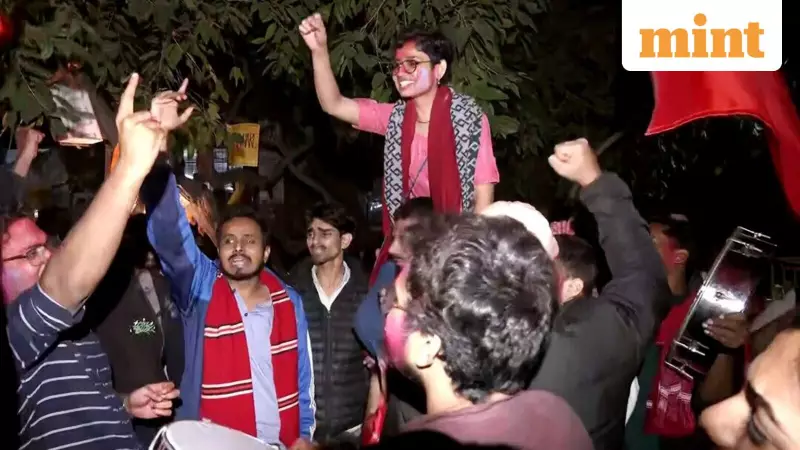
A fresh controversy has engulfed the Jawaharlal Nehru University (JNU) campus in New Delhi after a group of students raised contentious slogans targeting Prime Minister Narendra Modi and Union Home Minister Amit Shah. The incident occurred on Monday night, following the Supreme Court's decision to deny bail to activists Umar Khalid and Sharjeel Imam in the 2020 Delhi riots larger conspiracy case.
Protest and Provocative Slogans
According to videos that surfaced on social media, the protest was held inside the university premises. The students were demonstrating against the apex court's verdict, and during the gathering, slogans condemning the Prime Minister and the Home Minister were allegedly raised. The protest coincided with an annual event where students mark the violence that took place on the JNU campus on January 5, 2020.
Aditi Mishra, the President of the Jawaharlal Nehru University Students' Union, addressed the media regarding the event. She stated that the protest was an ideological expression and the slogans were not intended as personal attacks. "All of the slogans raised in the protest were ideological and do not attack anyone personally. They were not directed towards anyone," Mishra told PTI. A senior police officer confirmed that no formal complaint had been registered regarding the slogans as of the reporting time.

Sharp Political Reactions: From 'Separatists' to Defence
The incident triggered immediate and strong reactions from political leaders, primarily from the Bharatiya Janata Party (BJP). Delhi Minister and BJP leader Manjinder Singh Sirsa condemned the protest in severe terms, labeling the participants as "separatist people."
"I strongly condemn this. If there will be protests in this country, even against the Supreme Court's rulings, then what is left?" Sirsa said. He accused the protesters of having no regard for the country, the constitution, or the law. Sirsa further alleged that the Aam Aadmi Party (AAP) and the Congress party were behind the conspiracy involving figures like Umar Khalid and Sharjeel Imam.
Echoing similar sentiments, another Delhi Minister, Kapil Mishra, called the protesting students "desh ke dushman" (enemies of the country). He linked the sloganeering to support for terrorism and Naxalism, stating that the court's verdict had led to their frustration.
In contrast, Congress leader Udit Raj came out in defence of the JNU students. He described the protest as a legitimate way of expressing resentment against the Supreme Court's verdict. "They [Umar Khalid and Sharjeel Imam] are being treated like this as they are muslims. Injustice was done... The SC verdict is very unfortunate," Raj claimed, framing the issue around alleged religious bias.
The Core Issue: Supreme Court's Bail Verdict
The flashpoint for the protest was the Supreme Court's denial of bail to activists Umar Khalid and Sharjeel Imam. Both are accused in a case related to the larger conspiracy behind the communal riots that shook Delhi in February 2020. The court's decision, delivered earlier on Monday, was perceived by a section of students and activists as a continuation of unjust treatment, leading to the immediate demonstration on campus.
This episode is the latest in a long series of politically charged events at JNU, which often finds itself at the centre of national debates on free speech, nationalism, and dissent. The starkly divided political reactions underscore the deep ideological fault lines in Indian politics regarding campus activism and protest.