Bhopal's Premier Institutions Grapple With Severe LPG Supply Crisis
In a significant development affecting student life, top educational institutions in Bhopal are confronting acute shortages of commercial 19-kilogram LPG cylinders, despite no official restrictions or usage cuts being imposed. This supply disruption has forced temporary but substantial adjustments in hostel mess operations across multiple campuses, impacting thousands of students' daily meals.
National Law Institute University Implements Emergency Measures
The National Law Institute University (NLIU), a premier law school, has officially issued a "Temporary Adjustment in Mess Operations" notice in response to the restricted cylinder supplies. In correspondence addressed to Registrar Vivek Bakshi, the university's mess committee detailed how caterers are struggling to secure sufficient cylinders for daily cooking requirements.
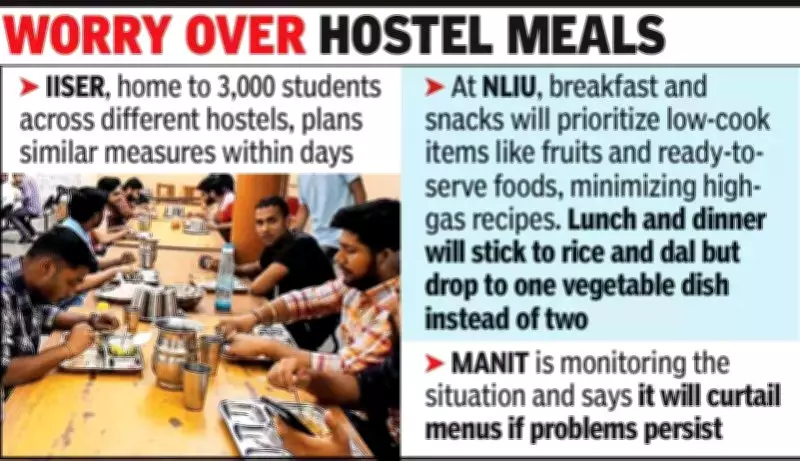
Following an emergency meeting, the committee implemented several critical changes. Food preparation has been centralized at the Old Boys' Hostel kitchen, with meals subsequently distributed to the other four hostels that collectively serve approximately 5,000 students. To conserve the limited gas supply, breakfast and snacks will now prioritize low-cook items such as fruits and ready-to-serve foods, while minimizing recipes that require extensive cooking.

For lunch and dinner, the menu has been streamlined to include rice and dal, but will feature only one vegetable dish instead of the usual two. The committee emphasized that "these arrangements are temporary to ensure smooth mess services during the current crisis." Registrar Bakshi confirmed the operational changes, stating, "We have made adjustments as per the immediate need."
Ripple Effects Across Other Major Institutions
The supply shortage is creating a ripple effect across Bhopal's educational landscape. The Indian Institute of Science Education and Research (IISER), which houses around 3,000 students across various hostels, is preparing to implement similar measures within days. Registrar Gaurav Awasthi revealed, "We have formally written to the state government regarding cylinder availability and expect a response tomorrow. Our contingency plan involves curtailing menu items and consolidating cooking operations to a single mess kitchen instead of maintaining multiple kitchens."
Meanwhile, the Maulana Azad National Institute of Technology (MANIT), with 5,000 students residing in hostels, is closely monitoring the situation. An official noted, "Currently, we are not experiencing operational problems, but if the supply shortage persists, we will need to curtail food items on our menus as well."
Student Concerns and Administrative Responses
Students across these institutions have expressed concerns about potential nutritional impacts due to the reduced menu variety. However, administrators uniformly stress that these are strictly short-term measures designed to navigate the immediate supply crisis while maintaining essential food services.
This widespread institutional challenge is particularly noteworthy given government assurances that commercial LPG supply to educational institutions would continue uninterrupted. The discrepancy between promised supply and actual availability has left administrators scrambling to implement contingency plans that balance operational feasibility with student welfare during this unexpected shortage period.