The Unsung Hero of Panjab University's Architectural Marvels
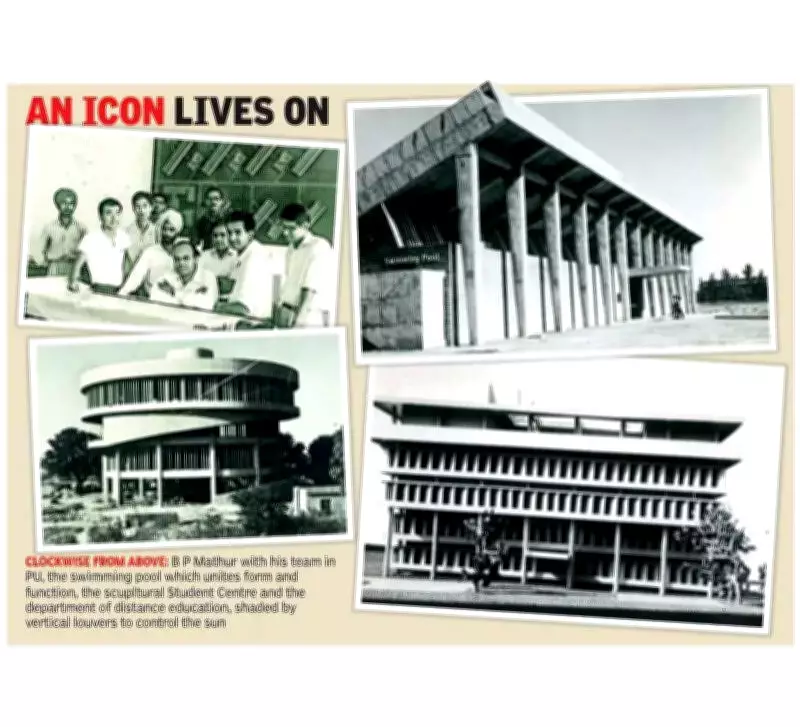
Chandigarh's iconic Panjab University stands as a testament to modernist architecture, but few know that much of its striking legacy owes to the brilliance of architect B P Mathur. While Pierre Jeanneret often receives acclaim, Mathur played a pivotal role, contributing significantly to sculptural masterpieces like the Gandhi Bhawan, the library, and administrative buildings. His individual designs, including the Students Centre, Museum of Fine Arts, hostels, swimming pool, and auditoriums, have become integral parts of the campus identity.
Early Career and Inspirations
Mathur graduated from Delhi Polytechnic in 1951 and immediately joined the Chandigarh Capital Project, working under Jeanneret. By 1958, he was appointed senior architect of the Construction Cell at Panjab University, where his career flourished until his untimely death in 1976 at age 50. His fascination with concrete construction began early, inspired by a detailed study of Brazilian architecture in 1951. He admired its sculptural quality and potential for evolving structural systems, which he later applied in Chandigarh.
Collaborative Innovations with Agya Ram
At the university, Mathur found a perfect partner in structural designer Agya Ram. Together, they pioneered a new vocabulary in concrete, blending technical acumen with aesthetic vision. The Students Centre exemplifies this, featuring a lyrical, encircling ramp that contrasts with the linear geometry of nearby buildings. Originally, its plaza flowed into an open ground floor, creating a vibrant space for student activities and socializing.

The Art Museum, crafted in red sandstone with a staggered form, stands gracefully beside the iconic Gandhi Bhawan without imposing on it. Its structural system used RCC slabs supported on central columns, allowing for continuous strip windows at roof level and maximizing wall space for displays.
Engineering Feats and Functional Designs
Mathur and Agya Ram tackled significant challenges, such as the Law Auditorium, which required a column-free structure for 800 people. After extensive experimentation, they constructed an RCC dome, a major achievement at the time. The open-air theatre, with gently curved stone walls, offers another explorative space, while the swimming pool featured an 18-foot-deep diving pool and stadia seating, showcasing Mathur's technical and aesthetic skills.
Hostels designed by Mathur prioritized comfort, privacy, and interaction, each with a unique architectural expression. In the distance education building, he innovated with vertical louvers to control sunlight, avoiding space wastage and heat accumulation common with deep verandas or horizontal louvers.
Attention to Detail and Lasting Impact
Even in projects like the administrative block, initially designed by Jeanneret, Mathur and Agya Ram contributed vital details. They experimented with a catenary curve for the porch, contrasting the building's rigid geometry. Tarun Mathur recalls his father studying geometry books to derive a parabolic equation, creating a model with jute fabric and plaster.
Mathur's work is marked by meticulous detail, functional clarity, and original aesthetics. His structures balance monumental form with human scale, earning recognition from architects worldwide. He didn't just build buildings; he crafted the identity of a post-independence India, proving modernism could be globally ambitious yet deeply rooted in local context.
His legacy is celebrated in the ongoing exhibition "Chandigarh's Indian Modernists" at the Government Museum and Art Gallery, with photos sourced from his son, Tarun Mathur. Through these works, Mathur's vision continues to inspire, reminding us of the power of architecture to shape culture and community.