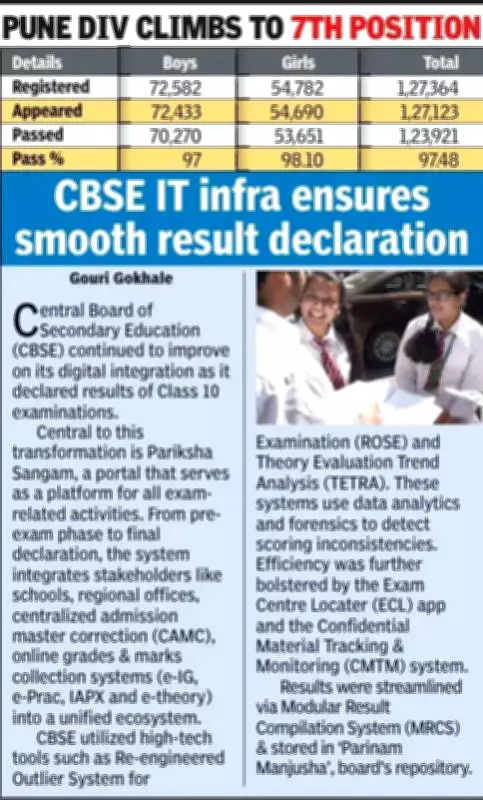
The Central Board of Secondary Education (CBSE) has announced the results for the first phase of the Class 10 board examinations, with the Pune regional division achieving a notable milestone. Covering the entire state of Maharashtra, the Pune division recorded an impressive pass percentage of 96.99%, propelling it to the 7th position in the national rankings. This marks a significant improvement from its 9th place standing in the previous year, reflecting a positive trend in academic performance across the region.
Maharashtra's Strong Performance in CBSE Exams
In Maharashtra, a total of 1,27,123 students appeared for the CBSE Class 10 examination this year. The cohort included 72,433 boys and 54,690 girls. The results showcased a high success rate, with 1,23,921 students successfully clearing the exam. This group comprised 70,270 boys and 53,651 girls, demonstrating consistent academic achievement across genders. For cities like Nagpur, this improved ranking serves as a morale booster, highlighting the growing emphasis on conceptual learning, academic discipline, and holistic development within the state's educational framework.
National Rankings and Regional Comparisons
Southern regions continued to dominate the national rankings, with Trivandrum and Vijayawada jointly securing the top position with a remarkable pass rate of 99.79%. Chennai followed closely at 99.58%, while Bengaluru achieved 98.91% and Delhi West recorded 97.45%. Delhi East stood sixth with 97.33%, just ahead of the Pune division. Pune's rise to the 7th spot places it ahead of other prominent regions such as Ahmedabad (96.61%) and Ludhiana (95.70%), underscoring the strengthening academic ecosystem in Maharashtra's CBSE schools.

Further down the rankings, Ajmer delivered a steady performance with 94.78%, followed by Bhubaneswar at 94.67% and Gurugram at 93.21%. Regions like Bhopal (92.48%), Panchkula (92.24%), and Lucknow (91.63%) also maintained solid pass percentages. At the lower end of the spectrum, Guwahati recorded 85.32%, with Ranchi at 86.18% and Noida at 87.66%.
New Dual-Examination System Under NEP
The results are part of CBSE's newly introduced dual-examination system, which aligns with the National Education Policy (NEP). Under this framework, Class 10 students now have the option to appear for two board exams. The first phase, conducted in February-March, serves as the primary examination, while the second is scheduled for May, offering students an opportunity to improve their scores. This innovative approach aims to reduce stress and provide flexibility in the assessment process.
Historic Early Declaration of Results
This year witnessed a historic early declaration of results, breaking from tradition. Typically announced in mid-May, the 2026 results were released nearly a month in advance on April 15. This was achieved after CBSE evaluated approximately 1.6 crore answer sheets in record time, showcasing improved efficiency in the evaluation process.
Overall National Performance and Future Prospects
Across India, the overall performance saw a marginal improvement. In 2026, a total of 24,71,777 students appeared for the CBSE Class 10 exams, with 23,16,008 passing. This brings the national pass percentage to 93.70%, representing a slight increase of 0.4% from last year's 93.66%. With the second examination window approaching, students now have an added chance to enhance their scores, further supporting academic growth.
The steady rise of the Pune region signals a promising trajectory for cities like Nagpur, as schools continue to raise academic benchmarks year after year. This achievement not only boosts confidence among students and educators but also sets a positive precedent for future educational initiatives in the region.