The year 2025 proved to be a watershed moment for the education system in Andhra Pradesh, as the state government rolled out a comprehensive suite of structural, academic, and governance reforms. This ambitious overhaul aimed at modernizing government schools, improving learning outcomes, and aligning the state's educational framework with national and global standards.
Structural and Governance Overhaul
One of the most significant milestones was the successful execution of the Mega District Selection Committee (DSC) recruitment drive after a five-year hiatus. Overcoming legal challenges, the process was completed in a record time, leading to the appointment of 16,347 new teachers, substantially easing the critical staff shortages in government institutions.
Parallelly, teacher administration was revamped with the introduction of the Teacher Transfer Act. This legislation mandated a transparent, web-based counselling system for transfers, significantly reducing avenues for political interference. To further bolster the workforce, over 4,000 educators were promoted across various cadres, providing career growth and motivation.

Academic Innovations and Digital Integration
Academic reforms were introduced with a clear focus on reducing stress and fostering holistic development. A key initiative was the implementation of a "no-bag day" every Saturday, dedicated to sports, arts, life skills, and co-curricular activities instead of conventional academics.
Digital governance received a massive boost with the consolidation of nearly 45 disparate applications into a single, unified platform. This integration enabled real-time tracking of student performance and streamlined communication between parents and teachers. The curriculum was also updated to align with NCERT standards, featuring bilingual textbooks embedded with QR codes for accessing digital content.
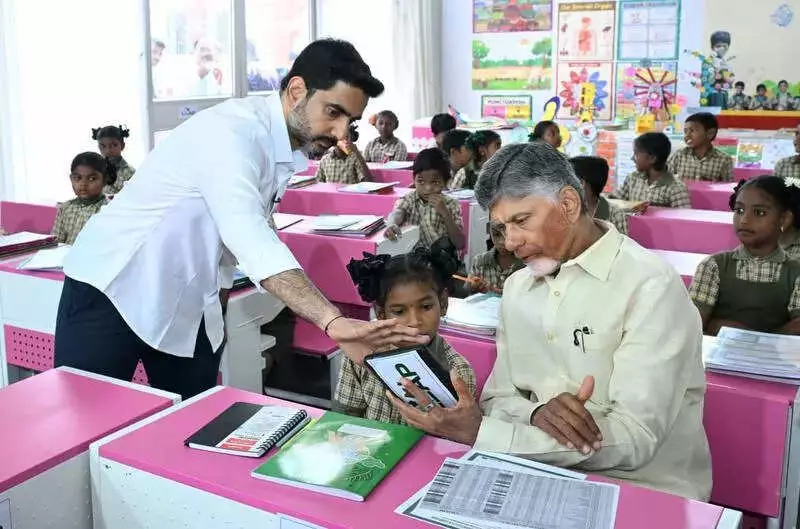
A strong emphasis was placed on Foundational Literacy and Numeracy (FLN). The state launched the LEAP (Learning Excellence in Andhra Pradesh) initiative, which synergized AI-based assessments, competency-based learning, and digital education tools. Under this program, 175 schools—one in each Assembly constituency—were selected for advanced infrastructure upgrades.
Equity, Outreach, and Record-Breaking Engagement
Ensuring equity remained a cornerstone of the reforms. The government distributed Sarvepalli Radhakrishna Vidyarthi Mitra Kits and assessment books to nearly 36 lakh students, deliberately keeping the materials free of any political imagery. To tackle illiteracy at its root, Mission "Akshara Andhra" was launched with the goal of achieving universal literacy.
Parental engagement scaled unprecedented heights when the department organized Mega Parent-Teacher Meetings simultaneously in over 61,000 schools. This colossal event attracted more than 5.3 million participants, earning Andhra Pradesh a coveted Guinness World Record.
Other notable programs included the YogaAndhra-2025 campaign, which engaged lakhs of students in month-long yoga awareness, and the Green Passport initiative to promote environmental consciousness. On the technological frontier, AI, STEM, and Robotics labs were established in 50 government schools in Visakhapatnam, while a 100-day action plan was initiated to improve Secondary School Certificate (SSC) results.
In summary, 2025 emerged as a defining year where systemic reforms, deep digital integration, and unwavering focus on student welfare collectively reshaped the educational landscape of Andhra Pradesh, setting a new benchmark for other states to follow.