UPSC Essentials Daily Quiz: International Relations MCQs for Week 146
Are you gearing up for the UPSC Civil Services Examination Prelims 2026? Enhance your revision and assess your progress with this comprehensive subject-wise quiz focused on International Relations. This initiative is designed to help aspirants revisit crucial static syllabus topics, ensuring a solid grasp of geopolitical dynamics and current affairs.
Quiz Overview and Importance
This quiz, part of the UPSC Essentials series, targets key areas in International Relations that are frequently tested in the prelims. By attempting these multiple-choice questions, you can identify strengths and weaknesses, making your study sessions more effective. The questions span from historical disputes like the Chagos Islands to contemporary issues such as US foreign policy shifts and international legal frameworks.
Question 1: Chagos Islands and Geopolitical Awareness
With reference to the Chagos Islands, consider the following statements:

- When Mauritius gained independence in 1968, Chagos remained with Britain.
- In 1966, Britain signed an agreement with the US, which made the British Indian Ocean Territory (BIOT) available for the two countries’ defence needs.
- The Chagos archipelago comprises more than 500 islands that lie in the Indian Ocean.
- The Chagos Islands were uninhabited until the late 18th century.
How many of the statements given above are correct?
- (a) Only one
- (b) Only two
- (c) Only three
- (d) All four
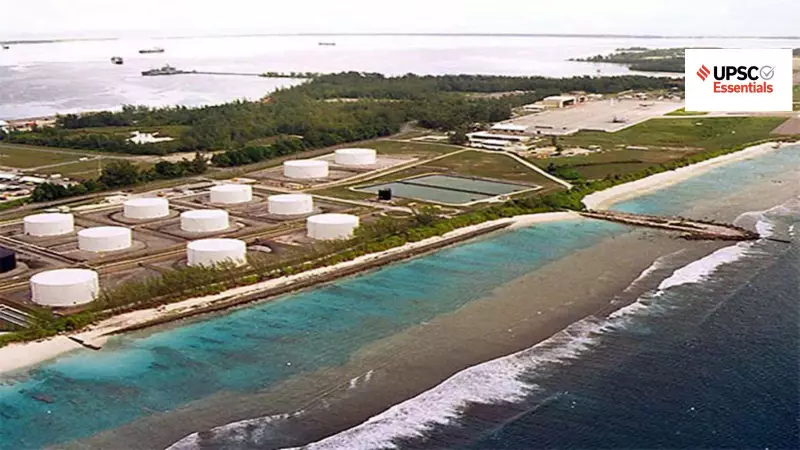
Relevance: This question evaluates your understanding of geopolitical issues in the Indian Ocean Region, including colonial legacies, decolonisation processes, and strategic military bases like Diego Garcia. It is a vital theme for UPSC prelims, linking international law and diplomatic disputes.
Explanation: The Chagos archipelago, consisting of 58 islands, is located approximately 500 km south of the Maldives in the Indian Ocean. Historically uninhabited until the late 18th century, French colonisers introduced slave labour for coconut plantations. In 1814, France ceded the islands to Britain. Statement 3 is incorrect as the archipelago has 58 islands, not over 500, while statement 4 is correct regarding its uninhabited status until the 18th century.
In 1965, the UK established the British Indian Ocean Territory (BIOT), incorporating the Chagos Islands. When Mauritius achieved independence in 1968, Chagos remained under British control, with the UK providing a grant for its detachment, making statement 1 accurate. Additionally, in 1966, Britain and the US signed an agreement utilising BIOT for defence purposes, leading to the development of the Diego Garcia military base, confirming statement 2. Thus, three statements are correct, and option (c) is the right answer.
Question 2: US Withdrawals from International Organisations
Recently, the United States withdrew from over 60 major international organisations and agreements. Which of the following international organisations is the United States still a part of?
- Intergovernmental Panel on Climate Change (IPCC)
- International Renewable Energy Agency (IRENA)
- UN Environment Programme (UNEP)
- International Energy Agency (IEA)
- International Solar Alliance (ISA)
Select the correct answer using the codes given below:
- (a) 2, 3, and 5
- (b) 1, 2 and 3
- (c) 1 and 5 only
- (d) 3 and 4 only
Relevance: This question tests awareness of recent shifts in US foreign policy and multilateral engagement, a high-priority area in current affairs for UPSC Prelims. It checks conceptual clarity about global climate, energy, and environmental institutions and their membership patterns.

Explanation: The United States recently exited over 60 international organisations, citing alignment with national interests. Key withdrawals include the UN Framework Convention on Climate Change (UNFCCC), Intergovernmental Panel on Climate Change (IPCC), International Renewable Energy Agency (IRENA), International Solar Alliance (ISA), and International Union for Conservation of Nature (IUCN). However, the US remains a member of the UN Environment Programme (UNEP) and the International Energy Agency (IEA), which continue to influence global climate policy and energy transitions. Therefore, option (d) is correct, as statements 3 and 4 are accurate.
Question 3: Places in News – Geographical Accuracy
With reference to the places in news, consider the following pairs:
- Chernobyl Nuclear Power Plant – Slavutych, Russia
- Nuuk city – Near Copenhagen (Denmark)
Which of the pairs given above is/are correctly marked?
- (a) 1 only
- (b) 2 only
- (c) Both 1 and 2
- (d) Neither 1 nor 2
Relevance: This question assesses map-based awareness and geopolitical clarity regarding places frequently in international news. It helps avoid common location traps involving Europe, the Arctic region, and conflict-related sites, which UPSC often targets.
Explanation: The Chernobyl Nuclear Power Plant is located in Pripyat, northern Ukraine, not Slavutych, Russia, making pair 1 incorrect. Nuuk is the capital city of Greenland, an autonomous territory within the Kingdom of Denmark, but it is not near Copenhagen; it is situated in Greenland, far from Denmark's capital. Thus, pair 2 is also incorrect. Option (d) is the correct answer, as neither pair is accurately marked.
Question 4: Genocide Convention and International Law
With reference to the Genocide Convention, consider the following statements:
- It was adopted by the United Nations after World War II.
- The convention enables any state party to bring a case against another even if it doesn’t have any direct link to the conflict in question.
Which of the statements given above is/are correct?
- (a) 1 only
- (b) 2 only
- (c) Both 1 and 2
- (d) Neither 1 nor 2
Relevance: This question links current international conflicts with legal accountability frameworks under the Genocide Convention. It helps in linking contemporary geopolitical disputes with international judicial processes and institutions.
Explanation: The Genocide Convention was adopted by the United Nations in the aftermath of World War II and the Holocaust, aiming to criminalise genocide under international law and prevent such atrocities, confirming statement 1. Additionally, the convention imposes obligations on states to prevent genocide and allows any state party to initiate cases against others, regardless of direct involvement, as demonstrated by Gambia's case against Myanmar at the International Court of Justice, making statement 2 correct. Therefore, option (c) is the accurate answer.
Question 5: UN Declaration for 2026
The United Nations declared 2026 as the:
- (a) International Year of Sustainable Agriculture
- (b) International Year of Millets and Nutri-Cereals
- (c) International Year of Desert Ecosystems
- (d) International Year of Rangelands and Pastoralists (IYRP)
Relevance: This question highlights UN focus on sustainable management of rangelands, biodiversity conservation, and pastoral livelihoods. It is important for linking environment, climate resilience, food security, and traditional livelihood systems in current affairs.
Explanation: The United Nations has designated 2026 as the International Year of Rangelands and Pastoralists (IYRP). This initiative advocates for policies that protect pastoralists' access to land and resources, promote mobility, and support inclusive governance. It aims to enhance rangeland management, ecosystem restoration, and equitable value chains, contributing to the Sustainable Development Goals (SDGs). Thus, option (d) is the correct answer.
Utilise this quiz to refine your International Relations knowledge and stay ahead in your UPSC CSE Prelims 2026 preparation. Regular practice with such subject-wise assessments can significantly boost your confidence and performance in the examination.