Odisha High Court Demands State Government Explanation on Higher Education Council Vacancies
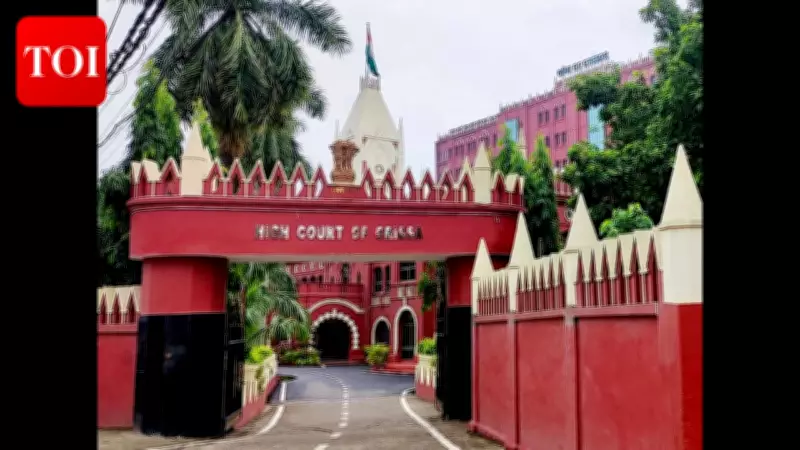
The Orissa High Court, sitting in Cuttack, issued a significant directive on Tuesday, compelling the state government to provide a detailed response concerning a Public Interest Litigation (PIL) that alleges severe administrative paralysis within the Odisha State Higher Education Council (OSHEC). The petition highlights a critical failure to fill numerous vacant positions, including the crucial role of vice-chairperson and 13 out of 15 council members, which petitioners argue has effectively crippled the council's statutory functions.
Legal Challenge Against "Illegal" In-Charge Arrangement
The PIL, formally submitted by advocate Prabir Kumar Das, rigorously contests the legality of the current administrative setup. Specifically, it questions the state government's decision to appoint the commissioner-cum-secretary of the higher education department as the in-charge vice-chairperson of OSHEC, a position assumed on September 6, 2024. Das contends that this arrangement blatantly contravenes the explicit provisions of the Odisha State Higher Education Council Act, 2017, labeling the move as "illegal and arbitrary" in its disregard for statutory mandates.
During the court proceedings, additional government advocate Debashis Tripathy informed the bench that steps are indeed being initiated to address the vacancy crisis. However, the petitioner countered this assertion, arguing that the prolonged reliance on an in-charge official for the vice-chairperson's role constitutes a continuous violation of the Act's legal framework, undermining the council's authority and operational integrity.

Judicial Directive and Timeline for Resolution
A division bench, presided over by Chief Justice Harish Tandon and Justice M S Raman, formally issued notice to the Odisha state government. The court has mandated the government to file a comprehensive reply within a strict two-week deadline, detailing all concrete steps undertaken to fill the persistent vacancies. Following this, the petitioner has been granted an additional week to submit a rejoinder, if deemed necessary. The matter has been scheduled for further judicial scrutiny on March 10, setting a clear timeline for accountability.
Chronology of Vacancies and Functional Breakdown
The petition meticulously outlines the timeline of the administrative vacuum. The previous vice-chairperson, Ashok Kumar Das, who commenced his tenure on January 2, 2018, completed his statutory six-year term on January 1, 2024. Although his tenure received an extension, he subsequently resigned on August 8, 2024. In the absence of a permanent appointment, the state government designated the commissioner-cum-secretary as the in-charge vice-chairperson.
Furthermore, the crisis extends deeply into the council's membership. The petition highlights that 13 of the 15 council members, originally appointed on February 20, 2019, saw their tenures conclusively end on February 19, 2025. To date, no substantive measures have been taken to appoint new members, leaving the council in a "truncated" state. This severe depletion of membership critically impairs OSHEC's capacity to operate as a full-fledged, decision-making body, stalling its advisory and policy-framing roles.
The Critical Role of OSHEC in State Education Policy
Emphasizing the council's paramount importance, the petitioner detailed OSHEC's foundational mandate. The council serves a vital advisory function, instrumental in shaping higher education policies, driving educational reforms, and formulating developmental schemes for Odisha. It is tasked with advising the state government on achieving key objectives like academic excellence, educational inclusiveness, and enhanced student outcomes across the state's higher education landscape.

As per Section 4 of the OSHEC Act, 2017, the council's chairperson is the state's Higher Education Minister. The vice-chairperson, however, must be a distinguished administrator with a proven academic record, specifically someone who holds or has held the rank of a professor. The council is constitutionally required to comprise 15 other members. This includes three vice-chancellors from state universities, two principals from autonomous colleges, two eminent scientists or social science experts, and seven persons of eminence from diverse fields such as arts, science and technology, culture, civil society, or industry. A central government nominee and a member secretary complete the council's composition, ensuring a broad-based, expert-driven body.
The ongoing vacancies thus represent not merely an administrative lapse but a fundamental breakdown in the governance structure designed to steer Odisha's higher education system toward progress and innovation.