Maharashtra's 1km RTE Quota Rule Sparks Outcry from Activists and Parents
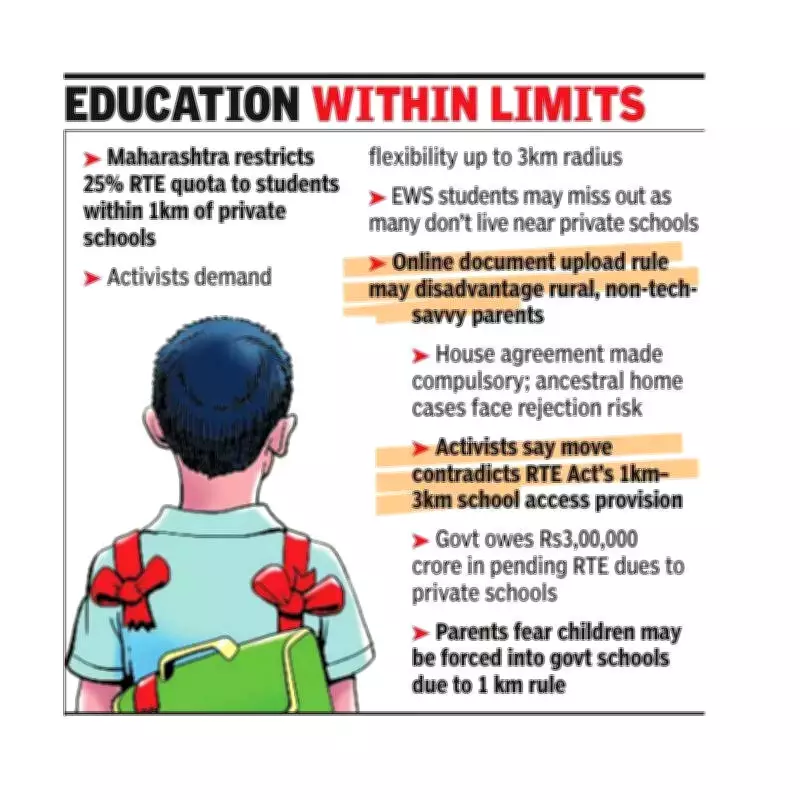
In a significant development, activists and parents in Maharashtra have strongly opposed the state government's recent order that restricts admissions under the 25% Right to Education (RTE) quota in private schools to beneficiaries residing within a strict 1-kilometer radius of the institution. They argue that this rigid rule lacks the necessary flexibility to include children from economically weaker sections (EWS) who may live up to 3 kilometers away, potentially excluding a large number of deserving students.
Concerns Over Exclusion and Systemic Flaws
Pune-based RTE activist Mukund Kirdat has voiced serious concerns about the repercussions of this move. He emphasized that it is not always feasible for EWS families to reside close to private schools, which could result in many children being disqualified from admissions. Kirdat pointed out that this rule not only harms students but also impacts private schools, as they may struggle to fill their mandated 25% quota with regular students, leading to operational challenges.
Activists have highlighted additional issues with the new system, particularly regarding the document verification process. They note that parents from EWS backgrounds may lack the technological savvy to upload required documents online, and internet access remains a problem in rural areas. Previously, original document verification was conducted at designated centers, but the shift to online submissions has created barriers for many families.

Documentation Hurdles and Manipulation Risks
Kirdat further elaborated on specific documentation challenges, stating, "In the new rule, a house agreement has been made compulsory. For those living in ancestral homes registered in their parents' names, this requirement is impractical, as family houses often lack formal agreements. Such forms are likely to be rejected, and facilitation centers could have helped explain these points. Moreover, this system could be easily manipulated by those with means, undermining its fairness."
Contradictions with RTE Act and Past Notifications
Mumbai-based RTE activist Hemangi Joshi criticized the government for twisting rules to its convenience. She referenced the RTE Act, which mandates that students from classes I to V should have a school within a 1km radius, and those from classes VI to VIII within 3km. Joshi argued, "The new 1km rule will detrimentally affect children from disadvantaged sections, as many areas lack schools within such a short distance. What will happen to these students?"
Kirdat also pointed to a Maharashtra government notification from March 15, 2013, which placed the responsibility on schools to identify children from disadvantaged groups within a 1km radius and extend the search to 3km if necessary. This historical context underscores the inconsistency in the current policy.
Financial and Committee Demands from Stakeholders
Meanwhile, Jagruti Dharmadhikari, president of the Independent English Schools Association, raised financial concerns, stating that the government owes over Rs 3,00,000 crores in pending dues to private schools for RTE quota admissions since the Act's implementation. She urged the government to clear these dues before introducing any changes. Additionally, Dharmadhikari called for the inclusion of representatives from parents, teachers, NGOs, and school managements in a committee to make recommendations, ensuring smoother implementation and fewer post-GR issues.
Parental Frustration and Calls for Quality Education
A resident of Sambhajinagar, hoping for her daughter's admission to Class I under the RTE quota, expressed frustration, saying, "The poor don't need schemes like Ladki Bahin. We need quality and affordable education for our children. With no school within a 1km radius of my house, does this mean I will be forced to send my child to a government school?" This sentiment echoes the broader demand for accessible and equitable educational opportunities for all children, regardless of their socioeconomic background.

The opposition to Maharashtra's new RTE rule highlights deep-seated issues in the education system, from geographical barriers to bureaucratic hurdles, calling for a more inclusive and flexible approach to ensure that every child has the right to quality education.