IITs Break Down Campus Barriers with New Cross-Campus Mobility Framework
For decades, the trajectory of an IIT student has been defined by a precise, high-stakes system that is largely non-negotiable. A JEE rank does not merely determine a branch of study; it dictates the campus, the professors, the laboratory access, and even the peer ecosystem that shapes an individual's academic journey. Once an IIT is allotted, the academic universe typically remains confined within those institutional boundaries.
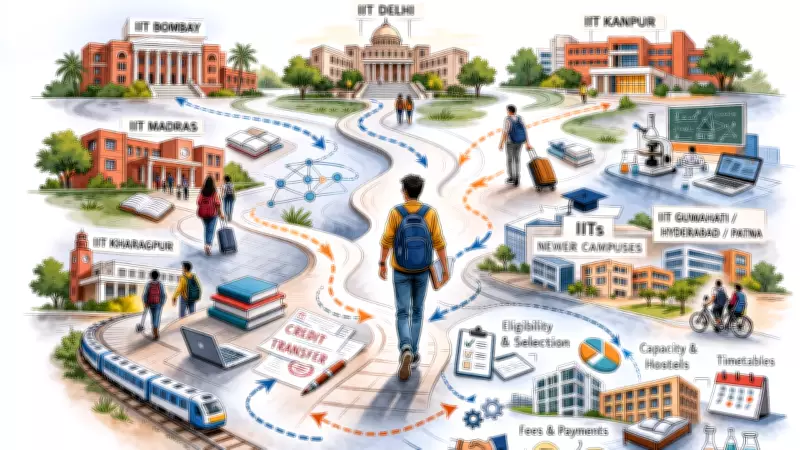
Now, in a significant structural evolution, the Indian Institutes of Technology have officially approved cross-campus mobility for undergraduate students. Under this new framework, students will gain the ability to take courses at another IIT and, in select cases, spend an entire semester there, with all earned credits seamlessly transferred back to their parent institute. In essence, this initiative aims to transform the IITs into a more interconnected academic network, substantially expanding student choice and flexibility.
From Locked Campuses to a Connected Network: Practical Implications
If implemented as envisioned, this plan could make IIT academics considerably less campus-bound. Currently, a student's course options are almost entirely shaped by what their own IIT offers in a given semester—dictated by faculty availability, elective offerings, laboratory access, and timetable constraints. Cross-campus mobility disrupts this model in a tangible way. A student may now enroll in a specialized course at another IIT or potentially complete a semester there, with those academic credits fully recognized at their home institute. The immediate benefit for students is a dramatically wider menu of courses and exposure beyond a single campus environment.

However, the programme is expected to commence in a limited capacity. Initially, only a small proportion of undergraduates—approximately 5 percent—may be eligible for a full semester exchange. Operating rules will vary by institute, as each IIT Senate will determine the specific details: eligibility criteria, selection processes, the number of students that can be sent and received, and what the host campus can accommodate regarding seats, laboratory capacity, and housing.
Implementation Challenges and the Selection Process
This is where critical implementation questions emerge. With participation limited to a small number of students, the selection methodology becomes paramount. If Cumulative Grade Point Average (CGPA) serves as the primary basis, students with higher grades will likely have greater access to these opportunities. If decisions are delegated to departments or programme coordinators, the rules must be clearly documented, transparently shared in advance, and governed by fixed timelines. Students require unambiguous understanding of how selection operates and what is expected from them.
Confronting the Hierarchy Within the IIT System
Not all IITs are perceived equally. The legacy campuses—such as Bombay, Delhi, Madras, Kanpur, and Kharagpur—occupy a distinct symbolic and placement space compared to newer entrants in the system. In this landscape, mobility may not flow evenly.
Will older IITs attract disproportionately high demand from students at newer campuses? If seats are limited, will competition intensify around particular destinations? Crucially, will some IITs become net exporters of high-performing students while others become net importers?
This represents a subtle but significant risk. If mobility ends up being predominantly unidirectional—for instance, with more students moving from certain IITs to a smaller set of highly preferred campuses—it could inadvertently reinforce existing hierarchies within the IIT network.
To maintain programme balance, IITs must diligently track patterns over time: which campuses are sending students, which are receiving them, and how participation distributes across branches and academic years. Periodically sharing this data would enable stakeholders to assess the system's functionality and determine if any corrective measures are necessary.
Logistical Hurdles: Where Reform Often Stumbles
Policy announcements frequently outpace administrative preparedness. Credit transfer systems appear elegant in theory, but their success hinges on meticulous coordination.

Curriculum mapping across 23 institutes is a formidable task. Course equivalence must be precise. Academic calendars require alignment. Assessment structures must communicate seamlessly across campuses. A core course at one IIT cannot become an elective afterthought at another without creating academic friction.
The practical layer is equally critical. Hostel space is often limited. Popular electives can fill rapidly. Even minor timetable clashes can complicate cross-campus registration. Numerous administrative details must be settled—whether fees are paid to the home IIT or the host, how mess and accommodation charges are adjusted, and how mid-semester academic changes are managed. These operational aspects, while seemingly routine, will fundamentally shape the everyday workability of the mobility framework.
The Placement Subtext and Career Implications
Officially, mobility is centered on learning. Unofficially, placement optics linger in the background. Will a semester spent at a legacy IIT influence internship perceptions? Will recruiters differentiate between degree origin and cross-campus exposure? Or will the parent IIT continue to dominate the signaling value in the labor market?
There is no immediate evidence that mobility will recalibrate hiring dynamics. Yet, in an ecosystem where institutional brand carries substantial weight, students will inevitably assess mobility opportunities partly through a career lens. Managing these expectations will therefore be crucial for the programme's perceived success.
Governance in a Networked Academic System
Perhaps the most profound shift is institutional rather than purely academic. Cross-campus mobility will push IITs to function as a distributed university system, even as they retain their individual autonomy and rule sets.
While institutional autonomy remains and should continue, coordination cannot be overlooked. The success and credibility of this initiative will depend on transparent Senate approvals, clearly communicated eligibility standards, robust mechanisms for handling complaints, and unambiguous deadlines. In a system founded on the promise of a fair entrance ranking, future academic opportunities must also be equitable. If mobility remains optional and rare, it risks being perceived as a symbolic reform—progressive in name but limited in actual effect.
A Reform Worth Strengthening with Clarity and Equity
There is no question that the intention behind cross-campus mobility is apt and timely. Contemporary higher education increasingly values interdisciplinarity, flexibility, and expansive academic networks over rigid institutional silos. Consequently, the IIT system, long admired for its academic rigor, requires this structural evolution to remain globally competitive.
However, this evolution must be paired with unwavering administrative clarity and robust equity safeguards. Mobility should not devolve into an elite privilege within an already elite system. Nor should it strain campuses that are unequipped for sudden student inflows. The IITs have opened the gates. The real test now lies in ensuring that what passes through them constitutes genuine academic mobility, firmly grounded in principles of fairness, institutional preparedness, and systemic balance.