IIM Visakhapatnam's Groundwater Dashboard Revolutionizes Andhra Pradesh Water Governance
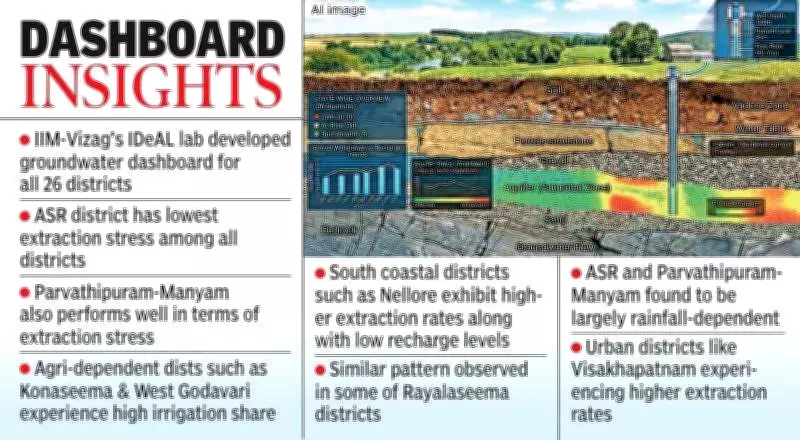
The Inter-Disciplinary Decision Sciences & Analytics Lab (IDeAL) at the Indian Institute of Management in Visakhapatnam has unveiled a groundbreaking groundwater dashboard covering all 26 districts of Andhra Pradesh. This innovative platform represents a significant advancement over conventional systems by providing comprehensive analytics through 13 critical indicators, moving far beyond basic water depth measurements.
Comprehensive Analytics and District-Specific Insights
Unlike traditional dashboards that typically focus solely on water depth, this sophisticated platform incorporates multiple dimensions of groundwater management. The system tracks percentage of extraction, recharge status, and detailed sector-wise contributions including industrial, household, and agricultural usage. It delivers advanced analytical capabilities alongside future predictions, offering unprecedented insights into water stress levels across individual districts with historical trend analysis.
According to water management experts, this enhanced district-level intelligence is crucial for developing effective policy interventions that ensure groundwater continues to support agricultural productivity, livelihoods, and sustainable local development. The initiative promises to transform groundwater governance from reactive management to proactive, data-driven decision-making.

Beyond Static Reporting: Nuanced District Analysis
The dashboard's capabilities extend far beyond simple status reporting. For instance, while both Alluri Sitharama Raju and Konaseema districts are classified as safe, they present dramatically different policy implications. Alluri Sitharama Raju demonstrates very low extraction stress but exhibits high dependence on monsoon patterns, whereas Konaseema maintains overall safety yet shows a significantly higher irrigation share that requires monitoring.
Similarly, Parvathipuram-Manyam, a tribal district, displays low extraction stress, while the Rayalaseema districts reveal comparatively higher stress levels than their coastal counterparts. These nuanced variations highlight distinct management priorities across regions, enabling decision-makers to move beyond one-size-fits-all approaches to targeted, evidence-based interventions.
Advanced Technology and Explainable AI Integration
IIM-Vizag director Professor M Chandrasekhar emphasized the dashboard's forward-looking capabilities. "The primary objective is to enable preparedness for future groundwater scenarios. Beyond forecasting, the system explains the underlying causes of emerging groundwater stress by identifying which indicators contribute most significantly to depletion trends," he stated.
Professor Shivshanker Singh Patel, head of IDeAL at IIM-V and the dashboard's lead developer, detailed the technological sophistication behind the platform. "We generate estimates through machine learning applications and employ SHAP (SHapley Additive exPlanations), an explainable AI technique that identifies key factors driving groundwater depletion, including extraction rates, recharge patterns, and sectoral usage."
Each district receives classification according to Central Ground Water Board standards—safe, critical, or over-exploited. "This dual capability of prediction and interpretation allows policymakers and stakeholders to make informed decisions about whether interventions should focus on consumption reduction, recharge enhancement, or alternative management strategies to ensure sustainable groundwater availability," Professor Patel explained.
Broader Mission and Societal Impact
IDeAL functions as a center of excellence applying interdisciplinary approaches to high-impact sectors including water resources, healthcare, education, and public policy. The lab's work aligns with broader sustainable development goals by leveraging data science, machine learning, artificial intelligence, optimization techniques, and behavioral insights to address complex societal challenges through rigorous, data-driven methodologies.

This groundwater dashboard initiative exemplifies how academic research institutions can contribute directly to practical governance solutions, creating tools that translate complex data into actionable intelligence for sustainable resource management across Andhra Pradesh's diverse geographical and socio-economic landscape.