The Deceptive Simplicity of Number Grid Puzzles
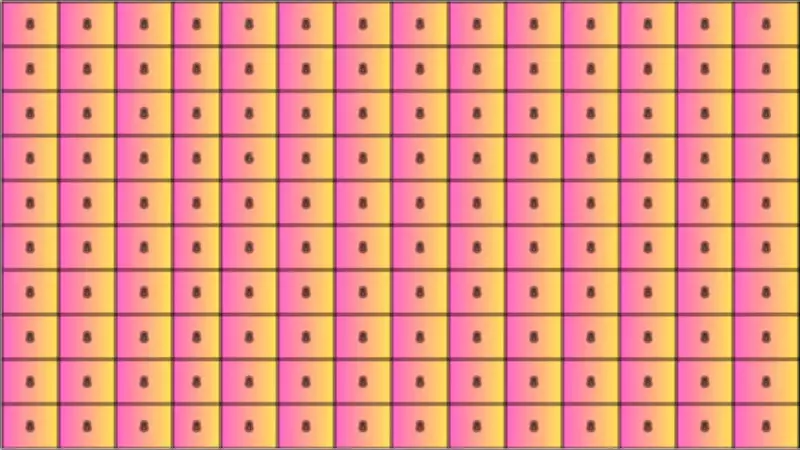
At first glance, the challenge appears straightforward and uncomplicated. A neatly arranged grid is uniformly filled with the number 8, presenting a clean and orderly visual field. However, concealed within this apparent uniformity lies a clever twist. A single digit deviates from the pattern, and this subtle anomaly is where the genuine engagement and cognitive exercise begin.
More Than Just a Game: The Cognitive Benefits of Observation Tests
This category of observation test transcends mere entertainment. It actively trains a young mind to decelerate its processing speed, meticulously notice fine details, and maintain sustained focus. In our contemporary environment saturated with constant distractions, even brief intervals of such mindful visual examination can yield significant developmental advantages.
Why Children Are Naturally Drawn to 'Spot the Odd One Out' Challenges
Children possess an innate curiosity and exploratory drive. When presented with a challenge framed as an engaging game, they instinctively lean in and participate without requiring external prompting or instruction.

A grid populated with identical numbers establishes a powerful visual rhythm and pattern. The eyes commence a rapid, almost automatic scanning process across the field. The introduction of the twist—that one divergent number—shatters the established pattern. This disruption forces the brain to abruptly shift cognitive gears, transitioning from passive recognition to active problem-solving.
This fleeting moment of surprise and discovery is profoundly effective at maintaining a child's engagement. It seamlessly transforms a learning opportunity into playful activity, often without the child consciously realizing the educational underpinnings of the task.
The Foundational Lessons Embedded Within the Puzzle
Fundamentally, this exercise is a practical lesson in cultivating attention. Not the loud, externally imposed variety, but the quiet, internally generated kind that systematically builds patience and perseverance.
When children diligently search for the anomalous number, they are actively learning to:
- Observe with care and precision instead of rushing to a conclusion.
- Persist with a task even when it begins to feel repetitive or challenging.
- Trust their intuitive instincts when something subtly appears "off" or doesn't quite fit.
These are precisely the same core cognitive skills applied in critical areas like reading comprehension, complex problem-solving, and everyday decision-making processes. Therefore, while the activity may resemble a simple grid of numbers, it is performing substantial developmental work behind the scenes.
A Gentle Reminder for Parents and Educators
It is easy to dismiss puzzles as mere time-pass activities or simple diversions. However, moments dedicated to such challenges can evolve into valuable small-scale bonding rituals and shared learning experiences.
Sitting alongside a child and observing their methodical scan of the grid reveals something special. The process showcases intense concentration, occasional moments of frustration, and ultimately, a brilliant spark of joy and accomplishment when they successfully identify the target.
Instead of immediately providing the answer, guiding with simple, open-ended questions proves far more beneficial:
- "Does anything in this row look slightly different to you?"
- "What happens if you try looking carefully at each column?"
- "Let's examine the grid together row by row."
This approach keeps the child actively thinking and problem-solving without inducing pressure. Over consistent practice, it builds robust confidence in their own innate ability to observe, analyze, and figure things out independently.
Cultivating Focus in an Era of Constant Distraction
In today's digital landscape, attention is perpetually fragmented and pulled in countless directions. Screens, notifications, and rapidly consumed content make it increasingly difficult to pause, look closely, and engage deeply with a single task.

A focused puzzle like this serves as a quiet yet powerful countermeasure to that habitual distraction. It requests just 10 to 15 seconds of undivided, pure focus. While this may seem minimal, for a developing and growing mind, this practice is profoundly meaningful.
Regular exposure to such targeted activities can demonstrably improve visual scanning accuracy, processing speed, and overall mental clarity. Furthermore, it provides children with a genuine sense of achievement that is not solely dependent on speed, but rather on keen awareness, patience, and perceptual accuracy.
Revealing the Solution to the Puzzle
For those who have engaged in a careful and systematic scan of the described grid, one number would have eventually stood out from the consistent pattern.
Amidst the sea of identical number 8s, the singular odd number is, in fact, the digit 6. It is strategically placed within the 5th column of the grid. This number hides effectively because its visual form is somewhat similar to an 8 at a cursory glance. However, once it is spotted through focused observation, it becomes unmistakable and impossible to overlook.