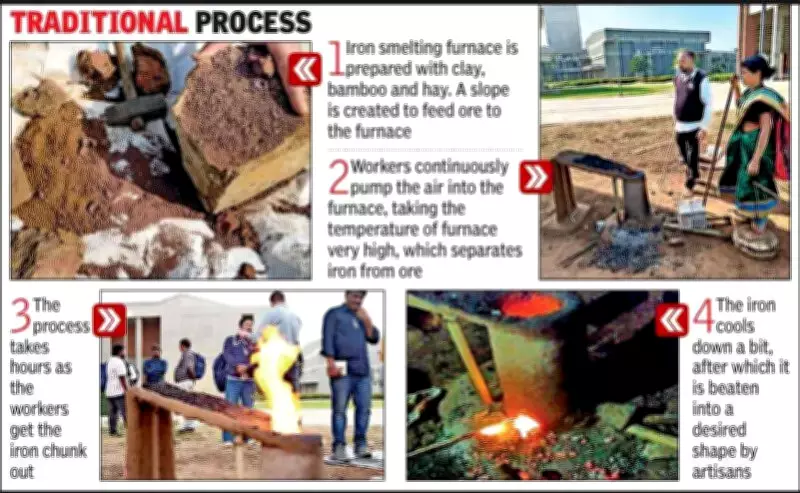
Ancient Iron Smelting Techniques Demonstrated at IIT Gandhinagar
In a remarkable display of living heritage, Vijay Kumar and Subhadra Dhurve from Dindori district in Madhya Pradesh recently demonstrated a centuries-old iron smelting technique on an open ground at IIT Gandhinagar (IIT-Gn). Their labor-intensive process, which involves using a traditional clay cone furnace and a hand-operated apparatus made of leather and wood, captivated researchers from across India and abroad.
Preserving Indigenous Metallurgical Traditions
The Dhurves belong to the Agaria community of Madhya Pradesh, a group historically renowned for its indigenous iron smelting practices. Alok Kumar Kanungo, associate research professor at IIT-Gn and convenor of the History, Science and Technology of Indian Metals and Metallurgy event, explained the significance of their demonstration. "We invited them to demonstrate how India successfully developed indigenous methods for blast furnaces to extract iron from ore," Kanungo stated.
He emphasized that these traditional methods enabled communities to achieve extremely high temperatures using simple tools, a practice sustained through generations. The demonstration was part of IIT-Gn's broader series exploring the history, science, and technology of Indian civilization, which gathered national and international researchers to examine metallurgical advancements.

Regional Variations and Technological Advancements
Kanungo noted that the event comprehensively covered metallurgical traditions from various regions of India, highlighting distinct regional variations in techniques and technological progress. "Different regions show different hues and technological advancements in procuring metals. Metals have played a major part in our history, and researchers elaborated on these aspects," he added.
Among the presenters, Anuradha Panda discussed traditional iron smelting practices and cultural narratives of the Agaria, Birijiya, and Meitei communities. She pointed out that archaeological evidence—including furnaces, kilns, slag, and iron artefacts—aligns with references found in ancient literary sources, providing a tangible link to historical practices.
Ethnoarchaeological Insights into Iron Production
Panda stressed that ethnoarchaeological studies offer a deeper understanding of the entire iron production process. This encompasses:
- Ore selection and extraction methods
- Furnace design and construction techniques
- Smelting processes and temperature management
She further explained that across India, diverse communities developed sophisticated indigenous knowledge systems to utilize locally available ores. This expertise was crucial for producing iron tools essential for agriculture, construction, and warfare, demonstrating how metallurgy was integral to societal development.
The event at IIT Gandhinagar not only showcased a rare traditional craft but also underscored the importance of preserving and studying indigenous knowledge systems. By bringing together researchers and practitioners, it fostered a greater appreciation for India's rich metallurgical heritage and its continued relevance in understanding historical technological innovations.