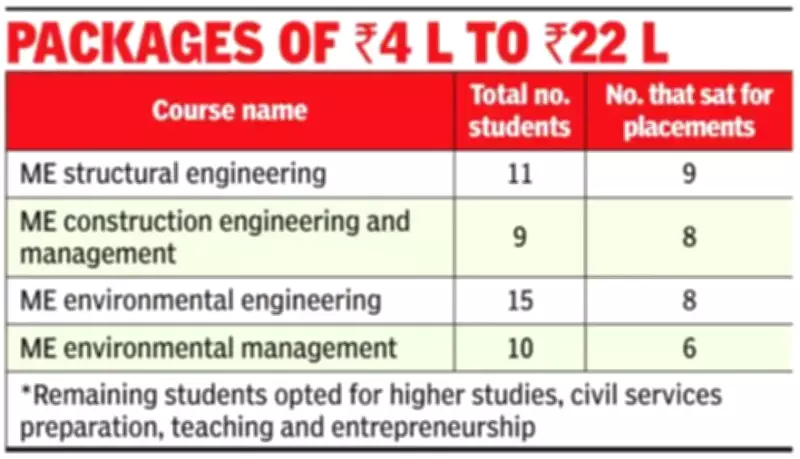
Chennai: Four postgraduate courses in civil engineering at the College of Engineering, Guindy (CEG) have achieved 100% placements in the 2025-26 academic year. The courses include structural engineering, construction engineering, environmental engineering, and environmental management.
Placement Details
All nine students from ME structural engineering who participated in campus placements were successfully placed. Similarly, eight students each from ME construction engineering and ME environmental engineering, along with six students from ME environmental management, secured job offers. The salary packages ranged from ₹4 lakh to ₹22 lakh per annum, with recruiters including VA Tech Wabag, Fichtner Consulting Engineers (India) Private Limited, L&T, and Sonne Infrastructure.
Factors Behind Success
Anna University registrar (in-charge) V Kumaresan attributed the success to an increased demand for core engineers and the upskilling of students through industry-oriented courses. The university has signed Memorandums of Understanding (MoUs) with companies such as Nemetschek and Bentley to offer courses in building information modelling (BIM), urban flood modelling, and other relevant topics. S Kanmani, head of the department of civil engineering at CEG, noted that internships have also helped both undergraduate (UG) and postgraduate (PG) students secure more job offers.

Undergraduate Placements
At the UG level, out of 136 students who graduated from BE civil engineering, BE civil engineering (Tamil medium), and BE geoinformatics, 67 opted for placements. Of these, 54 students (81%) have been placed so far. Kanmani explained that among civil engineering graduates, 40% opted for government jobs, 5% pursued higher studies, and another 5% chose entrepreneurship.
Industry Demand and Future Plans
Placement coordinators from the department highlighted that as the country invests heavily in infrastructure modernisation, climate resilience, urban development, transport networks, renewable energy, and smart cities, the need for civil engineers continues to grow. Investment in intelligent infrastructure systems has also created demand for engineers skilled in BIM, geographic information systems (GIS), Internet of Things (IoT), and digital twin platforms. Digital twins, which are virtual replicas of physical infrastructure assets, are increasingly used to manage bridges, highways, rail systems, and airports.
In the coming academic year, the department plans to introduce courses on artificial intelligence alongside BIM, renewable energy, and 3D printing as industry-oriented offerings for both UG and PG students. K Shanmuga Sundaram, director of the Centre for University-Industry Collaboration (CUIC) at Anna University, stated that these courses will further improve campus placements for civil engineering students.