Understanding the Golden Circle
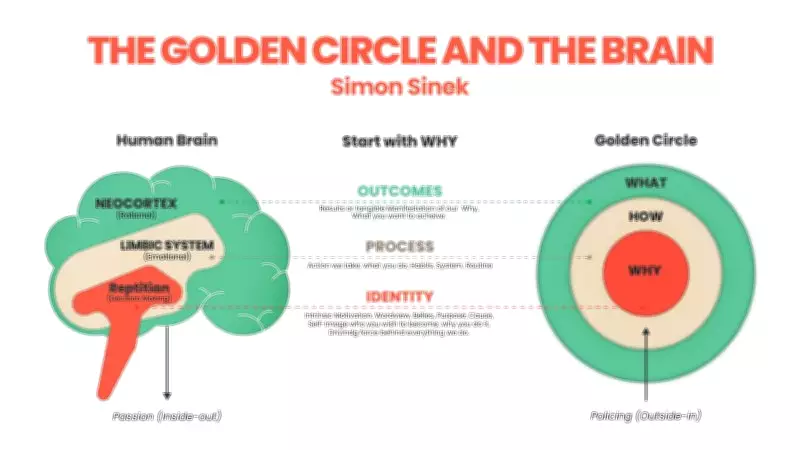
Simon Sinek's Golden Circle Theory presents a simple yet profound model: three concentric circles labeled 'Why', 'How', and 'What'. Most people and organizations communicate from the outside in—starting with 'What' they do, then 'How', and rarely 'Why'. Sinek argues that inspired leaders and companies reverse this order, starting with 'Why'—the core belief or purpose that drives them.
The Brain Science Behind the Model
The Golden Circle aligns with human biology. The outer 'What' corresponds to the neocortex, responsible for rational thought and language. The inner 'Why' connects to the limbic system, which governs feelings, trust, and decision-making. By leading with 'Why', speakers tap into emotions that drive action, not just logic.
Application in Leadership and Exam Preparation
For a CEO, the 'Why' is the company's mission—not profit, but the change they want to create. For a student preparing for India's toughest exams like UPSC, the 'Why' might be a desire to serve the nation or make a difference. According to Sinek, when the 'Why' is clear, discipline follows naturally. The model helps individuals sustain motivation during long, difficult journeys.

Real-World Examples
Sinek cites Apple as a prime example: their 'Why' is to challenge the status quo and empower individuals. This belief shapes every product and message. Similarly, Martin Luther King Jr. led with a vision of equality, not a plan of action. His 'Why' inspired millions.
Criticism and Practical Limits
Some critics argue the model oversimplifies complex organizational dynamics. However, Sinek maintains that 'Why' is a starting point, not a complete strategy. It provides direction but must be paired with execution ('How') and tangible results ('What').
Conclusion
The Golden Circle is more than a leadership fad—it is a framework for personal and professional clarity. Whether in business, education, or daily life, asking 'Why' first can transform how we approach challenges and inspire others.