From JEE Setback to Nobel Glory: The Unlikely Path of Venkatraman Ramakrishnan
Every year, millions of Indian students embark on a grueling journey, their futures hinging on the Joint Entrance Examination (JEE) results. The intense pressure, marked by endless coaching sessions, sleepless nights, and aspirations for IIT admission, creates a high-stakes environment where ranks often feel like definitive life verdicts. However, what if a low score isn't the end of the road? It's about embracing resilience when faced with perceived failure, encouraging individuals to pivot, redouble their efforts, and uncover unexpected passions and career trajectories far beyond conventional expectations.
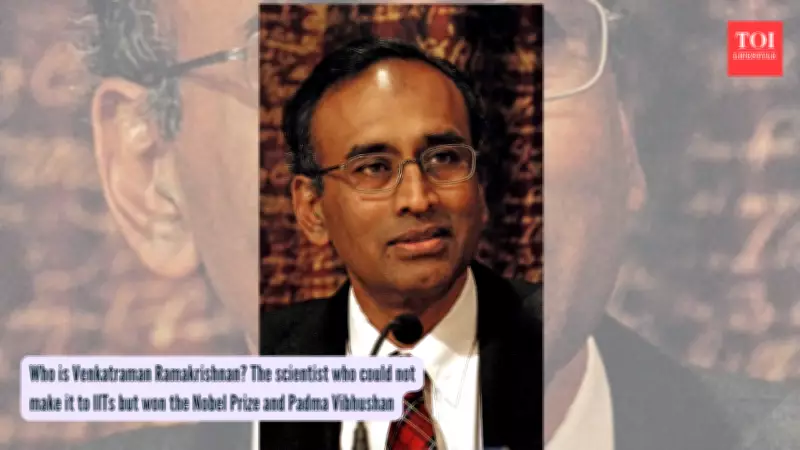
Who Is Venkatraman Ramakrishnan?
Venkatraman "Venki" Ramakrishnan, born in 1952 in Chidambaram, Tamil Nadu, is a distinguished British-American biologist who achieved global acclaim by deciphering the atomic structure of the ribosome. This groundbreaking work earned him the 2009 Nobel Prize in Chemistry, which he shared with fellow scientists Thomas A. Steitz and Ada Yonath. Raised in an academic family—his parents were professors, with his father leading the Biochemistry department at Baroda University—Ramakrishnan faced early setbacks. According to an Economic Times report, he attempted entrance exams for the Indian Institutes of Technology (IITs) and Christian Medical College (CMC) Vellore but did not secure admission to either institution.
A Journey Marked by Perseverance and Discovery
Undeterred by these initial rejections, Ramakrishnan pursued a Bachelor of Science in Physics at The Maharaja Sayajirao University of Baroda, supported by a National Science Talent Search Scholarship. The university's records highlight that this scholarship played a pivotal role in nurturing his scientific curiosity. After graduation, he moved to the United States, where he transitioned into the field of biology. His career path was not without obstacles; he encountered numerous rejections, including approximately 50 unsuccessful job applications early on. Despite these hurdles, he secured positions at prestigious institutions such as Yale University, Brookhaven National Laboratory, and later the MRC Laboratory of Molecular Biology in Cambridge, UK.

It was at Cambridge that Ramakrishnan made his seminal contribution, mapping the ribosome—the cellular machinery responsible for protein synthesis. His research, published in leading journals like Nature, Science, and Cell, solved a long-standing biological puzzle and revolutionized the understanding of molecular biology. In recognition of this achievement, the Nobel Committee awarded him the 2009 prize for studies on the ribosome's structure and function. Beyond this honor, Ramakrishnan served as President of the Royal Society from 2015 to 2020 and received India's Padma Vibhushan award in 2010.
Key Lessons for JEE Aspirants and Beyond
Ramakrishnan's story offers profound insights for today's students grappling with the pressures of competitive exams like JEE. During a 2010 lecture at the Indian Institute of Science (IISc), he openly discussed his failures in the IIT and CMC entrance tests, emphasizing that these setbacks did not diminish his determination. His journey underscores the importance of persistence, as he continued to push forward despite post-doctoral rejections and career challenges. Now at 73, Ramakrishnan remains an active figure in science, inspired by his work in Cambridge and authoring influential books such as Gene Machine.
This narrative serves as a powerful reminder that academic scores do not define one's potential for success. It encourages students to:
- Trust their instincts when facing disappointment.
- Explore diverse interests beyond traditional paths.
- Embrace resilience in the face of obstacles.
In a society often fixated on exam results, Ramakrishnan's life exemplifies how unconventional routes can lead to extraordinary achievements, offering hope and motivation to countless dreamers across India.