Yasuko Tamaki: Seven Decades at a Single Desk in Post-War Japan
For the vast majority of individuals, a professional career involves navigating multiple employers, diverse roles, and evolving industries. For Yasuko Tamaki, however, her entire working life unfolded with remarkable consistency at a single desk within the same company. Born in 1930, Tamaki embarked on her professional journey by joining a modest manufacturing firm in the aftermath of World War II, and she remarkably never departed.
A Lifetime of Steadfast Service at Sunco Industries
In the year 1956, at the age of 26, Yasuko Tamaki commenced her employment with Sunco Industries, a company specializing in the manufacture of screws and industrial fasteners. This period in Japan was characterized by nationwide efforts to rebuild from the profound devastation of the Second World War, making stable office positions highly coveted and prized opportunities.
Initially hired for an administrative role within the general affairs department, Tamaki's responsibilities centered on managing paperwork, facilitating correspondence, and ensuring internal coordination. This was fundamentally an ordinary, support-oriented position, designed to operate quietly behind the scenes to maintain the company's operational flow.

As decades progressed and colleagues transitioned in and out, Tamaki's daily routine remained strikingly unchanged. While office technology underwent revolutionary transformations globally, her core duties of handling reports, documents, and communications persisted. She became a dependable and constant presence within a workplace environment that was steadily evolving and expanding around her.
Defying Retirement Norms and Achieving Global Recognition
Japanese media profiles consistently note that Tamaki maintained the same daytime shift patterns for decades, typically working from morning until early evening. Unlike many long-tenured employees who ascend into senior executive roles or rotate through various departments, she chose to remain in the position where she felt most comfortable and effective.
Japan's traditional retirement age has historically been set around 55 to 60 years. Tamaki reached this milestone in the mid-1980s. Instead of stepping away, she continued her service under renewable one-year contracts, a common practice in Japan for retaining experienced employees whose institutional knowledge remains highly valuable.
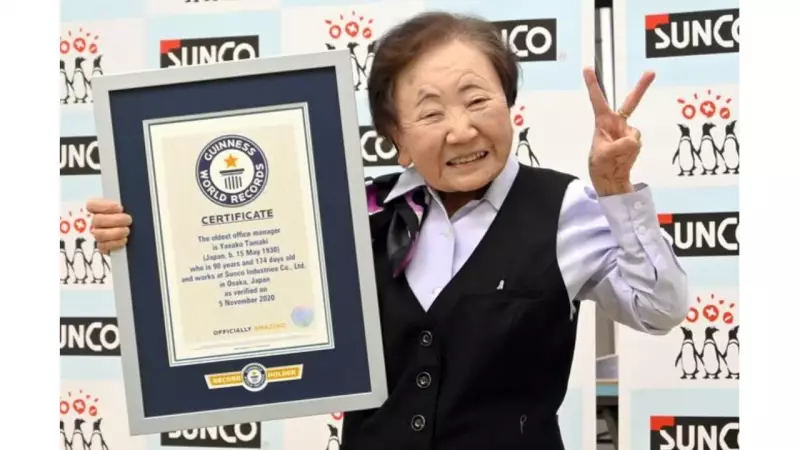
This arrangement enabled her to stay actively engaged in the workplace well into her advanced years, extending her professional service far beyond the typical career span. Her extraordinary continuity eventually captured international attention, leading Guinness World Records to officially recognize her as the world's oldest office manager during the 2020–2021 period, by which time she had already completed over 65 years in the same role.
Importantly, this global recognition did not signify the end of her career. Subsequent reports confirmed that she continued working into her nineties, bringing her total service at Sunco Industries tantalizingly close to the remarkable 70-year milestone.
Global Admiration, Criticism, and Cultural Reflection
Reactions to Yasuko Tamaki's unprecedented career story have been sharply divided across global audiences. Many view her as an enduring symbol of dedication, unwavering discipline, and profound purpose. They celebrate her steadfast commitment and the quiet dignity of a lifelong contribution.
Conversely, critics argue that her career narrative reflects potentially limited professional mobility and raise questions about why such extensive service did not accompany promotions or a reduced workload in later years. These debates often reveal more about shifting global attitudes toward work, ambition, and corporate loyalty than about Tamaki's personal choices.
In various interviews, Tamaki has consistently expressed that she genuinely enjoys her established routine and desires to continue working for as long as she remains physically and mentally able. Her perspective offers a personal counterpoint to the broader societal discussions her story ignites.

A Glimpse into Japan's Fading Lifetime Employment Tradition
Tamaki's career is intrinsically linked to Japan's once-dominant lifetime employment tradition, a system that was a defining pillar of the country's post-war corporate culture. This model, which promised job security and mutual loyalty between employer and employee, has significantly weakened in recent decades.
It has been increasingly replaced by short-term contracts, frequent job-hopping, and greater workforce fluidity, particularly among younger generations. Consequently, Yasuko Tamaki's story now feels exceptional precisely because it represents a rapidly disappearing archetype of work and organizational loyalty.
Yasuko Tamaki did not pursue lofty titles or seek new employers. Instead, she meticulously built a working life anchored in consistency, routine, and quiet, sustained contribution. Spending nearly 70 years in the same job at the same company is less a conventional tale of corporate ambition and more a profound narrative of personal endurance and deliberate choice.
Her journey offers a rare and poignant window into how work, personal identity, and deep-seated loyalty once powerfully intersected in the evolving landscape of modern Japan, serving as a living archive of a bygone professional era.