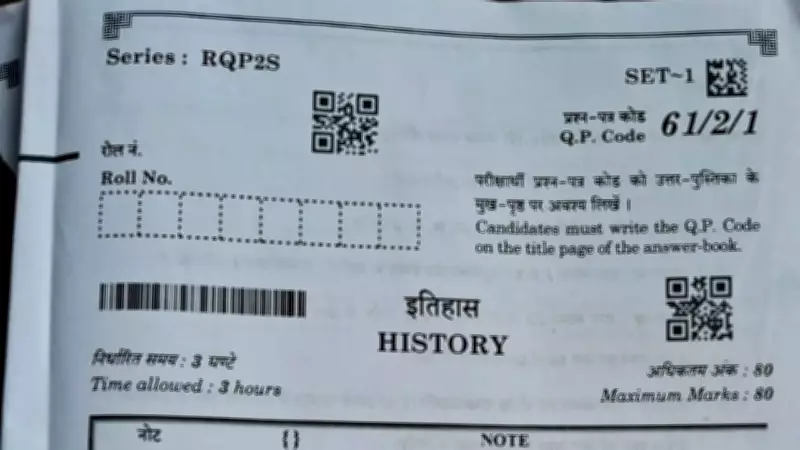
CBSE Class 12 History Exam 2026: Comprehensive Analysis and Student Feedback
The Central Board of Secondary Education successfully conducted the Class 12 History examination across India on March 30, 2026. The three-hour paper was administered from 10:30 AM to 1:30 PM at numerous examination centers nationwide, adhering strictly to the prescribed syllabus and examination pattern.
Student Perspectives: Mixed Reactions with Section B Highlighted as Difficult
Initial feedback from students indicates a generally balanced examination paper, though certain sections proved more challenging than others. Students from GGSSS Sonia Vihar and Sarvodaya Kanya Vidyalaya in Khajoori Khas reported that while most of the paper was manageable, Section B emerged as particularly demanding.
Aditi, a student who appeared for the exam, commented, "Section B was tough, and even the three-mark questions in that section were difficult. The rest of the paper was easy and could be attempted without much difficulty."

Another student, Payal, echoed similar sentiments, stating, "Overall, the paper was easy, but Section B was comparatively tough. The three-mark questions needed more thinking and were slightly lengthy."
Students noted that while many questions were direct and based on familiar topics from the curriculum, some required structured and detailed responses, particularly in the short-answer sections. This necessitated not just recall but deeper analytical thinking.
Teacher Analysis: Balanced Paper Emphasizing Conceptual Clarity
Educators who reviewed the paper described it as well-balanced with a strong focus on conceptual understanding rather than rote memorization.
Viewla Trivedi, PGT History at Silverline Prestige School, analyzed the 80-mark paper, stating, "The paper was easy to moderate. Out of 21 multiple-choice questions, most were easy, though a few statement-based questions were tricky. One picture-based question from Sanchi Stupa was included. The three-mark questions were moderate but slightly lengthy, while the long-answer questions were mostly easy except for one."
She further elaborated that source-based questions, while easy, were somewhat lengthy, and map-based questions were straightforward and scoring opportunities for prepared students.
Deepshikha Rudra, PGT History at Modern English School in Kahilipara, Guwahati, described the examination as well-balanced and closely aligned with both the CBSE sample paper and official syllabus.
"The multiple-choice questions and source-based questions were moderate in difficulty. Some questions were specifically framed to test conceptual understanding and analytical ability rather than mere memorization. The source-based questions were self-explanatory and aligned with NCERT textbooks, allowing students to interpret them effectively," she explained.
Rudra added that both short- and long-answer questions were analytical and centered on important historical themes. "The map-based question was straightforward and manageable for students who had practised map work. Overall, the paper maintained a careful balance between factual knowledge, analytical understanding, and interpretation skills," she concluded.
Examination Structure and Key Takeaways
The CBSE Class 12 History paper for 2026 demonstrated several notable characteristics:

- Balanced Difficulty: The paper maintained an overall easy-to-moderate difficulty level across most sections.
- Conceptual Focus: Questions emphasized understanding over memorization, particularly in source-based and analytical sections.
- Section B Challenges: This section stood out as more difficult, with three-mark questions requiring deeper thought and more detailed responses.
- Scoring Opportunities: Map-based questions and many long-answer questions provided straightforward scoring chances for well-prepared students.
- Alignment with Syllabus: The paper closely followed the prescribed CBSE syllabus and sample paper patterns.
The examination successfully tested students' historical knowledge while challenging their analytical and interpretive skills, reflecting the CBSE's ongoing emphasis on comprehensive learning outcomes in history education.