CBSE Class 10 Science Exam 2026 Successfully Conducted Across India
The Central Board of Secondary Education (CBSE) Class 10 Science examination for the academic year 2026 was held today, February 25, 2026. The crucial board exam commenced at 10:30 AM and concluded at 1:30 PM, spanning a duration of three hours. This comprehensive assessment tested students' understanding and application of core scientific principles across the three fundamental disciplines: Physics, Chemistry, and Biology.
Exam Structure and Question Paper Analysis
The three-hour question paper was meticulously designed to evaluate a broad spectrum of skills. It featured a balanced mix of numerical problems requiring precise calculations, detailed diagrams for labeling and interpretation, and numerous concept-based questions testing theoretical knowledge. A significant portion of the paper, particularly Section C, was explicitly crafted to challenge students' analytical abilities and higher-order thinking skills, moving beyond rote memorization to assess practical application.
An initial analysis of the paper content reveals distinct patterns across the subjects. The Chemistry and Biology sections were reported to be largely aligned with the NCERT curriculum, making them manageable for students who had thoroughly prepared from the standard textbooks. In contrast, the Physics section emerged as the most demanding part of the examination. It required not only conceptual clarity but also exceptional speed and precision in solving numerical problems, making effective time management an absolutely essential skill for students to navigate this section successfully.

Student Reactions and Feedback Post-Exam
Immediately following the examination, students from various parts of India shared their immediate reactions and feedback. The overall sentiment was categorized as "easy to moderate", though opinions varied significantly by subject.
- Biology: Widely regarded as the most straightforward section. Students reported that a majority of questions were directly based on NCERT content, rewarding those with strong textbook preparation.
- Chemistry: Described as manageable and fair. Students felt that with proper preparation and understanding of reactions and formulas, this section was approachable.
- Physics: Universally identified as the most challenging component. The primary hurdles were time-consuming numerical problems and complex diagram-based questions, which tested both speed and accuracy under pressure.
The analytical Section C, as anticipated, required careful planning and time allocation. The consensus among examinees was that thorough preparation, focused revision, and strategic time management were the critical factors for tackling the 2026 Science paper effectively.
Complete Science Paper PDF Now Available for Download
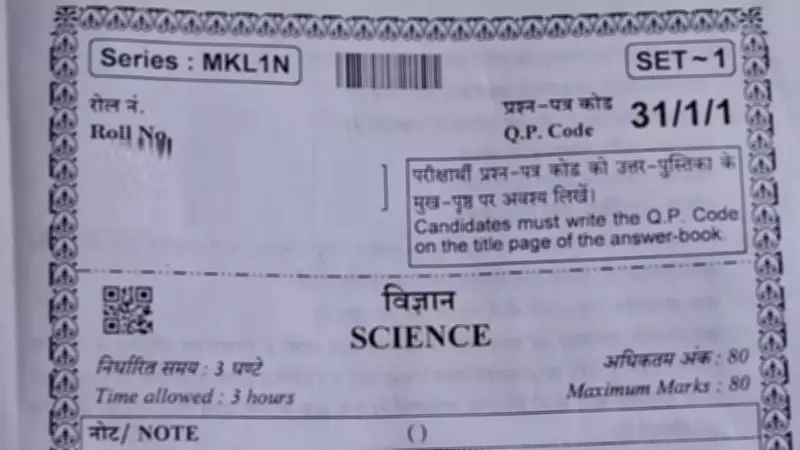
To facilitate a detailed and constructive review of the examination, the complete CBSE Class 10 Science question paper for 2026 has been made available in PDF format. This official document is an invaluable resource for students, teachers, and parents alike.
For students, the PDF enables several key post-exam activities:
- Reattempting questions for additional practice and rigorous self-assessment.
- Comparing their written answers with peers to gauge performance and understanding.
- Analyzing and refining time management strategies specific to different sections, especially Physics.
- Identifying specific topics or question types, such as numerical problems, that require focused improvement for future tests.
For educators and teachers, the PDF serves as a powerful pedagogical tool:
- Conducting structured classroom discussions and dedicated doubt-clearing sessions based on the actual paper.
- Creating targeted practice exercises, worksheets, and mock tests that mirror the latest exam pattern and difficulty level.
- Analyzing common student mistakes, question trends, and the overall emphasis of the board to better guide future batches.
The availability of this official document marks a significant step towards transparent and analytical exam preparation, helping the educational community dissect the assessment's pattern and demands thoroughly.