

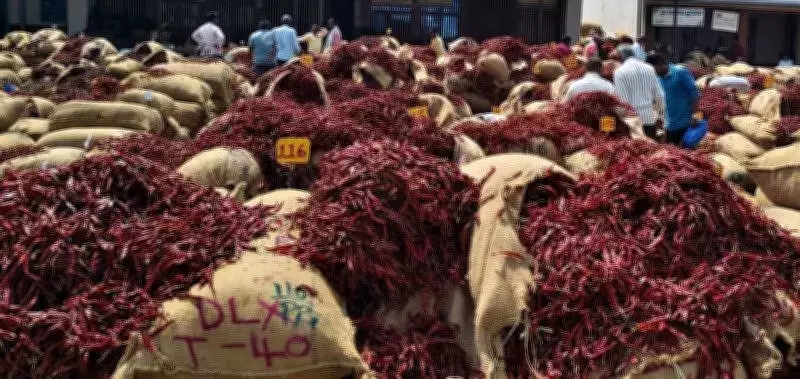
West Asia Conflict Triggers Severe Crisis for Byadagi Chilli Industry
The intensifying military confrontation in West Asia, involving the United States, Israel, and Iran, has created a devastating ripple effect thousands of miles away in Karnataka's Haveri district. The renowned Byadagi chilli, a key export commodity, is now at the center of a severe trade crisis as geopolitical tensions disrupt global shipping routes and payments.
Export Pipeline Paralyzed by Geopolitical Strife
According to local traders, the export of world-famous Byadagi chilli to Gulf countries has completely halted following recent military escalations. The conflict has nearly stopped large container ships from passing through the strategic Strait of Hormuz, creating a logistical nightmare for Indian exporters.
"We are in serious trouble due to this war," explained trader Shivanand Mallanagoudra. "Some containers are stranded at Mumbai and Chennai ports, leaving chilli worth hundreds of crores stuck in limbo. Additionally, crores owed to Byadagi traders from Iran have not been paid, creating a dual financial crisis."

Shipping Costs Skyrocket as Container Shortage Worsens
The transportation infrastructure has been severely impacted by the conflict. Raju Morageri, secretary of the traders' association, revealed alarming statistics about the shipping crisis.
"The shipments to the Middle East have stopped completely," Morageri stated. "There is a critical shortage of containers. Previously, the rent for a container was $1,800, but now it has reached $3,500—nearly double the pre-conflict rate. In the export business, we fix prices per kilogram, and it's impossible to cover these increased transport charges within that structure."
Basavaraj Benni, owner of a transport company, confirmed the dire situation. "Due to the war, traders now have to pay significantly more to ship chilli to West Asia. If these additional costs are passed back to farmers, the price they receive for their chilli will inevitably decrease," he explained.
Farmer Livelihoods Hang in the Balance
The timing of this crisis is particularly cruel for Byadagi chilli farmers who were just beginning to recover from previous setbacks. Trader SR Patil provided crucial context about the agricultural cycle.
"Every month, thousands of tonnes of chilli powder are exported to Gulf countries, but exports have stopped completely for the past 15 days," Patil said. "Personally, I am owed Rs 10 crore. Last year, excessive rain increased the supply of Byadagi chilli in the market, leading to price drops and reduced quality. This year, farmers grew fewer chillies in response, and initially they fetched good prices. Many farmers who suffered losses last year had already switched to other crops."
The current crisis threatens to undo this fragile recovery. Morageri emphasized the broader economic implications: "If petroleum prices rise due to the conflict, transportation costs will increase further. If these costs are adjusted, the prices farmers receive for their crops will decrease, impacting both agricultural producers and traders."
Global Market Disruption Beyond Gulf Countries
The impact extends beyond traditional Middle Eastern markets. Byadagi chilli, used extensively in spice preparation and cosmetics manufacturing, was previously exported to multiple Asian destinations including:
- Malaysia
- Indonesia
- Bali
- Thailand
- Singapore
However, the cost of renting containers for exporting chilli to conflict-affected regions—including Iran, Israel, and the United States—has increased dramatically, affecting trade flows across multiple continents.
Industry Plea for Swift Resolution
The collective sentiment among Haveri's chilli stakeholders is one of urgent concern. "We do not want this war," Morageri stated plainly. "We hope it stops as soon as possible. The fundamental question is: if rental costs continue to increase, how will farmers bring their produce to market? How will buyers send it abroad? This situation will inevitably lead to decreased crop prices."

Benni echoed this sentiment, adding: "We hope the war will end quickly so that the market can function as usual. The entire supply chain—from farmers to transporters to traders—is suffering."
The Byadagi chilli industry now finds itself caught in a geopolitical crossfire, with its fate tied to diplomatic developments in distant capitals. As containers remain stranded and payments delayed, the economic consequences continue to mount for one of Karnataka's most celebrated agricultural exports.





