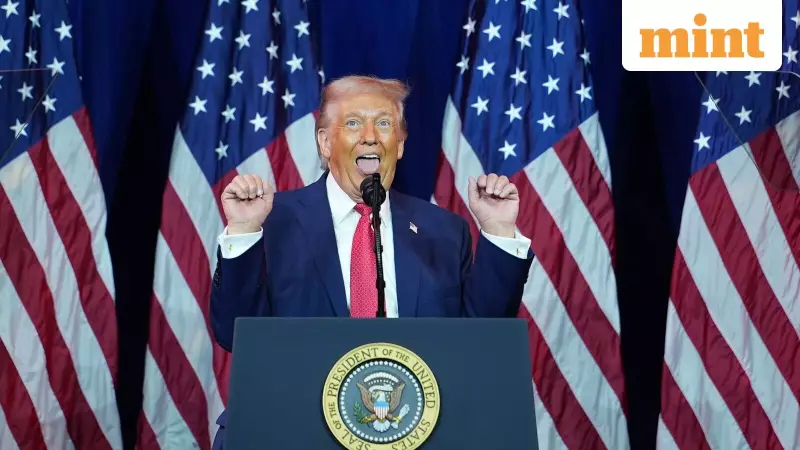
In a significant geopolitical development, former US President Donald Trump announced that Venezuela's interim authorities have agreed to transfer a massive quantity of oil to the United States. This move marks a sharp escalation in Washington's economic campaign against the government of Nicolas Maduro and signals a major shift in global energy alliances.
The Announcement and Its Immediate Impact
Late on Tuesday, via a social media post, Trump declared that between 30 and 50 million barrels of "high quality, sanctioned oil" would be turned over to the United States. He stated that the oil would be sold at prevailing market prices, with the proceeds controlled by the US President to benefit the people of both nations. At current prices, this cargo could be worth approximately $2.8 billion.
The announcement caused an immediate ripple in financial markets. The US oil benchmark, West Texas Intermediate, fell by as much as 2.4% following the news, trading near $56 a barrel. Representatives from the US Energy Department, the White House, and Venezuela's information and oil ministries did not provide further comments when approached.

A Strategic Blow to China and a Realignment of Alliances
This development deals a direct blow to China, which has been the top buyer of Venezuelan crude and a close economic partner of Caracas for years. Analysts suggest this aggressive move by the US is a forceful reassertion of its influence in Latin America, potentially forcing Beijing to reconsider its resource import strategies across the region.
"The Trump administration's aggressive reassertion of the Monroe Doctrine will have far-reaching implications for China," said Christopher Beddor, deputy China research director at Gavekal Dragonomics. "It's probably going to force a rethink of China's import reliance on natural resources from many other Latin American countries."
Reports indicate the US has demanded that Venezuela's interim government, led by Delcy Rodriguez, partner exclusively with the US on oil production and reduce its deep economic ties with China, Russia, Iran, and Cuba. This would represent a complete political realignment for Venezuela.
Logistical Realities and Market Implications
The volumes cited by Trump represent 30 to 50 days of Venezuela's current diminished oil production. The country, despite holding the world's largest proven crude reserves, now accounts for less than 1% of global supply after years of underinvestment and an exodus of foreign firms.
The oil is likely sourced from a growing backlog of unshipped crude stuck in storage tanks and on contracted ships since the US blockade began. Petroleos de Venezuela SA, the state oil company, is reportedly running out of storage space. Trump stated the oil would be taken by storage ships directly to US unloading docks, with Energy Secretary Chris Wright tasked to execute the plan immediately.
This one-time transfer is seen more as a political symbol than a structural market shift. "Even at the high end, 30 to 50 million barrels sounds big politically, but it is small economically," noted Haris Khurshid of Karobaar Capital LP. "That's a one-off flow, not a structural supply shift."
The heavy-sour crude from Venezuela is a perfect fit for refineries along the US Gulf Coast, operated by companies like Phillips 66 and Valero Energy Corp., whose share prices recently jumped. Some of the oil may also enter commercial storage, bolstering US stockpiles that are near five-year seasonal lows.
Meanwhile, the last American firm operating in Venezuela, Chevron Corp., continues production under a sanctions waiver and has booked at least 11 ships to Venezuelan ports. The geopolitical standoff continues at sea, with reports indicating Russia has deployed naval assets to escort a Venezuelan oil vessel pursued by US forces into the Atlantic.