How the US Trade Deal Will Transform India's Animal Feed Market
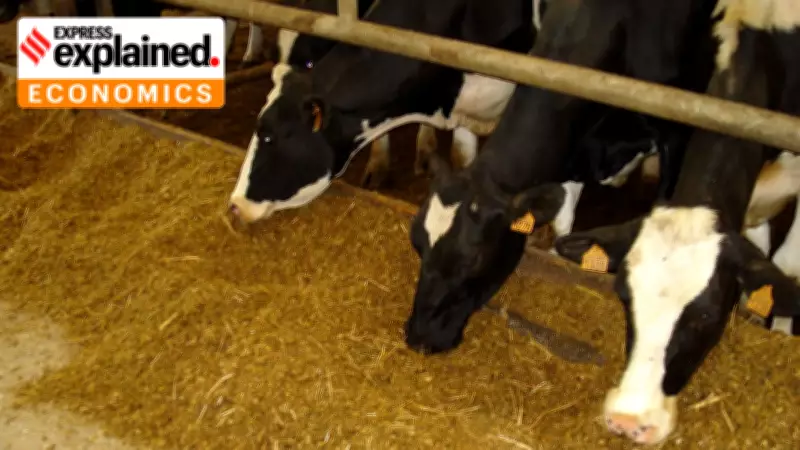
India is poised for a significant shift in dietary patterns, moving away from traditional cereals and staples towards foods rich in proteins and micronutrients. As demand for animal products like milk, eggs, meat, and fish grows, so does the need for feed and its ingredients. This transformation is being accelerated by a bilateral trade agreement with the United States, which is set to reshape India's feed industry.
The Rising Demand for Feed Ingredients
According to a report by the United States Department of Agriculture (USDA) titled 'The Growing Demand for Animal Products and Feed in India', released in March 2025, India's domestic corn (maize) consumption is projected to surge from an estimated 34.7 million tonnes in 2022-23 to 62.8 million tonnes by 2040 and 93 million tonnes by 2050 under a moderate GDP growth scenario of 4.6% annually. Similarly, soyabean meal consumption is expected to rise from 6.2 million tonnes to 17.7 million tonnes and 28.3 million tonnes over the same period.
Under a rapid GDP growth scenario of 6.6% per year, these numbers could be even higher: maize consumption at 98 million tonnes in 2040 and 200.2 million tonnes in 2050, and soyabean meal at 30.9 million tonnes and 68.3 million tonnes, respectively. With domestic production struggling to keep pace, large-scale imports are anticipated. The USDA projects imports of 11 million tonnes and 26 million tonnes for maize, and 6 million tonnes and 13 million tonnes for soyabean meal by 2040 and 2050 under the moderate scenario.

Challenges in Domestic Production
India's feed industry currently relies heavily on indigenous raw materials, but yield disparities present a major challenge. In 2024-25, India's per-hectare corn yield averaged 3.75 tonnes, compared to 11.25 tonnes in the US. For soyabean, yields were below one tonne in India versus 3.4 tonnes in the US. This gap opens a potential market for American crops, as India's annual maize and soyabean output of around 43 million tonnes and 12.5 million tonnes is a fraction of the US's 425 million tonnes and 120 million tonnes, respectively.
The total production of compound feed in India is estimated at 60 million tonnes, including 40 million tonnes for poultry, 18 million tonnes for cattle, and 2 million tonnes for aqua or shrimp feed. Divya Kumar Gulati, chairman of CLFMA of India, notes that the industry's size exceeds Rs 175,000 crore, based on average ex-mill prices.
Key Provisions of the US Trade Deal
Under the bilateral trade agreement, India has maintained its ban on imports of genetically modified (GM) maize and soyabean from the US. However, it has opened up imports for two other feed ingredients: red sorghum and distiller's dried grains with solubles (DDGS).
Red Sorghum: The US, as the world's largest producer and exporter of sorghum, has promoted it as a non-GM alternative to GM corn. In January 2025, the US Grains Council organized an exposure visit for Indian poultry industry stakeholders to highlight sorghum's potential. This move addresses the urgent need for non-GM feed solutions in India.
DDGS: Derived from maize during ethanol production, DDGS contains concentrated protein levels of 25-30% from maize and up to 40-45% from rice. India's grain-based ethanol distilleries already supply over 3 million tonnes of DDGS to the feed industry, with forecasts of 4.2 million tonnes in 2025-26. Imports from the US will supplement this, even though American DDGS is derived from GM corn.
Implications for India's Feed Industry
This trade deal represents a strategic shift, allowing India to diversify its feed sources while adhering to restrictions on GM crops. It supports the growing demand for animal products driven by rising incomes, urbanization, and a projected population of 1.5 billion by 2050. The agreement not only provides immediate solutions through sorghum and DDGS but also sets the stage for future negotiations on feed imports.
As India's diets evolve, the feed market is set to become a critical component of the agricultural economy, with the US trade deal playing a pivotal role in shaping its trajectory.