

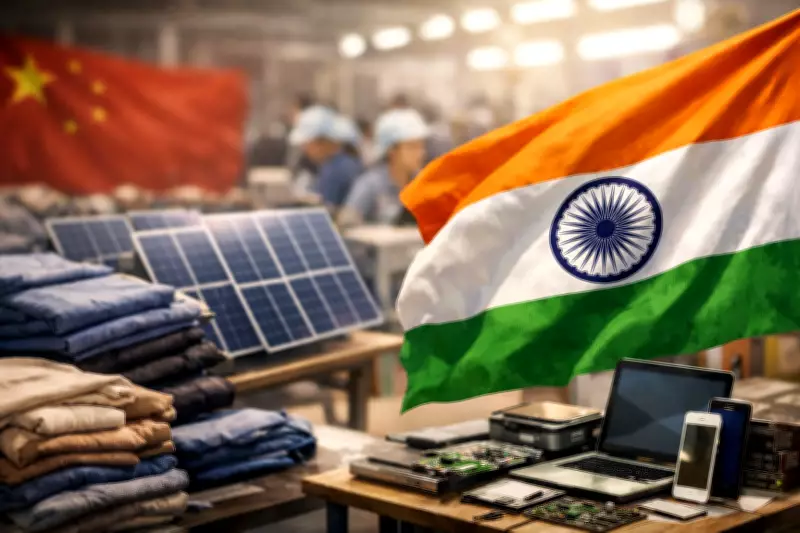
US Launches Major Trade Investigation Into Forced Labor in Global Supply Chains
The United States has initiated a significant trade investigation that could place India's exports of solar panels, electronics, and garments under increased scrutiny. According to a report by the Global Trade Research Initiative (GTRI), this probe focuses on the presence of forced labor in international supply chains and represents a substantial development in global trade enforcement.
Scope and Details of the US Investigation
On March 12, the United States Trade Representative (USTR) announced this investigation under Section 301 of the Trade Act of 1974. The inquiry encompasses 60 economies worldwide, including India, China, the European Union, the United Kingdom, Japan, Canada, Australia, Mexico, Brazil, Vietnam, Bangladesh, Cambodia, and Pakistan. This marks the second Section 301 investigation launched by Washington this month alone.
The investigation will specifically examine two critical situations:

- Where forced labor is used directly in the production of goods
- Where countries import inputs manufactured with forced labor from other nations and utilize them to produce goods that are subsequently exported to the United States
Officials will also evaluate whether advanced economies possess adequate legal frameworks and enforcement systems to prevent goods made with forced labor from entering their supply chains or being sold within them. The GTRI report emphasized that Washington believes such goods can still distort markets even if they pass through third countries before entering global trade, as lower production costs can provide them with an unfair price advantage over legitimate producers.
China's Central Role in the Investigation
China is expected to feature prominently in this investigation due to longstanding allegations regarding labor practices involving Uyghur and other Muslim minorities in the Xinjiang Uyghur Autonomous Region. Governments and human-rights groups have alleged that labor-transfer programs move workers into farms and factories connected to export-oriented industries.
China has consistently rejected these claims, maintaining that the programs are designed to create employment opportunities and provide vocational training. Previous investigations have linked labor programs in Xinjiang to several industries including cotton farming, textiles, garment production, tomato processing, and the manufacturing of polysilicon used in solar panels.
The controversy previously prompted the United States to implement the Uyghur Forced Labor Prevention Act, under which goods linked to Xinjiang are presumed to have been produced with forced labor unless importers can demonstrate otherwise. Consequently, several Chinese products have been identified as high risk in global supply chains.
These include:
- Cotton and cotton textiles, with Xinjiang accounting for approximately 20% of global cotton production
- Polysilicon used in solar panels
- Tomato paste and processed foods
- Garments and fabrics
- Electronics components and cables
- Peppers and garlic
The investigation is also anticipated to review labor practices in countries such as Myanmar and North Korea, where forced labor allegations linked to state authorities or armed groups have persisted for years.
Potential Impact on India's Export Sectors
While India prohibits forced labor under the Bonded Labour System (Abolition) Act of 1976, its export sectors could still be drawn into the investigation due to their dependence on imported inputs from China. According to the GTRI report, several key industries may be affected:
Solar Equipment: Exports from India to the United States often rely on imported polysilicon or solar cells that originate from Chinese supply chains previously questioned over alleged forced labor links in Xinjiang.
Electronics Manufacturing: Indian electronics manufacturers depend heavily on Chinese components, cables, and sub-assemblies. If these parts are traced back to regions associated with labor-transfer programs, they could face scrutiny during the investigation.

Textiles and Garments: Indian producers frequently use yarns and fabrics sourced from China. These inputs could encounter tighter traceability requirements if linked to cotton originating from Xinjiang.
The GTRI report warned that because the United States represents a major market for solar equipment, electronics, and garments, Indian exporters may confront higher compliance costs and stricter documentation requirements as US authorities demand detailed proof of the origin of inputs used across supply chains.
Broader Context of Section 301 Investigations
This forced labor probe follows another Section 301 investigation announced by the USTR on March 11. That separate inquiry is examining whether industrial policies in 16 economies have led to excess manufacturing capacity that harms US industries. India has been named in both probes, indicating increased trade scrutiny from Washington.
The report suggested that the United States appears to be relying more heavily on trade investigations after legal rulings constrained earlier tariff strategies. Additionally, the move may be aimed at discouraging countries from walking away from trade deals negotiated during the Trump administration after those agreements lost value following the US Supreme Court's February 20 ruling.
As global supply chains face unprecedented scrutiny, Indian exporters in key sectors must prepare for enhanced compliance requirements and potential market disruptions resulting from this comprehensive US investigation into forced labor practices worldwide.





