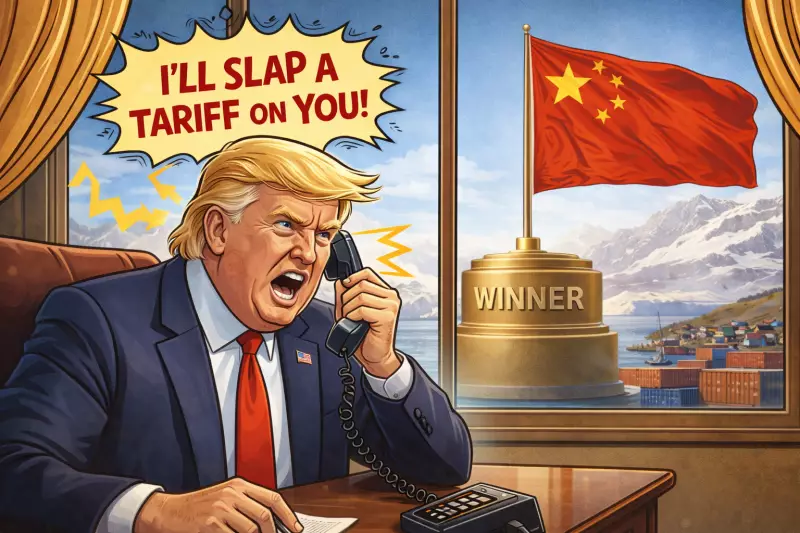
Trump's Greenland Gambit: Tariffs as Territorial Leverage
Donald Trump's latest tariff threat did not originate from a typical trade dispute or industrial heartland. It came from an unexpected direction: Greenland. The former US president has dramatically escalated his campaign to acquire the Danish autonomous territory, using tariffs as his primary weapon.
The Greenland Ultimatum
On Saturday, Trump declared he would impose sweeping new tariffs on European allies until the United States secures permission to purchase Greenland. Through a Truth Social post, he announced a 10% import tariff effective February 1 on goods from Denmark, Norway, Sweden, France, Germany, the Netherlands, Finland and Great Britain. This rate would jump to 25% on June 1 and remain until "a Deal is reached for the Complete and Total purchase of Greenland."
Trump accused these nations of "playing this very dangerous game" and warned they had "put a level of risk in play that is not tenable or sustainable." He argued that "strong measures" were necessary to resolve what he called a "potentially perilous situation" quickly and decisively.

European Backlash and Broader Implications
European leaders immediately rejected Trump's demand, warning that using tariffs in a sovereignty dispute threatens NATO unity and transatlantic trade relationships. The Greenland episode has become a flashpoint in a larger debate about Trump's tariff strategy and its effectiveness.
This latest threat has reignited discussions in Washington and global markets about whether tariffs—now Trump's primary economic and diplomatic tool—are actually benefiting the United States or causing more harm than good.
Five Trends Revealing Tariff Consequences
1. Weakening Job Growth Instead of Revival
The US labor market shows clear signs of losing momentum, particularly in trade-exposed sectors. Job creation in 2025 reached its weakest level since the COVID-19 slump, with multiple months of negative employment growth. Manufacturing jobs, which Trump repeatedly promised to restore, have begun declining again during his first year back in office after modest gains under the previous administration.
Real private fixed investment in manufacturing facilities declined steadily throughout 2025 after four years of growth. The manufacturing sector contracted for ten consecutive months by December, with companies citing higher input costs from tariffs and weaker demand.
Construction, another employment anchor, also shows strain. Tariffs on steel, copper and lumber have increased costs, contributing to the first sustained decline in construction spending since the pandemic's early months.
2. Persistent Inflation with Tariff Contributions
Trump has consistently argued that tariffs don't cause inflation, but price data suggests otherwise. US CPI inflation has remained close to 3% for over a year without meaningful cooling. Producer prices rose 2.7% through September, driven by higher food and energy costs indirectly affected by trade wars.
Tariffs increase costs for imported inputs that US businesses need, from machinery and steel to food and energy components. Many companies initially absorbed these costs in 2025 to protect market share, but that buffer is eroding. Economists expect more tariff burdens to pass directly to consumers in 2026, keeping inflation elevated just as the Federal Reserve hopes to declare victory.
3. China's Record Trade Surplus Despite US Tariffs
If the goal was to curb China's export dominance, the results prove disappointing. China closed 2025 with a record $1.19 trillion trade surplus—the largest ever recorded, even after inflation adjustments.
While exports to the US fell sharply under Trump's tariffs, Chinese manufacturers responded by scaling up sales to other markets. Exports to Africa jumped 25.8%, shipments to Southeast Asia rose 13.4%, and exports to the EU grew 8.4%. Chinese exporters "aggressively sought out customers in other markets when shipments to the US plunged," while firms increasingly bypass US tariffs by routing goods through Southeast Asia and other intermediaries.

4. Strained Alliances and US Isolation
The Greenland episode highlights how tariffs increasingly collide with diplomacy and security concerns. European leaders warned Trump's move risks a "dangerous downward spiral." British Prime Minister Keir Starmer stated that "applying tariffs on allies for pursuing the collective security of NATO allies is completely wrong." EU leaders declared "full solidarity" with Denmark and Greenland.
An emergency meeting of EU ambassadors has been called to coordinate a response. Trade experts warn that treating EU countries differently, as Trump proposes, could derail existing trade deals and push Europe closer to alternative partners, including China.
5. Misleading Tariff Revenue Claims
Trump frequently points to tariff revenue as proof of success, but the economic picture is more complex. The US has collected $261.6 billion in tariff revenue so far this year, representing a 186% increase from last year. However, this figure remains dwarfed by the $2.4 trillion raised annually through income taxes.
Economists warn that tariff revenue often spikes early, then levels off as companies shift supply chains, reduce volumes, or find workarounds. High tariffs also reduce overall trade, shrinking the base on which those revenues are collected.
Looking Ahead: Uncertainty and Consequences
Trump says he remains "open to negotiation" on Greenland, but European leaders insist the territory is not for sale. They warn that backing down under tariff pressure would set a dangerous precedent.
Markets are watching several critical developments:
- Jobs: Manufacturing and construction employment continue weakening
- Inflation: New tariffs risk keeping prices elevated
- China: Each trade shock accelerates Beijing's pivot toward non-US markets
- Legal Challenges: The Supreme Court's looming decision could either reinforce Trump's strategy or dramatically weaken it
Many factors that helped the US economy avoid a sharper slowdown in 2025 were temporary. Companies front-loaded inventories, absorbed costs, and delayed investment decisions while waiting for tariff clarity. These cushions are fading in 2026, even as new investigations could bring fresh duties on sectors like solar power, aircraft engines, and robotics.
The Bottom Line
During Trump's first term, tariffs were pitched as shock therapy. In his second term, they have hardened into habit. The policy now serves multiple purposes: punishing Iran, pressuring China, threatening Europe, and demanding territory from an ally. Legal authority often remains vague, while economic consequences receive secondary consideration.
The damage manifests in multiple areas: manufacturing investment declines, job growth slows, prices remain sticky, allies feel alienated, and China's export machine continues rolling. Ironically, the presidency that embraced tariffs to project strength abroad increasingly feels the consequences at home—quietly, steadily, and with effects that prove harder to undo than to announce.
The policy has reshaped global trade, just not in America's favor.