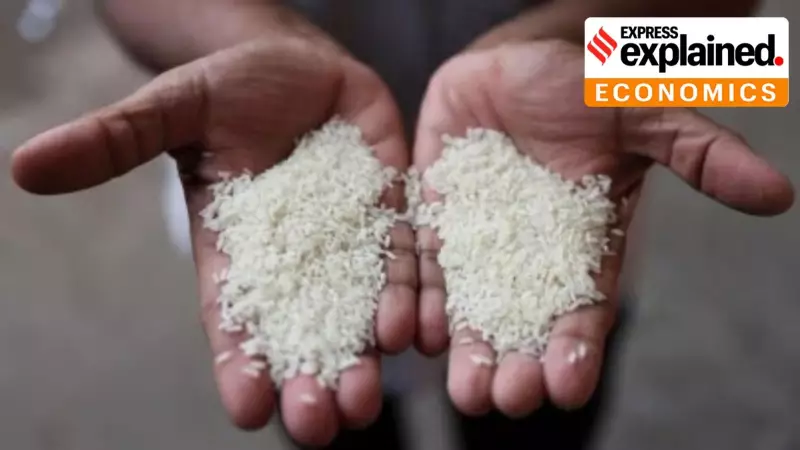
Trump's New Tariff Threat Clouds India's Basmati Rice Trade with Iran
United States President Donald Trump's latest trade move is sending shivers through India's basmati rice industry. The President has threatened to impose an additional 25 percent tariff on any country conducting business with Iran. This announcement has created significant uncertainty for Indian exporters who rely heavily on the Iranian market.
Iran's Crucial Role in India's Basmati Exports
Iran stands as India's third largest market for basmati rice. During the 2024-25 fiscal year, India exported basmati rice worth $5,944.49 million globally. Iran accounted for $753.20 million of this total, placing it just behind Saudi Arabia at $1,203.67 million and Iraq at $850.08 million.
In terms of quantity, India shipped 60.65 lakh tonnes of basmati rice worldwide. Iran received 8.55 lakh tonnes, while Iraq imported 9.06 lakh tonnes and Saudi Arabia took 11.74 lakh tonnes.

The current fiscal year shows interesting shifts. Exports to Iran have surged by 20.9 percent, jumping from 4.95 lakh tonnes in April-November 2024 to 5.99 lakh tonnes in the same period of 2025. Meanwhile, exports to Iraq have contracted by 2.9 percent and to Saudi Arabia by 2.8 percent.
The Dubai Connection and Payment Concerns
Official figures tell only part of the story. A substantial portion of basmati exports to Iran actually routes through Dubai. The United Arab Emirates imported 3.89 lakh tonnes of basmati rice from India in 2024-25 and 2.52 lakh tonnes during April-November 2025. Trade sources indicate many of these shipments eventually reach Iran.
Exporters prefer this indirect route for practical reasons. They utilize Dubai's more reliable banking channels and payment systems. Alternatively, they participate in Iranian government tenders floated by entities like the Government Trading Corporation of Iran. Both approaches offer safer payment options compared to direct deals with private Iranian buyers.
Trump's Tariff Creates Market Paralysis
Trump announced the proposed 25 percent duty rate in a Truth Social post on January 12. While not officially implemented yet, the threat has frozen fresh export contracts. Trade uncertainty has reached alarming levels.
Vijay Setia, former president of the All-India Rice Exporters' Association, explains the situation clearly. "The tariff threat has created huge uncertainty among the trade," he states. "Nobody wants to export in this situation where there is no guarantee of payment for even the rice already shipped out."
Price Volatility Hits Basmati Markets
The impact is visible in market prices. India primarily exports parboiled Pusa Basmati-1718 and Pusa Basmati-1509 rice to Iran. These varieties, developed by the Indian Agricultural Research Institute in Delhi, enjoy strong demand in Iran. Their extra kernel length and volume expansion capacity make them ideal for biryani preparation.
Price movements tell a concerning story. Pusa-1509 basmati rice rates in Haryana's mandis climbed from Rs 54-55 per kg in October to around Rs 68 by December. However, prices have since fallen to Rs 63-64 following recent street protests in Iran. Similarly, wholesale prices of Pusa-1718 rice have eased from Rs 70 to Rs 65-66 levels.
Pusa-1509 paddy prices have also declined. They dropped to Rs 3,200 per quintal in recent days from Rs 3,300-3,400 before the disturbances began.
Major Exporters and Historical Context
Several prominent companies lead India's basmati exports to Iran. These include Supple Tek Industries from Amritsar, Shree Jagdamba Agrico Exports based in Gharaunda, Shiv Shakti Inter Globe Exports from Taraori, GRM Overseas Ltd from Panipat, and KRBL Ltd from Noida.
Basmati exports to Iran actually peaked in 2018-19 at nearly 15 lakh tonnes valued over $1.5 billion. However, US sanctions reinstated under Trump's first administration in November 2018 caused exports to settle at lower levels. Those sanctions created foreign exchange shortages in Iran, leading to increased payment issues.

Iran's Own Policy Changes Compound Problems
Trump's tariff threat represents the latest challenge, but Iran's own policy shifts have also contributed. On January 1, Iran stopped issuing subsidized foreign currency. Previously, importers of essential products like rice could access dollars at a preferential exchange rate of 28,000 tomans.
Now all importers must buy foreign currency at the open market rate of around 130,000-131,000 tomans-to-the-dollar. This decision triggered both inflation and protests within Iran. More importantly for Indian traders, it has made Iranian imports economically unviable, dealing another blow to the basmati trade.
The combination of Trump's tariff threat and Iran's currency policy changes has created a perfect storm for India's basmati exporters. They now face unprecedented uncertainty in one of their most important international markets.