

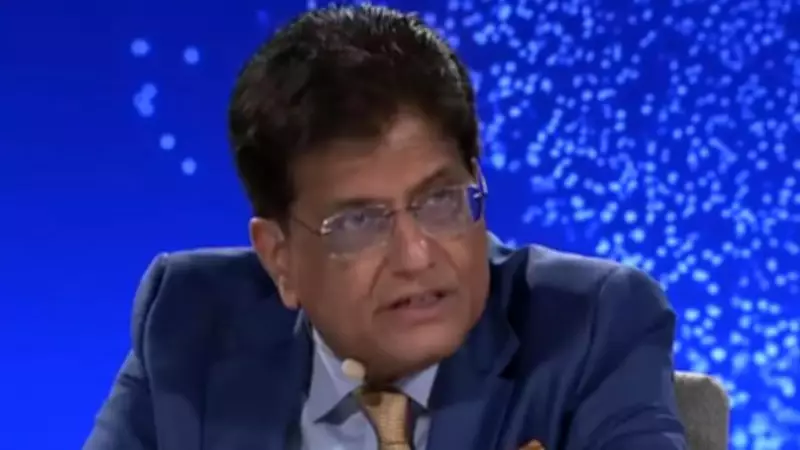
India Secures Best Trade Deal with US Among Competing Nations, Says Piyush Goyal
Commerce and Industry Minister Piyush Goyal declared on Saturday that India has achieved the most advantageous trade agreement with the United States when compared to other competing nations. This announcement underscores the formidable economic and strategic alliance between the two countries, as reported by PTI.
Powerful Relationship and Strategic Partnership
Speaking at the Raisina Dialogue 2026 in New Delhi, Goyal emphasized that India and the US share a "very powerful" relationship. He noted that the world's largest economy remains a crucial partner for New Delhi. "It has been a fantastic journey. We have the best of relations. You would have observed that through the last year, President Donald Trump has always had the best things to say about India as a country, and about Prime Minister Narendra Modi. We have fantastic relations with our counterparts there," Goyal stated.
He added, "Even within your family, sometimes you can have one or two misunderstandings. It's a part of the course. I think it's a very, very powerful relationship that the US and India share. And we got the best deal amongst all the nations with whom we compete."

Goyal highlighted that both nations are strategic partners and the largest democracies globally. He pointed out that the US, with its $30 trillion economy, is central to international trade. "We have a large responsibility cast on both our nations. They are the world's largest economy, USD 30 trillion economy, nobody can wish them away," he remarked.
Significance of Trade Agreements
Explaining the importance of trade deals, Goyal said such agreements aim to secure preferential access for a country's goods and services relative to competitors. "What's a trade deal? You are trying to get a preference or a preferential access for yourself, your goods, your services, compared to your competitor. And we got the best deal amongst all the competing nations. I mean whether it's in our neighbourhood Pakistan or Bangladesh. If we look at the Asian region, we got the best deal amongst all of the competitors..." he elaborated.
The minister further noted that the India-US partnership extends beyond trade, encompassing technology cooperation, critical minerals, defense ties, and investments. "There's a huge technology overlay on it. There's a huge critical minerals partnership, there's a defense partnership, there's a huge amount of investments that flow into India from the US. So it's a partnership of two countries which is going to define the future," Goyal asserted.
Details of the Bilateral Trade Agreement
His comments come as India and the US have finalized the framework for the first phase of a bilateral trade agreement. Under this framework, Washington had announced it would reduce reciprocal tariffs on India to 18 percent. However, after the US Supreme Court struck down the tariffs, President Donald Trump imposed a 10 percent tariff on all countries from February 24 for 150 days.
A meeting between the chief negotiators of both countries to finalize the legal text of the agreement has also been postponed. Under the proposed deal:
- India will eliminate or reduce tariffs on US industrial goods and a range of American agricultural products, including dried distillers' grains (DDGs), red sorghum for animal feed, tree nuts, fresh and processed fruits, soybean oil, wine, and spirits.
- India has indicated plans to purchase $500 billion worth of US energy products, aircraft and aircraft parts, precious metals, technology products, and coking coal over the next five years.
Free Trade Agreements and Domestic Interests
Goyal also referenced the nine free trade agreements finalized by the Modi government, stating they were negotiated while safeguarding domestic interests. "These nine free trade agreements, I can say on record with all the courage that I have on my command with all the responsibility that in not a single trade deal, has India compromised on any sensitivity of any of our stakeholders," he said.

Opposition parties have alleged that the government compromised farmers' interests in the India-US trade pact. In response, Goyal explained that opening the auto sector under certain FTAs would expand consumer choice and create employment opportunities. "Demand for this industry is growing at an average of 8 percent. So you can imagine how much more scope we have to create jobs," he noted.
He added that while companies from FTA partner countries might initially export cars to test the Indian market, they would eventually need to manufacture locally once demand is established. "Initially they can sell, say, 5,000 cars or 10,000 cars, to test the market, find the distraction -- and then come and manufacture here," Goyal said.
The government's broader objective is to build a global network of trade partnerships through multiple FTAs, reinforcing India's position in the international economic landscape.





