India and US Forge Interim Trade Agreement, Slashing Tariffs to 18%
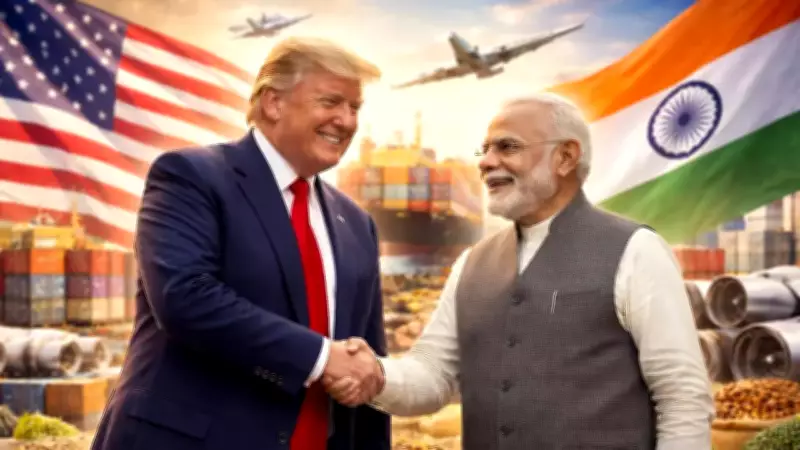
India and the United States have jointly announced a framework for an interim trade deal, with formal signing expected in the coming weeks. This landmark agreement significantly reduces the reciprocal tariff rate on India's exports to 18%, down from previous levels, while simultaneously, US President Donald Trump has revoked the 25% tariffs imposed on India for purchasing crude oil from Russia.
Key Provisions and Immediate Benefits
The joint statement declared, "The US and India are pleased to announce that they have reached a framework for an Interim Agreement regarding reciprocal and mutually beneficial trade." In exchange for tariff reductions on Indian goods, India will eliminate or reduce import duties on all US industrial goods and select US food and agricultural products.
This development follows months of intense negotiations and raises important questions about its implications for India's economy, particularly which sectors will benefit and how sensitive areas like agriculture and dairy will be handled.

Sector-Wise Impact: Who Gains from the Trade Deal?
Fundamentally, the 18% tariff rate provides India with a competitive advantage over regional counterparts in labor-intensive, export-driven sectors. This rate is lower than those of Vietnam, Bangladesh, China, Thailand, Pakistan, and Indonesia, and represents a substantial reduction from the 50% tariff imposed by the Trump administration in August 2025.
According to Commerce Minister Piyush Goyal, the agreement opens access to a $30 trillion market for Indian exports, particularly benefiting MSMEs, farmers, and fishermen. Specific sectors set to gain include:
- Textiles and apparel
- Leather and footwear
- Gems and jewellery
- Pharmaceuticals
- Machinery and automobiles
- Plastic and rubber products
- Home decor items
- Organic chemicals
- Artisanal products
Notably, tariffs on several products will drop to zero, including gems and diamonds, aircraft parts, and generic pharmaceuticals, providing a significant boost to India's Make in India initiative.
Additional Economic Advantages
India will also receive a preferential tariff rate quota for automotive parts, subject to tariffs addressing national security concerns. Both nations aim to enhance trade in technology products, such as Graphics Processing Units (GPUs) and data center equipment, while expanding joint technology cooperation.
Other cited benefits include:
- Major win for exporters, boosting export-led growth
- Reduced compliances and procedural delays
- Quicker access to US information and communication technology goods
- Strong push for establishing data centers
- Strengthening of electronics and semiconductor value chains
- Substantial support for domestic manufacturing
- Consumer benefits through reduced costs
- Job creation for MSMEs and startups
- Enhanced digital infrastructure
- Acceleration of India's digital AI ecosystem
Expert Analysis and Perspectives
Sachchidanand Shukla, Group Chief Economist at Larsen & Toubro, commented, "This looks like a good deal based on the joint statement. No sensitive agricultural & dairy opening has happened. Plus, there is preferential access for our auto, pharma, industrial and metal industries. The commodities given access under agriculture, e.g. soya oil, animal feed etc are not sensitive and manageable. Of course, the final text & implementation will matter."
Ranen Banerjee, Partner and Leader of Economic Advisory Services at PwC India, explained that Indian exporters in job-intensive sectors like textiles, leather, and jewellery will gain competitive market access at lowered tariff rates. "Given that Indian exporters had reoriented their exports to other markets over the last two quarters, they will get an additional fillip from the US market access," he told TOI.
Regarding India's commitment to purchase $500 billion in US energy products, aircraft, precious metals, technology products, and coking coal, Banerjee noted that these imports align with existing needs in energy, defense, and aviation, thus not imposing an additional burden.

Agriculture and Dairy: Protected Sectors
The joint statement confirms India has opened access to certain US agricultural products, including dried distillers' grains, red sorghum for animal feed, tree nuts, soybean oil, fresh and processed fruit, wine, and spirits. However, the government and experts emphasize that sensitive sectors in agriculture and dairy remain protected.
India has fully safeguarded products such as milk, cheese, wheat, rice, maize, soya, poultry, ethanol (fuel), tobacco, certain vegetables, and meat, with no duty concessions granted to the US on these goods. With approximately 50% of India's population reliant on agriculture for livelihood, this sector is treated as highly sensitive, with import duties crucial for sustaining rural livelihoods.
Piyush Goyal highlighted, "The agreement reflects India's commitment to safeguarding farmers' interests and sustaining rural livelihoods by completely protecting sensitive agricultural and dairy products, including maize, wheat, rice, soya, poultry, milk, cheese, ethanol (fuel), tobacco, certain vegetables, meat, etc."
Banerjee added that agricultural imports under the deal target premium consumption products with less price-sensitive consumers. He explained that items like red sorghum and dried distillers' grains will support growing demand in ethanol production and animal husbandry, aiding farm incomes without undermining domestic agriculture.
Bilateral Trade Context
The United States stands as India's single largest trading partner, accounting for about 18% of India's total exports, 6.22% of imports, and 10.73% of bilateral trade. In 2024-25, bilateral trade reached $186 billion, with $86.5 billion in exports and $45.3 billion in imports.
India maintains a trade surplus with the US, which increased to $41 billion in 2024-25 from $35.32 billion in 2023-24 and $27.7 billion in 2022-23. With the interim trade deal poised for signing, India stands to gain significantly, though experts caution that careful review of the final details remains essential.