Weekly Data Insights: India's Economic and Policy Developments
In this comprehensive weekly analysis, we delve into data-driven stories that shaped India's news landscape, presenting key developments through clear charts and detailed explanations. From landmark international agreements to domestic economic indicators and national honors, here's what the numbers reveal about India's current trajectory.
Historic Trade Agreement with European Union
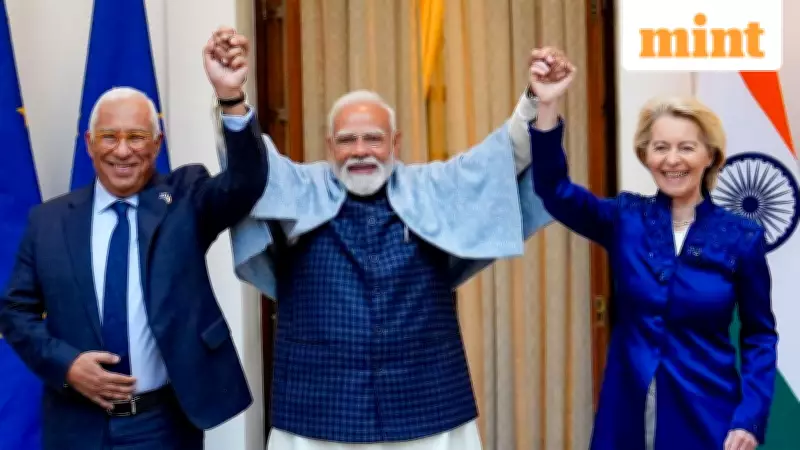
India and the European Union have successfully concluded negotiations for a monumental free trade agreement, widely referred to as the 'mother of all deals'. This groundbreaking pact provides India with enhanced access to one of the world's largest integrated economic blocs. Upon implementation, India will eliminate tariffs on approximately 96% of EU goods, while the EU will remove duties on about 97-98% of Indian products.
Given that the European Union represents a market nearly as substantial as the United States for Indian exporters, several key sectors are poised to benefit significantly:

- Textiles and apparel
- Leather and footwear
- Marine products
- Gems and jewellery
This agreement arrives at a crucial time when US tariffs have been exerting pressure on these export-oriented industries. While the EU deal offers a valuable cushion, full implementation is expected to take up to one year to complete.
Emerging Market Ranking Declines
India's position on the emerging market tracker slipped to sixth place in December, marking its poorest performance since February 2025. The country maintained the top ranking for only five months during 2025, a decrease from eight months in the previous year.
During December, weak performance in equity markets and currency valuation overshadowed strong GDP growth and manufacturing activity, pulling India's composite score down to 49.7 out of 100. Key factors contributing to this decline include:
- Market capitalization falling 1.8% month-on-month
- Rupee depreciation of 1.4% against the US dollar
- Export growth slowing to 1.9% year-on-year from 19.4% in November
China secured the top position, supported by relatively steady export growth, strong import cover, and more stable currency performance compared to other emerging markets.
Padma Awards 2026 Recognize Diverse Achievements
The government honored 131 individuals across various fields in this year's Padma Awards list, with arts dominating the recognition. The distribution highlights evolving national priorities:
- Arts led with 44 recipients
- Literature and education followed with 18 awardees
- Together, these two categories accounted for nearly half of all honors
Historically, arts has been the most recognized category since the awards' inception in 1954, accounting for 24% of total Padma honors across cinema, music, and dance. The 2026 list shows increased recognition for technical fields, with science and engineering recording their highest tally in 12 years and medicine achieving its biggest haul in a decade.
Key Economic Indicators and Policy Developments
Industrial Production Growth: India's industrial output expanded 7.8% in December, marking the fastest growth in over two years. This robust performance followed strong growth of 7.2% in November, driven by festive demand and GST rate reductions. The manufacturing sector grew 8.1% year-on-year, while mining output accelerated to 6.8% and electricity generation rebounded with 6.3% growth.
Budget Impact Analysis: The Union Budget has gradually lost its market-moving influence over recent years. Analysis reveals increasingly muted reactions on Budget Day, with the Sensex showing modest movements of 0.4% in 2023, 0.6% in 2024, and remaining flat in 2025. This reflects a shift toward more continuous and predictable policymaking, with investors positioning themselves weeks in advance.
Additional Notable Figures
GDP Projection: The Economic Survey projects India's GDP growth between 6.8-7.2% for 2026-27, representing steady growth amid global uncertainty, though lower than the 7.4% estimated for FY26.

Corporate Provision: Larsen & Toubro made a one-time provision of ₹1,191 crore to comply with India's new labour codes, resulting in a 4% year-on-year decline in consolidated profit to ₹3,215 crore.
Tourism Initiatives: The Budget may propose ₹500 crore for tourism promotion schemes, with potential measures to develop adventure tourism as a new revenue source for states.
Technology Investment: Nvidia Corp has invested an additional $2 billion in CoreWeave Inc to accelerate efforts to add over 5GW of artificial intelligence computing capacity by 2030.
Aviation Regulations: Four domestic airlines carrying 95% of air passengers are urging the government to relax crew rest rules implemented on 1 November.