

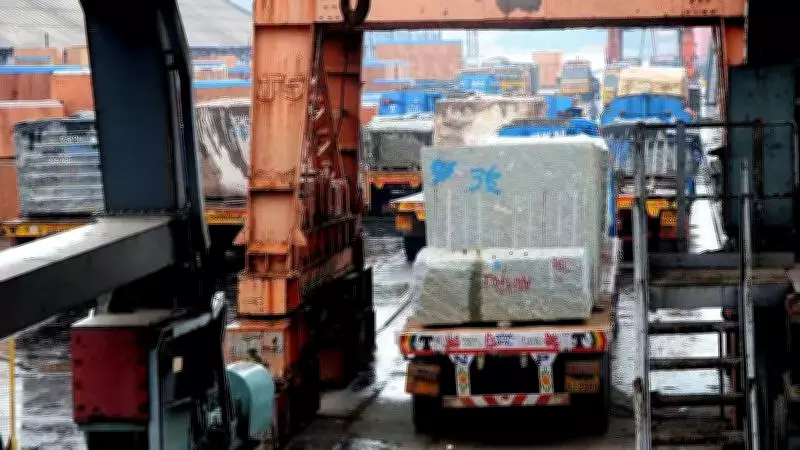
Geopolitical Tensions Cripple Telangana's Granite Exports, Strand Cargo at Port
The ongoing geopolitical conflict involving Iran, the United States, and Israel has begun to severely impact Telangana's granite industry, disrupting critical exports and leaving large consignments stranded at Kakinada port in Andhra Pradesh. Rising shipping costs and stringent restrictions on cargo vessels navigating sensitive international waters have effectively halted the movement of containers carrying granite cubes, marble, slabs, and tiles destined for overseas markets.
Industry in Crisis: Exports Grind to a Halt
This alarming situation has triggered serious concern among traders and workers in the granite hubs of Karimnagar and Khammam districts, where the industry supports thousands of livelihoods. Industry sources reveal that nearly 80% of the granite cubes, slabs, marble, and tiles produced in Telangana are exported, with only about 20% sold within India. The state's granite finds buyers in numerous countries, including Japan, Iraq, Qatar, Oman, the US, China, Iran, Kuwait, Saudi Arabia, Canada, and Korea. Notably, China alone accounts for nearly half of all exports, making it a crucial market.
Granite from Karimnagar and Khammam districts, particularly the internationally popular tan brown and maple brown varieties, enjoys strong demand in both domestic and global markets. Any prolonged disruption in exports could therefore deal a severe blow to the region's granite sector, which is a cornerstone of the local economy.

Soaring Costs and Stranded Shipments
Exporters report that the spike in shipping costs has already made transportation economically unviable for many traders. The freight rate for transporting granite from Kakinada port to China and the Middle East has risen sharply from approximately $20 per tonne to nearly $29 per tonne. This significant increase has dampened demand from overseas buyers, forcing exporters to delay shipments indefinitely.
Consequently, thousands of tonnes of granite slabs and tiles are now accumulating at Kakinada port, awaiting shipment as exporters grapple with rising costs and uncertain shipping routes. Shipping companies have begun imposing steep war-risk surcharges on containers passing through critical chokepoints like the Strait of Hormuz, escalating transportation costs dramatically. Traders indicate that these additional charges can reach up to ₹2 lakh per container, placing a heavy financial burden on exporters.
Faced with these prohibitive costs, several cargo ships carrying granite slabs and tiles have reportedly turned back instead of proceeding through high-risk shipping routes. Exporters suggest that if Iran grants exemptions or relaxations for Indian cargo vessels, it could help clear the backlog of containers currently stuck at the port, providing some relief to the beleaguered industry.
Threat to Quarry Operations and Employment
The crisis has also raised fears about potential disruptions in quarry operations. Industry insiders warn that if bulk diesel supplies are restricted—a possibility being discussed amid the geopolitical tensions—granite quarrying activities could come to a complete halt, leaving thousands of workers without jobs. Quarries typically require about 1,000 liters of diesel daily, and with bulk diesel sales already suspended in some areas, production is grinding to a stop.
The prolonged disruption has left traders deeply worried about mounting losses and the possibility of a further slowdown in the state's granite trade if the conflict continues unabated. In Karimnagar district alone, there are 414 granite quarries, with 292 located in Karimnagar, alongside 200 polishing units. Other districts like Rajanna Sircilla, Peddapalli, and Jagtial also host multiple quarries, collectively providing direct employment for around 90,000 people and indirect jobs for another 50,000. Khammam district boasts 70 granite quarries and 200 polishing units, supporting significant direct and indirect employment.
This multifaceted crisis underscores how regional geopolitical conflicts can have far-reaching economic repercussions, directly affecting local industries and livelihoods in seemingly unrelated regions like Telangana.






