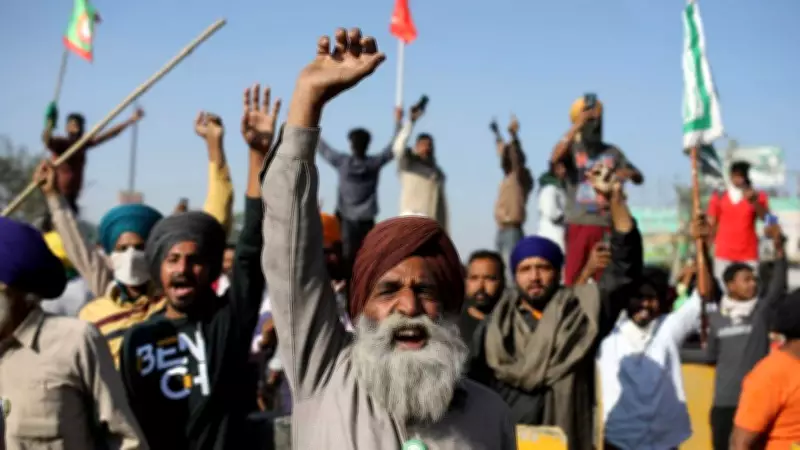
Farmer Outfits Condemn India-US Trade Agreement, Plan Massive Nationwide Demonstrations
Major farmer organizations across India have launched scathing criticism against the recently announced India-United States trade deal framework, labeling it a complete capitulation of Indian agriculture to American corporate interests. The Samyukt Kisan Morcha (SKM), along with its non-political faction and the All India Kisan Sabha, has called for extensive nationwide protests and announced support for a general strike scheduled for February 12.
Accusations of Surrender and Demands for Resignation
In a strongly worded statement, the SKM declared that the proposed interim trade agreement represents a "total surrender" of Indian farmers and the agricultural sector to multinational corporations from the United States. The organization has demanded the immediate resignation of Union Commerce Minister Piyush Goyal, accusing him of deliberately misleading the nation about the scope and implications of the trade negotiations.
"The framework completely contradicts Commerce Minister Goyal's assurances that agriculture and dairy would be excluded from Free Trade Agreements and that the government would protect farmers' interests," the SKM statement asserted. "The minister is knowingly spreading falsehoods. SKM views his actions as treacherous and insists on his resignation. We also demand that the Prime Minister refrain from signing the India-US FTA or face massive, united mass struggles across the country."

Contradictions and Concerns Over Agricultural Impact
Farmer leaders have highlighted what they see as glaring contradictions in the government's position. Jagjit Singh Dallewal of SKM (Non-Political) pointed out that while Minister Goyal claims protection for agriculture and dairy, the official India-US joint statement indicates India has agreed to discuss and resolve non-tariff barriers on US agricultural and food products. "These positions are directly contradictory," Dallewal stated. "The joint statement reveals that under US pressure, our government has agreed to open Indian markets to American farm products, which will inflict severe losses on Indian farmers."
All India Kisan Sabha leader Krishna Prasad warned that the trade deal would profoundly affect the agriculture sector by opening markets for items such as dried distillers' grains, red sorghum for animal feed, and soybean oil, with additional negative impacts on the dairy industry. He argued that agreements with the US and European Union are designed to benefit their "stagnant" economies rather than India.
Widespread Farmer Opposition and Planned Actions
Bhartiya Kisan Union leader Rakesh Tikait reported that villagers are increasingly questioning how these trade deals will affect their livelihoods and called upon farmers to join the protests. In a more dramatic gesture, Darshan Pal of the Krantikari Kisan Union (Punjab) announced that members would burn effigies of Prime Minister Narendra Modi and US President Donald Trump, arguing that the deal would further harm farmers already struggling with low incomes and debt.
The SKM expressed particular alarm about dairy imports, noting that existing FTAs with the UK, New Zealand, and the EU already facilitate such imports, and the reduction of non-tariff barriers with the US would enable greater entry of American milk and dairy products.
Warning of Unequal Trade Structure and Market Flooding
The organization highlighted what it termed an "unequal trade structure," noting that while US tariffs on Indian goods have increased to 18 percent, India's tariffs on US agricultural products—previously ranging from 30 to 150 percent—are proposed to be reduced to zero. This move, SKM warned, would expose Indian farmers to cheap imports of maize, wheat, soybean oil, ethanol, and genetically modified foods and seeds, severely disrupting domestic markets and farm incomes.

Specific concerns were raised about fruit growers in Jammu & Kashmir, Himachal Pradesh, and northeastern states, who could face competition from imported apples, pineapples, coconut, and dry fruits. SKM cautioned that heavily subsidized US farm products might flood Indian markets at a time when domestic agriculture is already under stress from rising input costs, falling prices, declining growth, and increasing farm debt.
Broader Criticism and Call for United Protest
Referring to the recent Union Budget, SKM criticized the government for failing to address slowing agricultural growth and employment generation while implementing customs duty cuts that could harm MSMEs and industry. The organization accused the government of prioritizing corporate interests over those of farmers, laborers, and rural workers, and also criticized industry bodies that have welcomed the trade framework.
SKM has appealed to all political parties, farmers and agricultural workers' organizations, trade unions, and mass organizations to join the protest demonstrations on February 12. This date coincides with a one-day general strike called by the Joint Platform of Central Trade Unions and sectoral federations against the imposition of labor codes and the trade deals.
Details of the India-US Trade Framework
India and the United States announced on Saturday that they have reached a framework for an interim trade agreement aimed at boosting two-way trade through mutual tariff reductions. Under the deal, Washington will lower tariffs on Indian goods to 18 percent from the current 50 percent, while New Delhi will eliminate or reduce import duties on all US industrial goods and a wide range of American food and agricultural products. These include dried distillers' grains, red sorghum for animal feed, tree nuts, fresh and processed fruit, soybean oil, wine, and spirits.
According to the joint statement, India has expressed its intention to purchase US energy products, aircraft and aircraft parts, precious metals, technology products, and coking coal worth an estimated $500 billion over the next five years.