

Indo-US Trade Deal Sparks Market Turmoil as Cotton and Soybean Prices Plunge in Nagpur
In a significant development impacting the agricultural heartland of Nagpur, the prices of cotton and soybean, two of the region's primary crops, have experienced a sharp decline. Market analysts and traders are attributing this downturn to apprehensions surrounding the proposed Indo-US trade agreement, even though the pact has not yet been formally implemented.
Trade Pact Provisions and Their Direct Impact
The draft of the trade agreement outlines provisions for duty-free imports of extra-long staple cotton from the United States. Additionally, it includes limited duty-free access for Distillers Dried Grains With Solubles (DDGS), a byproduct used extensively as animal feed. This is particularly concerning as DDGS is closely linked to soybean pricing dynamics within India.
Current Market Rates Versus MSP

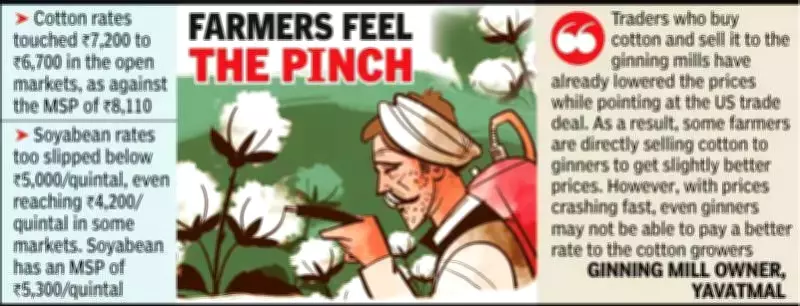
- Cotton: Open market rates have fallen to a range between Rs 6,700 and Rs 7,200 per quintal. This is notably below the government's Minimum Support Price (MSP) of Rs 8,110 per quintal.
- Soybean: Prices have dipped below the MSP of Rs 5,300 per quintal, with some markets reporting rates as low as Rs 4,200 per quintal.
Farmers' Organizations Voice Strong Concerns
The Shetkari Sangathana, a prominent farmers' outfit in Maharashtra, has raised alarms over the potential consequences of the trade deal. In a press note, president Anil Ghanwat highlighted that DDGS derived from rice and maize is already exerting downward pressure on domestic soybean prices. He emphasized that if DDGS is imported duty-free from the US, it could severely affect not only soybean but also maize prices in India.
Farm activist Vijay Jawandhia corroborated these concerns, stating that the trade deal has already begun to influence domestic markets, with both cotton and soybean prices slipping below MSP levels.
On-the-Ground Realities and Farmer Distress
A ginning mill owner from Yavatmal provided insight into the immediate effects: "Traders purchasing cotton for ginning mills have reduced prices, citing the US trade deal as a reason. Some farmers are attempting to sell directly to ginners for marginally better rates, but with prices collapsing rapidly, even ginners may struggle to offer favorable prices to growers." Meanwhile, procurement by the Cotton Corporation of India (CCI) under the MSP framework continues.
Manish Jadhav, a farmer from Mahalgaon Taluka in Yavatmal, noted that while most soybean produce has been sold, limited cotton stocks remain. However, farmers are increasingly anxious about the long-term implications of the price crash. Those who held onto their crops in anticipation of better prices now face potential losses.
This situation underscores the vulnerability of agricultural markets to international trade policies, with stakeholders calling for careful consideration to protect domestic farmers' interests.






