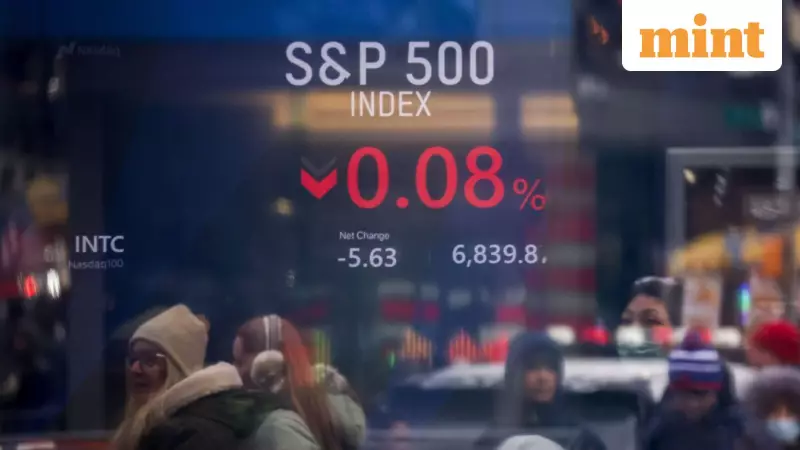
As the new year begins, a critical question looms over global investors, especially those with exposure to US equities: Is a major stock market crash imminent in 2026? While the S&P 500 index showed weakness in early January, weighed down by tech stocks, the broader debate centers on the probability of a severe downturn.
The $64 Trillion Question: Predicting the Unpredictable
Market crashes, like major earthquakes, are notoriously difficult to forecast. Yet, the potential reward for accurate timing is enormous, fueling endless speculation. Spencer Jakab of The Wall Street Journal highlights this dilemma in his Markets A.M. analysis. The consensus among seasoned financial minds is that the best strategy is to build a resilient investment portfolio and understand the statistical odds, much like insurers model natural disasters.
Recent analysis provides a clearer picture of these odds. Victor Haghani and James White of Elm Wealth, a firm catering to sophisticated investors, conducted an insightful survey. They asked their clients to estimate the chance of a 30% drop in the S&P 500 within the next 12 months, before presenting any data. The average guess was a significant 31%. This sentiment aligns with the long-running survey by Yale University economist Robert Shiller.

The Gap Between Fear and Market Reality
However, when real money is on the line, the perceived risk plummets. According to Elm Wealth's calculations based on the options market, where investors bet actual capital, the implied probability of a crash is only 8%. This stark contrast reveals a wide gap between investor anxiety and the market's priced-in expectations.
Steven Blitz, Chief US Economist at TS Lombard, supports this market-based view. He agrees that an 8% to 10% probability, translating to an event expected once every 10 to 12.5 years, reflects the historical frequency and is a reasonable current estimate. The last major crash triggered by the Covid-19 pandemic was roughly six years ago, in early 2020.
Why Elevated Risks Cannot Be Ignored
Despite the relatively low odds suggested by derivatives markets, several warning signs are flashing. Blitz points out that market crashes tend to occur more frequently when the Misery Index—the sum of inflation and unemployment rates—is on the rise, a condition present in the current economic climate. He draws a parallel to the volatile period between 1966 and 1982, which was more prone to crashes than the bullish era that followed.
Compounding this risk is the high valuation of stocks. Blitz notes that equity markets are trading at historically expensive levels. When combined with negative macroeconomic trends, this elevated valuation could potentially increase the odds of a sharp correction beyond the historical average.
An intriguing finding from Elm Wealth's study was the reaction of investors who read their detailed crash analysis. Even after understanding the historical data, their revised prediction for a crash in the coming year was still 15%—nearly double what the options market implies. This persistent fear can be costly. As legendary fund manager Peter Lynch famously warned, more money is often lost by investors preparing for corrections or trying to time the market than in the corrections themselves.
In conclusion, while the cold calculus of the options market suggests a low probability of a catastrophic crash in 2026, underlying economic pressures and high valuations warrant caution. For Indian investors with global portfolios, the key takeaway is not to panic-sell based on fear but to ensure their investments are built on a sturdy, diversified foundation capable of weathering periodic storms, whenever they may arrive.