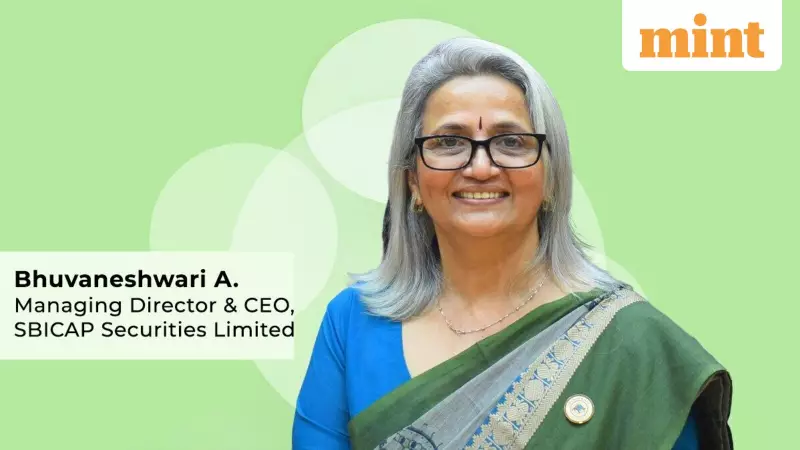
In a significant and optimistic assessment, Bhuvaneshwari A., the Managing Director and Chief Executive Officer of SBICAP Securities, has declared that the Indian equity market is in a stronger position today than it was a year ago, setting the stage for a potentially outperforming 2026. In an exclusive interview, she detailed the fundamental tailwinds supporting this constructive view, while also highlighting key risks and sharing critical expectations from the upcoming Union Budget 2026.
Five Pillars of Optimism for Indian Equities
The top executive pointed to five core factors that justify the positive sentiment for the coming year. First, a sharp earnings acceleration is anticipated, with a return to double-digit profit growth for FY27 and FY28, rebounding from the low single-digit growth expected in FY26.
Second, market valuations have become more compelling. The Nifty50 is currently trading at a one-year forward price-to-earnings (P/E) ratio of 19-20 times. This marks a significant moderation from the elevated levels of 22-23 times seen during the market peak in September 2024.

Third, a crucial valuation normalisation has occurred. India's valuation premium compared to the MSCI Emerging Markets index has compressed substantially. It has fallen from a high of 80% in September 2024 to a more sustainable 47% as of December 2025, which is now below the 10-year average premium of 57%.
Fourth, several external headwinds are now discounted. Market prices have largely factored in challenges such as volatility in the US dollar and Indian rupee exchange rate, geopolitical shifts, and outflows from foreign portfolio investors (FPIs).
Finally, domestic consumption is set for a revival. A cumulative reduction of 125 basis points in the repo rate, recent income tax reforms, and GST rationalisation are expected to boost demand. This is further supported by a healthy monsoon, which bodes well for the rural economy.
Wealth Creation Phase and Growth-Inflation Outlook
According to Bhuvaneshwari, the market has moved past the consolidation phase and the excessive valuations of 2025. The risk-reward balance is now favourable for long-term investors. She emphasised that the opportunity for wealth creation is abundant across large, mid, and small-cap stocks for those adopting a disciplined, bottom-up investment approach. Investors can expect a healthy long-term compounded annual growth rate (CAGR) of 12-14% by focusing on fundamentally sound businesses.
On India's macro-economic front, she reaffirmed the country's status as the world's fastest-growing major economy, on track to become the third-largest globally by 2030. While subdued food prices have temporarily moderated inflation and impacted nominal GDP growth, this is seen as a transitory phase. Inflation is expected to stabilise within a 3-4% band in FY27, supporting a robust nominal GDP growth of 10-11% in the medium to long term.
Budget 2026: A Blueprint for Long-Term Investor Ecosystem
Looking ahead to the Union Budget 2026, the SBICAP Securities CEO presented a trio of recommendations aimed at transforming India's capital markets from being transaction-centric to becoming enablers of long-term wealth creation for households.
1. Rationalising Long-Term Capital Gains (LTCG) Tax: The proposal is to create a calibrated tax regime for PAN-linked retail investors that rewards longer holding periods with reduced tax rates. This is envisioned not as a revenue loss but as a behavioural nudge to encourage patience over speculation, thereby supporting market stability and aligning household savings with India's growth story.
2. Reducing Securities Transaction Tax (STT) Friction: A calibrated reduction in STT, especially for delivery-based trades and ETFs, is advocated. The goal is to lower the cost of ownership for compliant, long-term investors and SIP participants, thereby enhancing formal participation in the capital markets.

3. Democratising Access to Government Securities (G-Secs): To bring sovereign debt instruments closer to retail investors, the recommendation is to allow G-Sec investments through SEBI-regulated brokers using existing KYC-verified platforms. This move could deepen the bond market and provide safe, yield-bearing options to common citizens.
While the outlook is positive, Bhuvaneshwari cautioned that risks remain. These include potential volatility in global crude oil prices, the need for sustained domestic liquidity support to capital markets, and extended timelines in international trade negotiations. Nonetheless, the foundation for a constructive 2026 appears firmly in place.