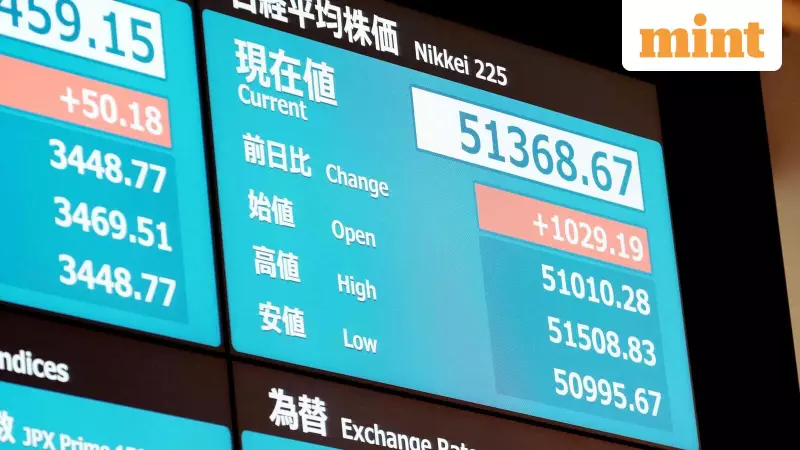
Japan's Nikkei index surged to a historic peak on Tuesday. Markets played catch-up after a public holiday earlier in the week. They mirrored Wall Street's strong two-day rally.
Record-Breaking Gains
The Nikkei jumped as much as 3.6% during the session. It reached an unprecedented level of 53,814.79. The broader Topix index also climbed sharply. It gained up to 2.4%, hitting a fresh record high of 3,599.31.
Major Japanese stocks experienced robust advances. SoftBank saw its shares rise up to 5%. Advantest surged by 8.99%. Tokyo Electron jumped 8.31%.

Wall Street's Influence
Overnight in the United States, key indices set new records. The Dow Jones Industrial Average and the S&P 500 both climbed to all-time peaks. Technology shares led the gains.
The S&P 500 added 0.16%, finishing at 6,977.27. The Dow Jones Industrial Average increased by 86.13 points, or 0.17%. It closed at 49,590.20. Both indices reached new intraday highs and ended at record levels. The Nasdaq Composite rose 0.26%, ending at 23,733.90.
What Drove the Rally?
Nikkei 225 futures surged over the three-day holiday weekend. This followed a report by the Yomiuri Shimbun newspaper late Friday. The report suggested Prime Minister Sanae Takaichi might dissolve the Lower House as early as this month. This raised the possibility of a snap election in early February.
Takaichi is Japan's first female prime minister. She advocates for expansionary fiscal policies. Her approval ratings remain strong currently. An early election could strengthen her political position. It might give her more room to govern effectively.
Maki Sawada, an equities strategist at Nomura Securities, commented on the situation. Reuters quoted her saying markets widely believe a dissolution would lead to a weaker yen, higher equities, and lower bond prices. The idea is that early elections signal proactive fiscal spending.
Additional Factors
Investor sentiment received another boost from the yen's sharp decline. The currency weakened significantly since Tokyo's Friday close. A weaker yen increases the value of overseas earnings for Japan's export-focused companies.
Japanese government bond yields also moved higher. Yields on 10-year bonds increased by more than 5 basis points to 2.15%. Twenty-year yields jumped over 8 basis points to 3.137%.
Meanwhile, the Japanese yen eased slightly against the US dollar. It hit a one-year low of 158.25.