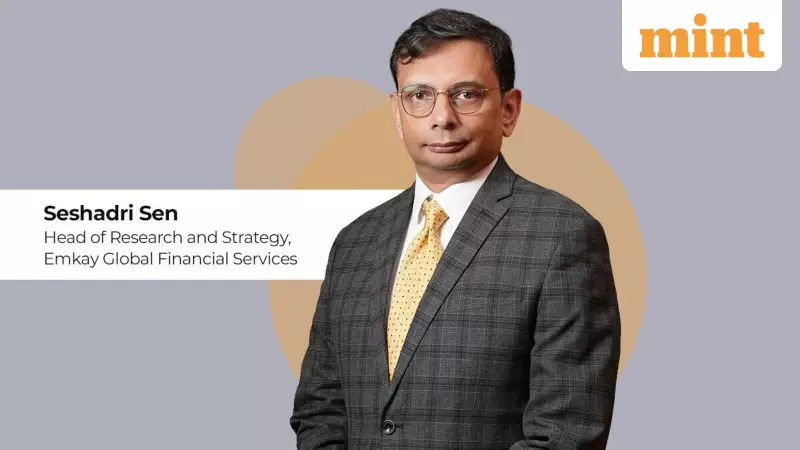
The Indian stock market is poised for a robust performance in the coming year, with the benchmark Nifty 50 index projected to deliver double-digit returns and potentially touch the 29,000 mark within the next 12 months. This optimistic outlook comes from Seshadri Sen, Head of Research and Strategy at Emkay Global Financial Services, who shared his insights in a recent interview.
Market Headwinds and the Path to Recovery
Sen explained that the domestic market struggled to maintain a sustained bull trend due to two significant challenges. The first was the lagged impact of twin tightening—both fiscal and monetary—through calendar year 2024 (CY24), which dampened growth and corporate earnings. This led to substantial earnings downgrades in the broader market towards the end of 2024. The second hurdle was global: high US tariffs weakened the rupee, discouraging foreign investors, while the artificial intelligence (AI) boom diverted capital from India to developed markets like the United States.
Despite these past obstacles, the forecast for 2026 is constructive and expected to be significantly better than 2025. The 12-month target for the Nifty 50 stands at around 29,000. While short-term volatility may persist due to currency stress and trade uncertainties, Sen views any meaningful market correction as a buying opportunity, backed by improving earnings visibility and macroeconomic stability.

Mid and Small-Caps: The Engine for Alpha
A key highlight of the forecast is the expected outperformance of mid and small-cap stocks (SMIDs) over a one- to two-year horizon. These segments are delivering higher earnings growth, improving their balance sheets, and gaining market share from larger companies in sectors like financials, IT services, non-pharma healthcare, electronics manufacturing services (EMS), and platform businesses.
However, Sen emphasises that a bottom-up, selective stock-picking approach with strict valuation discipline is critical. While large-cap stocks may provide stability, the primary opportunity for generating alpha (excess returns) is likely to come from the mid and small-cap space, even as they may experience near-term volatility.
Key Catalysts and Sectoral Preferences
Several factors indicate a potential revival in corporate earnings starting from the third quarter onward. FY27 earnings estimates have begun to rise after a prolonged phase of downgrades. The proportion of earnings upgrades is increasing while downgrades are falling. Credit growth, especially in retail and unsecured lending, appears to be bottoming out, which should support consumption. Furthermore, the positive effects of GST cuts, interest rate reductions, and regulatory easing are yet to be fully reflected in corporate profits.
Regarding growth-inflation dynamics, headline inflation is bottoming out but should remain within the Reserve Bank of India's (RBI) tolerance band for the next three to four quarters. The current weakness in nominal GDP is a slight concern, but Sen believes sufficient fiscal and monetary stimuli are in place to enable a recovery in CY26.
On the delayed India-US trade deal, Sen notes it keeps pressure on the rupee, making foreign investors cautious and adding to short-term market vulnerability, particularly for export-oriented sectors like textiles and seafood. However, he does not view the delay as structurally negative, seeing the deal as inevitable and a major future catalyst for currency stability and foreign institutional investor (FII) inflows once concluded.
Sectors where Emkay Global is bullish for the next one to two years include:

- Discretionary Consumption: Automobiles (passenger vehicles, two-wheelers), consumer durables (air conditioners), and internet/platform-led consumption themes.
- Industrials: Supported by sustained government capital expenditure in railways, defence, power, and renewables.
- Healthcare: Especially non-pharma segments.
- Utilities & Power: Representing a multi-year structural growth story.
- Financials: Preference for select small and mid-sized banks and NBFCs over large banks.