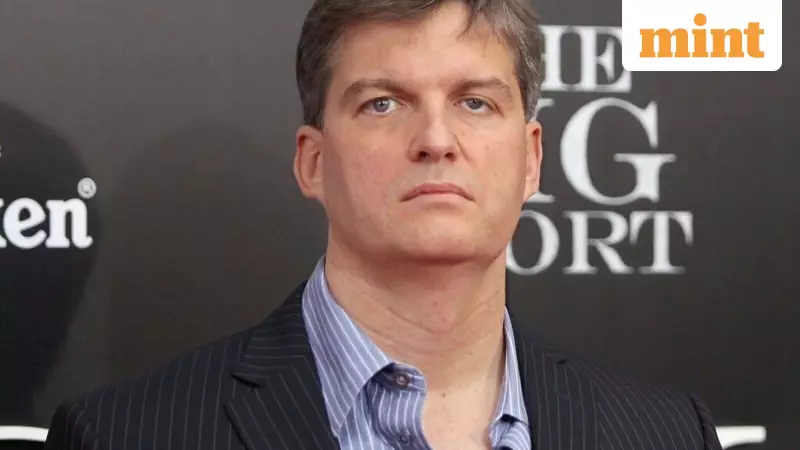
Michael Burry, the hedge fund manager immortalised in the film 'The Big Short' for his prescient bet against the US housing market, is now taking aim at the heart of the artificial intelligence boom. Burry has revealed significant short positions against two of AI's biggest champions: chipmaker Nvidia and software firm Palantir Technologies.
The Cassandra of Wall Street Sounds the Alarm
On November 3, Burry's firm, Scion Asset Management, disclosed it had purchased put options—bets that profit if a stock falls—against Nvidia and Palantir. The total value of these positions is estimated at around $10 million. However, if his prediction proves correct and these stocks tumble, the potential payoff could be staggering, possibly exceeding $1 billion. This move is a direct challenge to the market's most powerful trend, as Nvidia and Palantir together command a market value of roughly $5 trillion.
Burry, who has largely stayed out of the spotlight for the past decade, has re-emerged with a stark warning. He argues that the current AI investment frenzy mirrors the infamous dot-com bubble of the late 1990s. "This bubble looks an awful lot like the dot-com bubble," Burry stated on a podcast hosted by author Michael Lewis. He reframed it as a "data-transmission bubble," suggesting the infrastructure hype has detached from economic reality.

Burry's Thesis: Why Nvidia and Palantir Are Vulnerable
Burry's criticism of the two companies is detailed but distinct. For Palantir, he highlights an over-reliance on government contracts and what he sees as excessive executive compensation. He also points to rising competition, notably from legacy tech giant IBM. His bet is structured to pay off if Palantir's stock, trading around $200, falls to $50 per share by 2027.
Palantir's CEO, Alex Karp, has fiercely rejected this analysis, calling Burry "bats— crazy" in a CNBC interview and accusing him of market manipulation.
For Nvidia, Burry's concerns are more complex. He alleges questionable accounting practices between Nvidia and its major customers, such as Oracle and Meta Platforms. He draws a parallel to the fallen energy giant Enron, suggesting Nvidia has been helping to finance its customers' purchases of its own chips—a practice that could artificially inflate sales figures. Burry also questions the reported lifespan of the AI chips and their impact on earnings. His bet targets a drop in Nvidia's share price from near $190 to $110 by 2027, a decline of approximately 37%.
Nvidia has strongly denied these claims. In a memo reported by Barron's, the company stated, "Nvidia does not resemble historical accounting frauds because Nvidia’s underlying business is economically sound, our reporting is complete and transparent, and we care about our reputation for integrity."
A History of Being Early, Not Wrong
Wall Street is watching Burry's play with a mix of respect and scepticism. His legendary success in 2008 is balanced against a series of premature or incorrect crash predictions over the last 15 years. For instance, his cryptic "SELL" post on January 31, 2023, preceded a 70% rally in the S&P 500, a call he later admitted was wrong.
Michael Green, a former hedge fund manager and current chief strategist at Simplify Asset Management, notes Burry's pattern. "Michael, if he had one failing in the dot-com cycle, it was being early to the process. The housing bubble? It was being early to the process," Green observed. The central question remains timing: "How quickly does this end?"
Despite the criticism, Burry commands a massive following. After closing his hedge fund last month, he launched a finance newsletter on Substack, 'Cassandra Unchained,' which quickly garnered about 171,000 subscribers paying $379 per year. The newsletter's rapid success underscores the deep-seated anxiety his AI bubble thesis has tapped into regarding data centre limits and circular investments within the tech sector.

So far, the market has not heeded Burry's warning in a sustained way. While both Nvidia and Palantir shares have seen some decline since his bet was revealed, the drops have been choppy. Paradoxically, as strategist Michael Green suggests, the very awareness of such bearish bets might be fuelling the rally further, convincing some investors that the momentum is unstoppable. The world now watches to see if Michael Burry, once again, is early but not wrong.