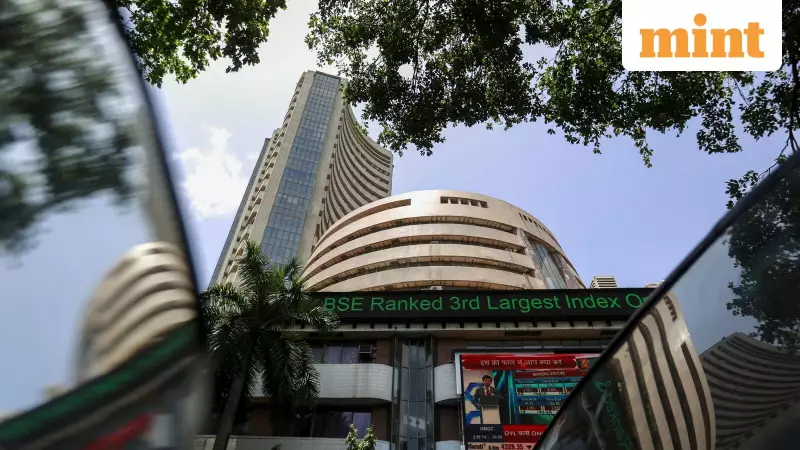
The financial year 2025 presented a complex and divided picture for India's equity markets, where investor fortunes varied dramatically depending on where they placed their bets. While broader indices showed resilience, a deep dive reveals a story of sharp contrasts across company sizes, sectors, and underlying economic pressures.
A Tale of Three Markets: Divergence Across Capitalizations
The headline numbers for CY2025 tell a clear story of selective growth. Large-cap stocks managed a respectable gain of approximately 9%, weathering global headwinds better than their smaller counterparts. The mid-cap segment eked out a more modest 4% increase. However, the year proved punishing for smaller companies, with the small-cap index declining by a significant 9%. This stark performance gap highlights the risk-off sentiment that dominated parts of the year, pushing investors towards perceived safety.
Sectoral performance was equally split. Automobiles, banking, and metals emerged as relative outperformers, delivering strong returns to investors. The auto sector, in particular, received a powerful boost from a substantial and unexpected reduction in the Goods and Services Tax (GST), which lifted both earnings prospects and valuation multiples. The financial sector rode on the back of attractive entry valuations, robust balance sheets, and stable credit quality. In contrast, the Information Technology (IT) sector underperformed the broader market, struggling with global demand uncertainties.

Headwinds That Held Back Growth
Despite these pockets of strength, several formidable challenges capped the market's upside potential throughout 2025. Corporate earnings growth remained subdued, with estimates for FY2025–26 hovering at a muted 6–8%, accompanied by multiple earnings downgrades by analysts.
A major external shock came from currency markets. The Indian rupee depreciated sharply by around 6% against the US dollar. This decline was primarily driven by a worsening trade balance, exacerbated by the United States imposing steep tariffs on Indian exports. This policy move directly hurt India's trade competitiveness.
The sentiment among foreign institutional investors (FIIs) turned deeply cautious. With India's earnings momentum slowing relative to other global markets, FIIs recorded net outflows of a massive $17.7 billion in 2025. Astonishingly, this figure exceeded the outflows witnessed during the 2008 global financial crisis. This capital flight, coupled with widening trade deficits between June and December 2025, pushed India's current account deficit toward an estimated 1.5% of GDP by FY2027.
CY2026 Outlook: The Crucial Role of a US-India Tariff Resolution
The outlook for CY2026 hinges critically on one major geopolitical-economic resolution: a positive trade agreement between India and the United States. History offers a lesson in swift sentiment reversal; after the 2008 crisis stabilized in 2009, India witnessed strong equity inflows the following year. Analysts believe a similar pivot is possible.
Any concrete progress toward a US-India tariff agreement could trigger meaningful FII inflows, support a re-rating of Indian equity valuations, and strengthen the rupee. In this optimistic scenario, supported by an improving macro environment, corporate earnings are projected to grow by 15–17% in FY2027. The financial sector is expected to be a powerhouse, driving 45–50% of incremental earnings growth between FY26 and FY28, with metals, energy, consumption, and IT also contributing.
Valuations, following the correction, appear reasonable at around 20 times earnings, with India's premium over other emerging markets sitting below long-term averages. However, the caveat remains clear: delays in securing a tariff agreement could continue to weigh on market sentiment and performance.

Oil Prices: A Limited Risk for India
On the commodities front, developments in Venezuela are being watched, but are unlikely to pose a major threat to India's economy. While Venezuelan crude is a key import for refiners in the U.S., China, and India, global oil dynamics are currently favorable. Global demand remains weak, with prices below $60 per barrel—a level that stifles new investment. Simultaneously, global supply is rising, limiting the market's capacity to absorb extra output. Consequently, U.S. actions in Venezuela are not expected to materially alter oil prices, and the impact on India's substantial oil import bill should be minimal.
Disclaimer: This analysis is for educational purposes only. The views and recommendations are those of individual analysts or broking companies. Investors are advised to consult with certified experts before making any investment decisions.