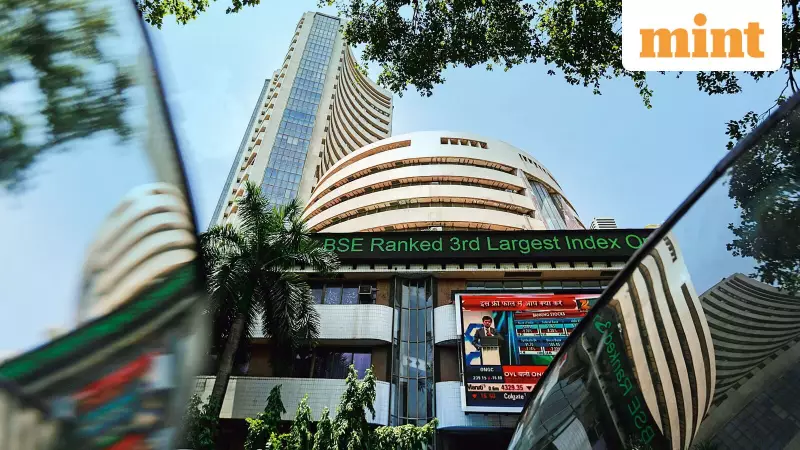
Indian financial markets experienced a brutal week of trading, with benchmark indices plunging approximately 2.5% to emerge as the worst-performing major market globally. This significant downturn was driven by a combination of relentless foreign portfolio investor (FPI) selling, weakening corporate earnings momentum, and growing pre-budget uncertainty that rattled investor confidence.
Sustained Foreign Selling and Earnings Disappointment
The Nifty 50 index slipped below the crucial psychological support level of 25,100, closing the week at 25,048.65 points. This decline has heightened fears among market participants that the index could potentially fall below the 25,000 mark in the coming sessions. According to Vikas Gupta, CEO and chief investment strategist at Omniscience Capital, market sentiments typically become fragile ahead of the Union Budget, leaving indices vulnerable to further downward pressure.
The last instance when the Nifty 50 closed below the 25,000 level occurred on October 3, 2025, at 24,894.25 points. This historical context underscores the significance of current market movements and the potential for further deterioration in investor sentiment.

Corporate Profitability Hits Multi-Year Low
A comprehensive Mint analysis of 189 early corporate results reveals a troubling trend: despite notable acceleration in top-line growth, corporate profits have reached their weakest point in at least three years. This divergence between revenue growth and profitability has raised serious concerns about the sustainability of corporate earnings and their impact on market valuations.
Experts warn that weak December-quarter earnings could continue to keep markets under substantial pressure in the coming weeks. The earnings disappointment comes at a particularly sensitive time, with investors already grappling with multiple macroeconomic challenges.
Broad-Based Sectoral Decline
The market downturn was remarkably broad-based, with all major sectors ending the week in negative territory. Realty stocks bore the brunt of the sell-off, plummeting approximately 11% amid growing concerns about execution delays and weaker sales expectations. Consumer durables and telecommunications sectors fell close to 5%, while power and healthcare stocks declined about 4%.
Gupta explained this sectoral weakness, noting that "realty, consumer, and telecom stocks were all trading at high valuation multiples that are not justified for the slower revenue and earnings growth they're projecting." This valuation disconnect has made these sectors particularly vulnerable to correction during periods of market stress.
Foreign Capital Exodus to AI-Heavy Markets
Weighted down by premium valuations and a prolonged sluggish earnings cycle, Indian equities are witnessing a significant exodus of foreign capital. Investors are increasingly redirecting funds toward artificial intelligence-heavy markets like Taiwan and South Korea, which offer more compelling growth narratives and technological momentum.
This strategic pivot has left India among the worst-performing markets globally, even as broader US-Europe trade tensions rattled the international financial landscape. Interestingly, while US President Donald Trump's softer stance on fresh European Union tariffs related to his Greenland purchase proposal triggered a global relief rally, domestic Indian equities struggled to participate meaningfully in this recovery.
FPI Strategy and Market Dynamics
Market analysts have observed that foreign portfolio investors have been systematically building short positions on every market bounce, reflecting their persistently weak confidence in corporate earnings prospects. This tactical approach suggests that any news-led relief rallies might have limited upside potential moving forward, similar to the Greenland-related bounce witnessed during the week.
The scale of foreign selling has been substantial, with FPIs offloading nearly ₹34,000 crore worth of shares in January alone. This massive capital outflow represents one of the most significant headwinds facing Indian markets currently.

Pre-Budget Sector Preferences and Outlook
At this critical juncture, market strategists are recommending specific sectoral exposures ahead of the Union Budget. Gupta expressed preference for public and private banks, energy-transition themes spanning renewables and power generation, and infrastructure plays related to roads and railways. He also expects defence stocks to gain traction but cautioned investors against excessive valuations in this segment.
This tactical preference aligns with broader market behavior patterns. A separate Mint analysis indicates that defence- and infrastructure-related stocks typically become more volatile during the pre-budget week, as expectations of budget announcements heighten investor interest in these policy-sensitive sectors.
Broader Risk-Off Sentiment Extends Beyond Equities
The prevailing risk-off sentiment isn't confined to equity markets alone. Even traditional safe-haven assets like gold and silver, where investors typically seek shelter from equity market volatility, experienced sharp price swings during the week. Bullion futures corrected 6-8% from fresh highs as US tariff threats eased mid-week.
Despite this correction, spot gold and silver have significantly outperformed equities throughout January, gaining 16% and 38% respectively, while the Nifty 50 has declined 4%. This performance divergence highlights the extent of risk aversion permeating financial markets and the flight to quality assets amid growing uncertainty.
Looking ahead, analysts expect markets to remain cautious in the coming week as investors carefully weigh the Federal Reserve's interest rate outlook against the implications of the upcoming Union Budget. Additional pressure may emerge from rising crude oil prices and the rupee's depreciation to a record low of 91.95 against the US dollar, amid growing concerns that India has limited policy headroom remaining to support economic growth.