Bharat Coking Coal Ltd (BCCL), India's largest producer of coking coal, is launching its initial public offering (IPO) with a narrative firmly hitched to the nation's rising steel demand. However, a closer look at its business reveals a persistent and significant reliance on the power sector, casting a shadow on its pure-play steel story.
The Steel Growth Promise and Current Reality
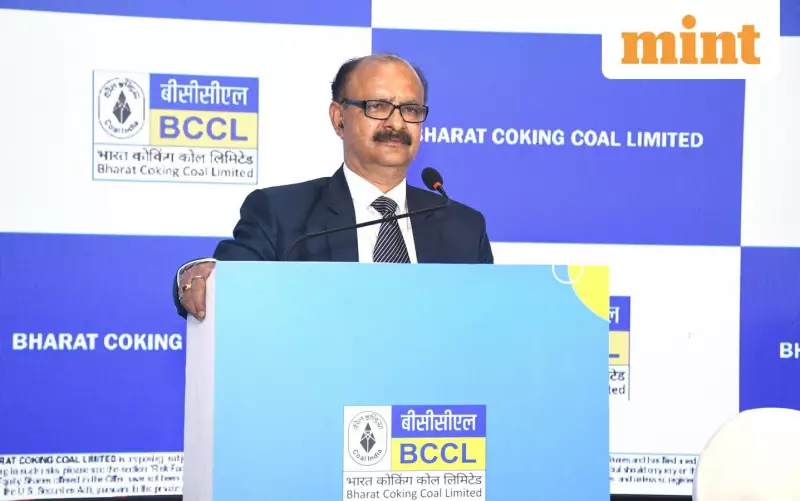
The company's management, led by Chairman and Managing Director Manoj Kumar Agarwal, positions the IPO as a direct gateway for investors to benefit from India's steel expansion. Coking coal, a key ingredient for making coke used in steel production, commands a premium over thermal coal used in power plants.
"The real value of coking coal is not getting reflected properly in the Coal India valuation. Now, anybody who purchases Bharat Coking Coal shares will become a direct beneficiary of India's steel growth story," Agarwal stated in an interview on Monday, January 5.

Despite this ambitious positioning, the current financials tell a different tale. In the fiscal year 2025, a staggering three-fourths of BCCL's revenues came from the power sector. Only 18% originated from steel companies. Among its top ten customers, only one was a steelmaker—the state-owned Steel Authority of India Ltd (SAIL)—with the rest being power producers.
The Core Challenge: High Ash Content
The central issue undermining BCCL's steel narrative is the quality of its coal. Indian coking coal has a significantly high ash content compared to international standards. BCCL's coal contains 39-40% ash, whereas the steel industry requires 13-14% ash. Imported coking coal from Australia, for instance, has only 8-9% ash.
This high ash content makes the coal unsuitable for steelmaking without extensive processing. Consequently, most of BCCL's output is sold to power companies, which use it as a heating material similar to thermal coal, paying only a slight premium. The company mined 40.5 million tonnes (mt) of coal in FY25 and expects production to reach 54 mt by FY30, after a dip in the current fiscal due to heavy rains.
To address this, BCCL is embarking on a major capital expenditure plan. It has guided for an annual capex of ₹1,000 crore over the next five years, partly to set up three new coal washeries with a combined capacity of 7 million tonnes per annum (mtpa). Washing reduces ash content to 18-19%, which is still above the steel industry's requirement but allows it to be sold at a discount to imports and blended by steelmakers.
Future Projections: Power Dominance to Continue
Even with these investments, analysts project that the power sector will remain BCCL's largest revenue contributor for the foreseeable future. Brokerage Philip Capital's Suman Kumar points out that by 2030, power companies are expected to account for 30 mtpa of volume against a total projected volume of 54 mtpa.
Sales to the steel sector are projected to grow modestly from the current 2 mtpa to about 10 mtpa by 2030. "In addition, there are execution risks around the commissioning of washeries. Taken together, these factors do not fully align with the company’s stated growth narrative of being driven solely by India’s rising steel demand," Kumar noted.
Mukesh Agrawal, director (finance) at parent company Coal India, maintains optimism, stating that growth from 40 to 54 million tonnes will come from the steel sector, directly benefiting shareholders through higher realizations and increased EBITDA.
IPO Details and Financial Health
The BCCL IPO opens for subscription on January 9 and closes on January 13, with a price band of ₹21 to ₹23 per share. The entire offer is an offer for sale, where 100% owner Coal India will sell a tenth of its stake to raise up to ₹1,071 crore at the upper end of the band. This values the company at approximately ₹10,711 crore.
BCCL enters the market with a zero-debt balance sheet and healthy return ratios. However, investors should note that its net profit declined by a significant 21% in FY25 compared to FY24. The company also plans to reduce its employee count by 10,000 by 2030, bringing the total to 23,000.

Key takeaways for investors:
- While marketed as a coking coal play, BCCL currently functions largely as a thermal coal supplier to the power sector.
- Its growth hinges on a ₹5,000 crore washery expansion plan to improve coal quality.
- Even if 2030 targets are met, the company will likely remain a utility-linked stock for most of this decade, with power sector sales dominating volumes.
The IPO presents a bet on India's infrastructure and steel growth, but it is tempered by the operational reality of coal quality and the company's entrenched customer base in the power industry.