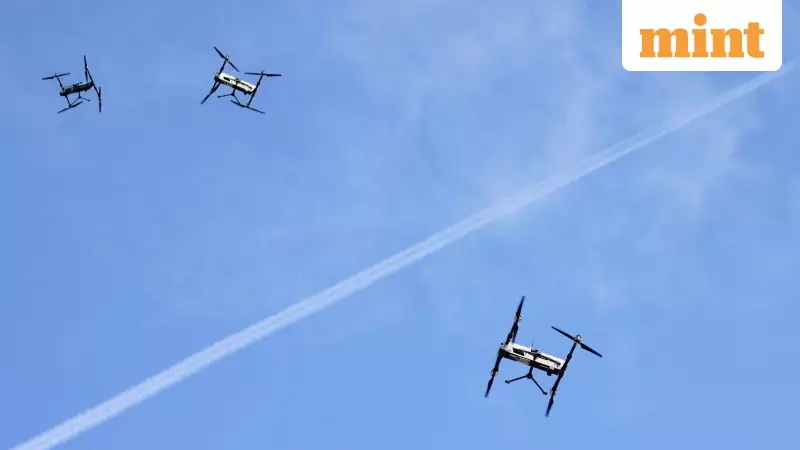
India's defence sector is poised for a significant boost, with reports indicating the upcoming Union Budget for 2026-27 may introduce a major manufacturing-focused incentive scheme. This initiative, expected to fall under the Drone Shakti program, aims to accelerate the indigenous production of unmanned aerial vehicles (UAVs), a critical need for modern battle equipment.
Budget Blueprint for a Drone-Powered Future
According to a Moneycontrol report, the government is likely to announce this scheme in the forthcoming budget. The proposed plan is anticipated to run for five years, aligning with the period of the Sixteenth Finance Commission. This move underscores a strategic push towards self-reliance in high-tech drones capable of surveillance and precision strikes, reducing dependency on foreign imports.
The potential policy tailwind is expected to benefit domestic companies at the forefront of drone technology. While this is not a stock recommendation, here is a look at three firms whose business models align closely with the government's vision for an 'Atmanirbhar' drone ecosystem.

Zen Technologies: Simulating Threats and Neutralising Drones
Zen Technologies has carved a niche as a leader in defence simulation and training solutions. The company specialises in creating state-of-the-art simulators for tanks, artillery, and aircraft, providing the military with safe and cost-effective alternatives to live drills.
A key growth area is its Counter Unmanned Aerial System (CUAS) platform. This multi-layered system is designed to detect, identify, and neutralise rogue drones, addressing a growing security concern. Financially, the company reported a Q2 FY26 revenue of ₹173.60 crore, with a net profit of ₹62 crore. Management has set a medium-term goal of generating a cumulative revenue of ₹6,000 crore over FY26, FY27, and FY28, banking on defence modernisation and its technological edge.
Paras Defence & Space: Betting on Hydrogen-Powered Cargo Drones
Paras Defence and Space Technologies is an advanced engineering firm focused on indigenous design and manufacturing. Its drone ambitions are channeled through a joint venture, Paras Heven Advanced Drones Private Ltd, where it holds a 51% stake with Israel's Heven Drones.
The JV plans to manufacture advanced logistics and cargo drones in India for both military and civilian use, with payload capacities ranging from 10 to 40 kg. A standout feature is the integration of proprietary hydrogen-powered technology, promising longer flight endurance than battery-operated models. The company's Q2 FY26 performance was strong, with revenue rising to ₹105.7 crore and net profit jumping to ₹19.5 crore from ₹12.7 crore a year earlier.
DroneAcharya Aerial Innovations: Building a Skilled Ecosystem
DroneAcharya Aerial Innovations operates as a comprehensive drone solutions provider. Its services span training—it is a DGCA-certified Remote Pilot Training Organisation (RPTO)—defence systems, aerial services, and consulting. The company designs and manufactures drones for agriculture, defence, logistics, and infrastructure.
In the first half of FY26, the company focused on operational efficiency, reporting standalone operational revenue of ₹9.58 crore and a net profit of ₹1.94 crore. With an expanding indigenous product range for defence and a strong order pipeline, the management remains confident about sustaining profitability.
Navigating the Investment Airspace
Investing in the drone sector requires careful evaluation beyond potential policy boosts. Key factors include the actual implementation of government schemes, the pace of technological innovation, and each company's financial health and execution capabilities. Investors should conduct thorough fundamental analysis, assess corporate governance, and consider valuations before making any investment decision.
The anticipated Drone Shakti incentives in Budget 2026-27 could be a catalyst, but long-term success will depend on how these companies convert opportunities into sustainable revenue and profit.