

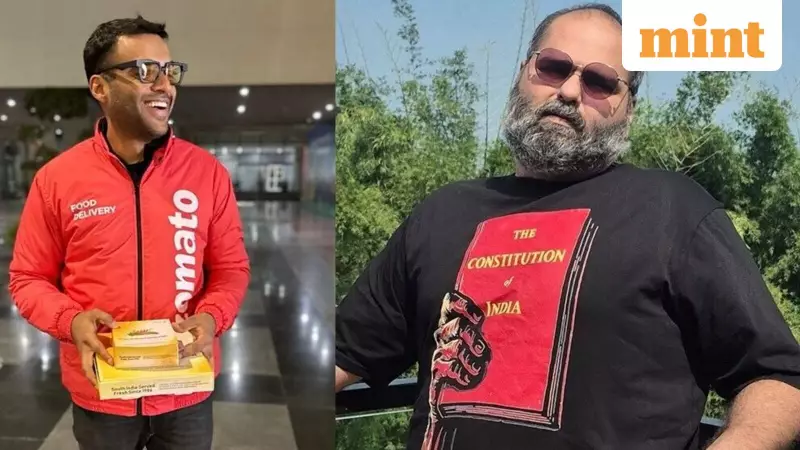
Zomato founder and CEO Deepinder Goyal has announced that both Zomato and its quick-commerce arm Blinkit achieved their highest-ever single-day order volumes on New Year's Eve. This milestone came even as a nationwide strike by gig delivery partners, demanding better pay, safer conditions, and social security benefits, unfolded across the country.
The Social Media Firestorm
Following his announcement, Goyal became highly active on social media platforms, vigorously defending the existing gig work ecosystem and attempting to counter public skepticism. However, his posts ignited a significant backlash, with comedian Kunal Kamra leading the charge for greater transparency.
Kamra directly challenged Goyal to disclose the hourly wages of gig workers over the past year to conclusively settle the debate. "How much did they get paid hourly over the last one year. It’s just another number you have it, give it & end the debate…" Kamra stated. He even offered a deal, tweeting, "If you tell me they were at least paid 50 rupees every hour they were on the app. I’ll never tweet about gig workers again…" As of the latest reports, Deepinder Goyal has not publicly responded to Kamra's specific challenge.

Netizens Debate the Math of the Gig Economy
The comedian's intervention polarized social media users, leading to a heated discussion about the economics of food and grocery delivery. One user alleged that the current compensation is approximately ₹28 per order, claiming companies aim to reduce it to ₹14. Another user calculated that, based on Kamra's ₹50-per-hour benchmark, an eight-hour workday for 26 days would yield only ₹10,400 per month, calling it a bare minimum for survival in cities like Bengaluru and advocating for at least ₹15,000.
A poignant analogy compared gig workers to a chef paid only for minutes spent cooking, not for the hours spent waiting in the kitchen. "Exploitation is a rainbow—it hides behind colourful interfaces," the user remarked, highlighting the issue of unpaid idle time on apps.
Defenders of the Gig Model and a Neutral Perspective
Amid the criticism, a section of netizens defended the platform and the gig economy model. Supporters argued that the sector provides crucial employment to nearly one crore people, offering flexible earnings that many choose willingly over other alternatives. "The gig economy feeds families right now. Fix gaps, add protections, but pretending it’s all exploitation helps no one," one comment read.
Some users attempted to present a numerical defense. One claimed that with 450,000 riders, an average compensation of ₹30 per order, and a 10-hour shift, the math works out to roughly ₹50 per hour. Another asserted that Zomato delivery partners earned an average of ₹28,000 per month in 2024 with about 7 hours of daily login time, translating to ₹130-150 per hour, significantly above Kamra's benchmark.
The debate underscores a deep divide: while critics demand accountability and fair wages accounting for all work hours, proponents see the gig economy as a vital, voluntary source of livelihood that has helped reduce urban unemployment and provided income flexibility for millions.






