

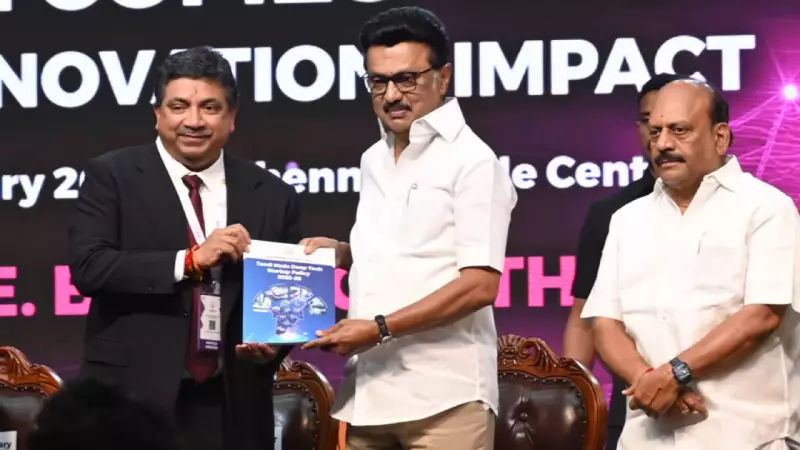
The Tamil Nadu government has taken a decisive step towards transforming the state into a leading innovation hub with the launch of a dedicated policy for deep technology startups. Chief Minister M K Stalin unveiled the Tamil Nadu Deep Tech Startup Policy (2025-26) on Thursday at the UmagineTN technology summit in Chennai, marking a strategic shift from traditional IT services.
Key Goals and Financial Targets
The newly announced policy sets clear and ambitious targets for the coming years. The primary objective is to provide direct support to 100 deep tech startups operating within the state. To fuel this growth, the government aims to mobilize a total of Rs 100 crore in investments from a mix of public funds and private capital, including venture capital firms.
Furthermore, the policy introduces a novel 'Government as Early Adopter Programme'. This initiative is designed to help startups by supporting pilot deployments and field validation of their products and solutions within government departments, providing a crucial first customer and real-world testing ground.

Building a Robust Ecosystem
The vision extends beyond just funding. The policy is structured to develop the entire deep tech ecosystem from the ground up. A major focus will be on facilitating technology transfer from academic institutions and R&D centers to startups for commercialization, thereby bridging the gap between research and the market.
To build a skilled workforce, the policy mandates specialized skilling programs and research fellowships for students and professionals. The state also plans to establish a network of Centers of Excellence and create sector-specific test beds where startups can validate and demonstrate their deep tech solutions.
Support is extended across the spectrum, from the startups themselves to key enablers like incubators, accelerators, and research consortia. The policy also proposes R&D grants, covers product development costs, and aims to ease procurement by the private sector through market access programs.
A Three-Stage Selection and Priority Sectors
Deep-tech startups seeking benefits under this policy will undergo a rigorous selection process. This includes an initial technical screening by an expert panel, followed by a comprehensive evaluation conducted by the newly formed Tamil Nadu Deep Tech Advisory Group.
The policy has identified various priority sectors for support, categorized based on short-term and long-term horizons and the state's existing industrial strengths. While the specific sectors were not detailed in the announcement, they are expected to align with areas like artificial intelligence, advanced manufacturing, and biotechnology.
CM Stalin's Vision for a Tech-Driven Tamil Nadu
Speaking at the launch, Chief Minister Stalin emphasized the state's strategic transition. He stated that Tamil Nadu is consciously moving from its established role in IT services towards high-tech development, startups, and an innovation-driven economy.
"Government policies to promote deep-tech and consistent investment into research and development capabilities have changed Tamil Nadu from an IT service hub to a technology and innovation hub," Stalin said. He highlighted that Chennai is increasingly attracting advanced Global Capability Centers (GCCs), R&D wings, and AI centers of multinational corporations.
The Chief Minister credited the state's talent pool as the cornerstone of this transformation. "Talent availability in the state makes all of this possible," he remarked, referencing the government's scheme of distributing laptops with AI chatbot subscriptions to students. "We do not see this as a freebie. This is an investment in the future," Stalin concluded, underlining the long-term vision behind the new deep tech push.






