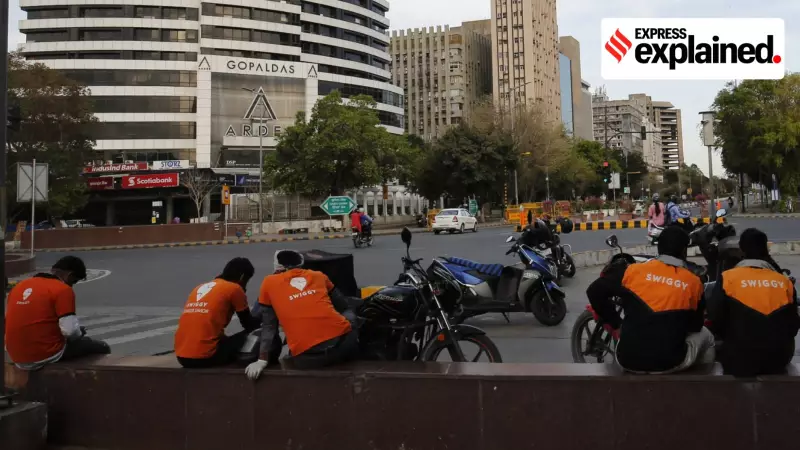
The nationwide strike by thousands of food and grocery delivery workers on New Year's Eve has thrust India's booming gig economy into a fierce and public debate. The protest, demanding better pay, safety, and social security, quickly escalated into a war of words on social media platform X, pitting platform companies and their defenders against worker unions and political advocates.
The Strike and the Immediate Backlash
On one of the busiest days of the year for delivery platforms, workers associated with companies like Zomato's Blinkit, Swiggy, and Zepto downed their bags in a coordinated strike. The discontent, simmering for years over declining per-order payments, algorithmic pressure, and a lack of benefits, finally found a visible outlet.
The backlash from the platform side was swift. Zomato founder Deepinder Goyal took to X, dismissing the striking workers as a small group of "miscreants" and claiming record delivery numbers were achieved despite the protest. He presented data suggesting the strike had minimal impact, a move that further infuriated worker advocates.

In stark contrast, AAP MP Raghav Chadha emerged as a vocal supporter, spending New Year's Eve with protesting riders in Delhi. He argued that the workers who built instant-commerce giants are now forced to strike to have their basic grievances heard.
Beyond Flexibility: The Economic Reality for Gig Workers
At the heart of the debate is a fundamental question: Is gig work truly a flexible earning option, or is it a precarious form of employment exploiting India's vast labour surplus? The numbers paint a complex picture.
Goyal shared data indicating that in 2025, the average hourly earnings for Zomato delivery partners were approximately Rs 102, marking a nearly 11% year-on-year increase. He calculated that a worker putting in 10-hour days for 26 days could earn a gross income of around Rs 26,500.
However, a startling revelation from his own data was the transient nature of this work. Most delivery workers were active on the platform for only 38 days in 2025, averaging seven hours on working days. A mere 2.3% worked more than 250 days. Goyal framed this as proof of the model's success—offering supplemental, flexible income rather than full-time jobs.
Critics and workers counter this narrative fiercely. They point to:
- Unpredictable and declining earnings: Base pay cuts, like Blinkit reducing fees from Rs 50 to Rs 15 per delivery in 2023, coupled with complex, opaque incentive structures.
- No social safety net: The absence of health insurance, accident cover, or old-age benefits.
- Algorithmic control: Systems that push for maximum deliveries without transparency, impacting safety and income.
- The "oversupply" trap: The high attrition rate suggests the jobs are unsustainable long-term, but a rush for limited opportunities keeps a steady stream of new workers.
As Chadha poignantly noted on X, for many, logging in on a strike day is not approval of the system but sheer survival. "When one day's income decides rent, electricity, or a child's school fee... it is desperation," he wrote.
The 10-Minute Promise and the Human Cost
A key flashpoint is the hyper-competitive promise of 10-minute deliveries. Companies argue this is achieved through dense networks of "dark stores" and efficient planning, not by forcing riders to speed. Goyal stated that delivery partners typically travel less than 2 km at an average speed of 15 km/h and aren't even shown the 10-minute timer.
Workers tell a different story. They say the focus on hyper-local deliveries means shorter trips but also lower earnings per order, as distance-based incentives shrink. The relentless pressure to meet delivery windows, regardless of official claims, adds to stress and road risks. Chadha framed it as a public safety issue, asking, "When we celebrate a 10-minute delivery, we should ask who pays the price when something goes wrong?"

Visibility, Inequality, and the Path to Regulation
In a nuanced argument, Goyal suggested the gig economy hasn't created inequality but has made it uncomfortably visible to the urban middle class. Unlike factory workers or farmers, delivery personnel arrive at consumers' doorsteps, making the human cost of convenience impossible to ignore.
However, many argue that inequality is already starkly visible in Indian daily life. The unique challenge with platform work is the lack of traditional employer-employee relationships, which has historically left workers in a regulatory vacuum.
There is now legislative movement. The Code on Social Security, 2020, notified last year, brings gig and platform workers under a formal welfare framework for the first time. It mandates the creation of a Social Security Fund, with contributions of 1-2% of annual turnover from aggregators like Zomato, Swiggy, Amazon, and Flipkart. This fund aims to provide health, disability, and old-age support.
States like Karnataka and Rajasthan have also passed laws to ensure dignity for gig workers. These steps acknowledge the massive scale of this workforce, estimated at 7.7 million in 2020-21 by NITI Aayog and projected to swell to 23.5 million by 2029-30.
The debate, therefore, is no longer just about flexibility versus exploitation. It is about shaping the future of work for millions, ensuring that India's economic innovation does not come at the cost of dignifying and securing the lives of those who power it daily.