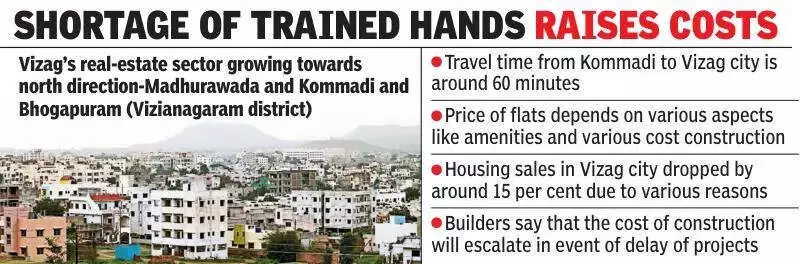
A wave of construction activity is sweeping through Visakhapatnam, driven by both public and private sector projects. However, the city's ambitious growth trajectory is hitting a significant roadblock: a severe and widening shortage of skilled labour. Builders and contractors warn that this deficit is slowing down execution, increasing costs, and threatening to delay the city's infrastructure goals.
Projects Advance, But Workforce Lags Behind
From smart-city upgrades and airport expansion to numerous housing projects, development in Vizag is progressing on multiple fronts simultaneously. Yet, the pace is not matching potential. Contractors across the board report significant difficulty in hiring experienced workers, particularly trained masons, electricians, and specialists in finishing work. This scarcity is directly stretching project timelines and inflating wage bills, with small and medium-sized firms feeling the pinch the hardest.
National industry assessments consistently list skilled-labour scarcity as a leading challenge for the construction sector, and Visakhapatnam is a prime example. "A project moves only as fast as its workforce," explained a senior project manager, highlighting a stark contrast. While machinery and materials are readily available, progress on-site frequently stalls due to the lack of trained hands.

Demand-Supply Gap Widens, Retention Becomes Key Issue
E Ashok Kumar, President of CREDAI Visakhapatnam, confirmed that the demand-supply gap is expanding as the city's development pipeline grows. "Most builders are ready to take up more work, but skilled labour is not keeping pace," he stated. He emphasized that building a stronger, more dependable workforce is critical if Visakhapatnam is to meet its infrastructure goals.
To address this, CREDAI is taking proactive steps by setting up a skill development centre. The aim is to improve workmanship quality and build confidence among workers handling specialised tasks. Builders also point to a related challenge: major public works in nearby districts are attracting labourers with higher-paying roles, making it even harder for city-based contractors to retain their existing workforce.
Training Initiatives and the Call for Long-Term Solutions
While local training institutes in Vizag have introduced new courses to bridge the gap, administrators stress that short-term programmes alone are insufficient to meet the industry's deep-rooted needs. There is a strong, unified call for more robust solutions like structured apprenticeships and supervised on-site training to create a sustainable pipeline of skilled workers.
The consequences of the shortage are already visible. Municipal projects, including road works and public hostels, are experiencing delays, postponing benefits for residents. In the private sector, real-estate developers caution that prolonged housing project timelines could eventually weaken buyer confidence in the market.
Industry bodies are urging a coordinated effort involving scaled-up apprenticeships, stronger linkages between contractors and training institutes, and incentives for certified workers to remain in the region. Builders identify the next 12 to 18 months as a critical period. They believe that if training and skill development expand rapidly, Vizag can sustain its current growth momentum. If not, the city risks seeing its construction push stall under the weight of continuous delays and ever-rising costs.