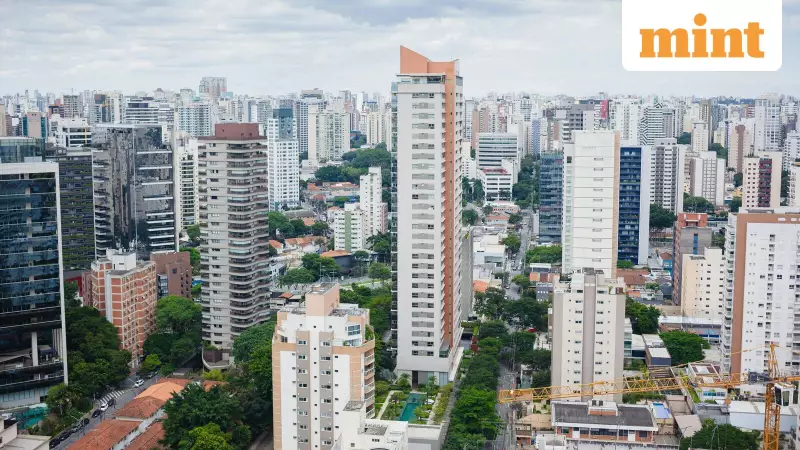
Mumbai has reinforced its status as India's premier real estate hub, achieving the highest residential sales in the country while also recording its second-best year for office space leasing in over ten years, according to the latest findings from Knight Frank India.
Office Market Shows Robust Health with GCC Surge
The second half of 2025 (H2 2025) proved pivotal for Mumbai's commercial sector. As per the India Real Estate: Office and Residential Market, July-December 2025 report, the city's annual office leasing reached 9.8 million square feet. Although this marks a slight 5% dip from the previous year, it solidifies 2025 as the second-strongest year for commercial absorption since 2015.
Leasing activity in H2 2025 alone stood at 4.3 million sq ft, bolstered by significant transactions in scalable suburban areas. The standout trend was the dramatic rise of Global Capability Centres (GCCs). Their share of total office leasing skyrocketed from a mere 9% in H2 2024 to 27% in H2 2025. This surge was led by firms in the Banking, Financial Services and Insurance (BFSI), technology, and engineering sectors expanding their high-end analytics and shared services operations in the city.

Shifting Occupier Dynamics and Firming Rents
The report highlights a notable shift in the occupier profile. While India-facing companies remained the largest segment with a 40% share, this was a substantial decrease from the 72% dominance they held a year earlier. Concurrently, third-party IT and IT-enabled Services (ITeS) firms expanded their presence, accounting for 20% of leasing. These firms primarily sought cost-efficient spaces in suburban hubs like Andheri East, Goregaon, Airoli, and Thane.
This quality-driven demand, coupled with a 12% annual decline in new completions, pushed rental values upward. The average transacted rent rose by 6% year-on-year to ₹125 per square foot per month. Despite the new supply constraints, the overall vacancy rate held steady at 18.3%, indicating a balanced market.
Gulam Zia, International Partner and Senior Executive Director at Knight Frank India, commented, "Mumbai's office market continues to demonstrate long-term stability. The most compelling story is the rapid rise of GCCs, whose market share nearly tripled this year as global firms leverage Mumbai's deep talent pool."
Residential Market: Prices Climb as Demand Shifts Upward
On the residential front, Mumbai's performance was equally impressive. The city registered the sale of 97,188 housing units in 2025, a 1% increase from the preceding year. Sales in the second half of the year were particularly strong at 50,153 units, reflecting a 3% growth.
Mirroring the trend in the office sector, residential prices also firmed up. The average price per square foot climbed by 7% annually to reach ₹8,856. Knight Frank noted a clear movement in buyer preference away from affordable housing. Demand is now increasingly concentrated in higher-value segments, especially in the ₹2 crore to ₹5 crore price category.
The report credited improved infrastructure, such as the operational Metro Line 3 and the Mumbai Trans Harbour Link (MTHL), for sustaining demand in peripheral and suburban markets, making these areas more accessible and attractive to homebuyers.
In summary, Mumbai's real estate landscape in 2025 was defined by resilient growth, a strategic pivot towards high-value GCCs in offices, and a sustained appetite for premium housing, underpinned by critical infrastructure enhancements.