

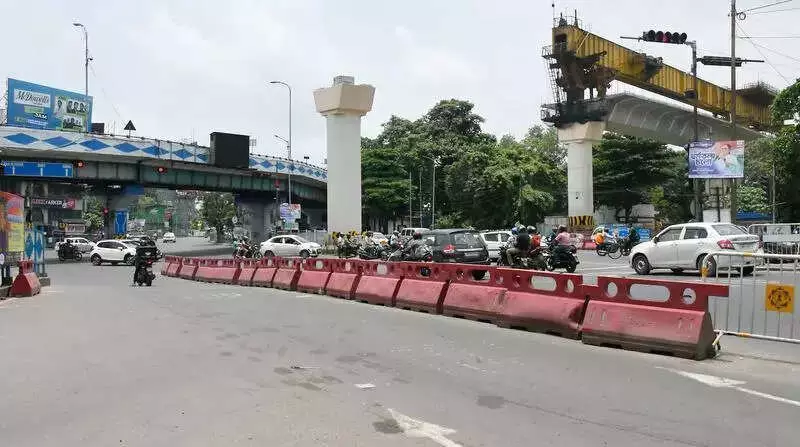
In a significant move to expedite a long-delayed infrastructure project, the Calcutta High Court has issued a firm directive to the West Bengal state government. The court has ordered the authorities to finalize and communicate the dates for essential traffic diversions by January 6, 2026. This step is crucial to ensure the completion of viaduct bridging work for the Kolkata Metro's Orange Line at the busy Chingrighata crossing by the February 15, 2026 deadline.
Court Rejects Delays, Cites Public Interest
A division bench comprising Acting Chief Justice Sujoy Paul and Justice Ajay Kumar Gupta made the observation on Tuesday, emphasizing that perpetual festivals and existing traffic congestion cannot be excuses for inaction. The bench stated that such factors are persistent in Kolkata and should not halt critical development work.
The court explicitly noted, "One festival is followed by another festival. It is difficult to get a festival-free season. Traffic congestion and pressure will continue to enhance and will not reduce." Therefore, it ruled that fixing early dates for construction is in the public's paramount interest to allow citizens to benefit from the new metro link at the earliest and to prevent a further escalation in the project's cost. The bench warned that any decision ignoring these factors would be "irrational".

Background of the Stalled Project
The project in question involves the 32-km Orange Line (New Garia-Airport corridor), being implemented by the Rail Vikas Nigam Limited (RVNL). A critical gap of 366 meters in the viaduct remains at the Chingrighata crossing on the EM Bypass. To bridge this, RVNL needs to launch two concrete girders between three piers at this extremely busy intersection.
This work requires a complete stoppage of traffic on the road below for two consecutive weekend nights. However, the girder-launching work has been pending since February 2 of this year due to a lack of consensus on traffic blockade dates between agencies. The state had called a meeting on December 17 at Metro Bhavan to resolve the issue, but delays persisted.
Legal Proceedings and State's Objections
The court's directive came during the hearing of a Public Interest Litigation (PIL). Advocate General Kishore Datta, representing the state, had argued that the police were reluctant to permit traffic stoppages before January 20 due to concerns over massive congestion from vehicles carrying Gangasagar pilgrims.
Datta also pleaded for a stay on the court's order and questioned the maintainability of the PIL. However, the division bench rejected both arguments. The court upheld the maintainability of the petition, stressing that the project involves huge amounts of public money. The bench drew a parallel with the High Court's past intervention in removing hurdles for the East-West Metro line.
"Needless to emphasise that if a project is sanctioned, it requires spending a huge amount of money. With the delay of the project, not only are people deprived of the benefit arising out of such a project, but the cost also gets escalated, which is ultimately a burden on the state exchequer," the bench held.
The Path Forward and Implications
The court acknowledged that it would not have ordinarily interfered but was compelled to do so because an undertaking given by authorities on September 4 to reach a consensus had failed to "translate into reality." Consequently, the bench has mandated the state to decide on the two required weekend night blockades and inform both the Kolkata Metro and RVNL by the January 6 deadline.
This judicial push is expected to unlock the final leg of construction for the Beleghata to Salt Lake Sector V section of the Orange Line. RVNL was initially aiming to commission this section by June 2025. The court's intervention is now seen as a decisive step to prevent indefinite delays and cost overruns, bringing Kolkata closer to a vital new metro connectivity between New Garia, the airport, and the IT hub of Sector V.






