

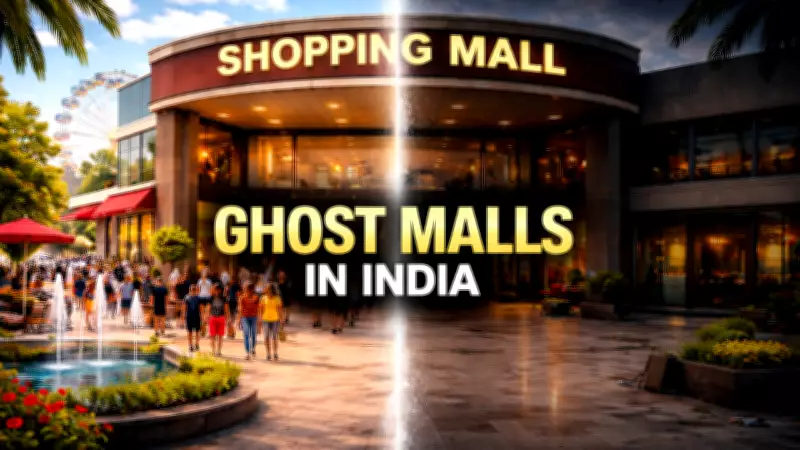
The Rise of India's Ghost Malls: From Bustling Hubs to Hollow Halls
What was once a vibrant weekend escape—buzzing food courts, lively cinema halls, shoppers laden with bags—now feels eerily empty. Walk into many of India's shopping malls today, and while the lights remain on and escalators still move, the crowds have vanished. Welcome to the phenomenon of ghost malls, where shops remain open, food counters still serve, yet the atmosphere is hauntingly quiet.
A Nationwide Retail Crisis: 74 Malls, 15.5 Million Square Feet Vacant
This is the stark reality for approximately 20% of malls across India, according to a comprehensive report by Knight Frank India. Out of 365 surveyed shopping centers, 74 have been classified as "ghost malls," collectively accounting for about 15.5 million square feet of vacant or underutilized retail space. These are not merely struggling properties with a few closed stores but commercial spaces that have lost their fundamental pulse, characterized by high vacancy rates, weak foot traffic, and dysfunctional tenant mixes.
The irony is profound: these malls were originally built as symbols of aspiration during India's retail boom in the 2000s, representing modern lifestyles with global brands, multiplexes, and family-friendly environments. Today, they stand as quiet reminders of what happens when real estate ambition outpaces retail reality.

Geographical Concentration: West and South India Dominate the Ghost Mall Map
The distribution of these underperforming assets is not uniform across the country. West and South India contain the highest concentration of ghost malls, largely because these regions experienced the most aggressive mall development during the initial retail real estate push. Cities here saw rapid construction as developers rushed to capitalize on urban land and consumer optimism, but scale alone failed to ensure sustainability.
Why Do Malls Become Ghost Towns? Multiple Factors at Play
Poor Planning and Oversupply: The Primary Culprits
Contrary to popular belief, the rise of ghost malls is less about declining consumer spending and more about poor planning and oversupply in specific micro-markets. Naveen Malpani, Partner and Consumer & Retail Industry Leader at Grant Thornton Bharat, explains: "India's ghost malls are less a reflection of weak consumption and more a result of uneven supply expansion and gaps in asset positioning. Nearly 20% of malls across 30+ cities are currently under-occupied, with stress visible in both smaller cities and pockets of larger urban markets."
Many malls suffer from lack of differentiation, especially when multiple centers compete in the same locality. This leads to fragmented footfall and frequent shop closures. The Noida corridor exemplifies this: Great India Place, Wave Mall, and DLF Mall of India all target similar shoppers, with the newer, modern DLF Mall gradually drawing traffic away from older establishments.
Location Misfires and Aging Infrastructure
Location, ironically, is both a mall's greatest asset and potential downfall. Poor initial planning—such as choosing wrong catchments or misjudging demand—has doomed many centers. In smaller cities, developers sometimes overestimated future demand, constructing multiple malls where one would suffice, leaving several half-empty from inception.
Additionally, first-generation malls from the early 2000s have failed to keep pace with evolving consumer expectations. As newer complexes with modern designs and better experiences emerged, older centers that didn't renovate or reinvent themselves saw patrons drift away. Gurugram's MG Road malls, once the city's premier retail stretch, gradually lost relevance to newer destinations like CyberHub and Golf Course Road developments.
Fragmented Ownership and Anchor Tenant Departures
Many underperforming malls suffer from fragmented ownership structures. During construction, developers often sell individual shop units to multiple investors to raise funds. Without a single managing entity, maintaining quality standards and curating appropriate tenant mixes becomes nearly impossible. The result is a disjointed collection of unrelated shops that fails to create a cohesive shopping experience.

Anchor tenants—multiplexes, supermarkets, or major brands—are crucial for driving foot traffic. When these anchors exit, a domino effect ensues: footfall drops sharply, smaller retailers struggle, shops close, and the mall rapidly declines into emptiness. A single anchor's departure can threaten an entire center's viability.
E-commerce Impact and External Challenges
While e-commerce has changed retail dynamics over the past decade, it's not the primary cause of mall decline. However, it has accelerated the erosion of categories like books, music, and basic electronics that shoppers now prefer buying online. The COVID-19 pandemic exacerbated existing financial struggles, with many malls unable to survive prolonged closures.
External administrative issues also contribute. Projects entangled in legal disputes—land title conflicts, zoning problems, or approval delays—often struggle to lease spaces effectively. Bengaluru's Grand Sigma Mall serves as an extreme example: legal issues prevented it from fully opening, leading to eventual demolition and total value loss.
The Great Contradiction: Empty Malls Amid Retail Space Shortage
Here lies the fascinating paradox: India has ghost malls while simultaneously suffering from a shortage of quality retail space. This contradiction highlights that not all retail space is equal. The problem isn't pure oversupply but rather a mismatch—dead space in wrong locations with wrong designs, tenant mixes, or consumer propositions.
Millions of newly affluent consumers drive demand for luxury brands like Louis Vuitton, Chanel, and Dior, yet India has very few true luxury malls. As Saurabh Bharara of DLF notes, top global brands are eager to enter India but find high-quality space scarce. Luxury retail demands more than square footage—it requires appropriate ambience, co-tenants, consumer profiles, and proven footfall.
Revitalization Opportunities: Transforming Ghost Malls into Vibrant Destinations
Strategic Reinvention: Multiple Pathways to Revival
Not every ghost mall must remain dormant. With 15.5 million square feet of empty retail space, significant opportunities exist for transformation. Tier 1 cities hold two-thirds of the potential (approximately INR 236 crore), while Tier 2 cities add another INR 121 crore. Instead of constructing new malls, investors can revive dormant centers with projected rental yields of 5.86%.
Regionally, the West and South dominate, generating 77% of projected rental revenue. The key is strategic execution: selecting the right properties and implementing effective revitalization plans can turn these "sleeping giants" into high-yield investments. Fifteen shortlisted centers across 11 cities could collectively produce Rs 357 crore annually.
Beyond Shopping: Innovative Reuse Concepts
- Entertainment Hubs: Convert empty units into amusement parks, gaming arenas, bowling alleys, or sports facilities, creating "day-out" experiences that benefit remaining retail and food outlets.
- Retail Revival: Reposition malls through modern interiors, better layouts, new anchor stores, trendy cafes, and enhanced marketing to attract shoppers back.
- Co-working Spaces: Transform malls with large floor spaces, parking, and central locations into flexible workspaces for startups, small businesses, and corporations, with food courts becoming lounges or meeting spots.
- Education Facilities: Host coaching centers, skill-development institutes, or satellite university campuses, leveraging existing infrastructure in Tier 2 cities where quality education is limited.
- Healthcare Centers: Utilize mall layouts, parking, and multiple entrances for clinics, diagnostic labs, pharmacies, or small hospitals, providing stable leases and community access.
- Mixed-use Redevelopment: When retail alone fails, incorporate offices, schools, or medical facilities, or completely rebuild structures for new purposes.
Conclusion: A Lesson in Adaptation and Opportunity
The story of India's ghost malls transcends empty corridors and silent food courts—it's a powerful lesson in adaptation. While many first-generation malls failed to evolve with changing consumer tastes, their vast spaces, central locations, and existing infrastructure hold immense potential for reinvention. From entertainment hubs and co-working spaces to education centers and healthcare facilities, these properties can be transformed to meet contemporary urban demands.
For investors and urban planners alike, the message is clear: with strategic vision and execution, what once felt hollow can become vibrant, profitable destinations. India's retail real estate indeed has a "second chapter" ready to be written, proving that the malls of yesterday could very well become the thriving landmarks of tomorrow.





