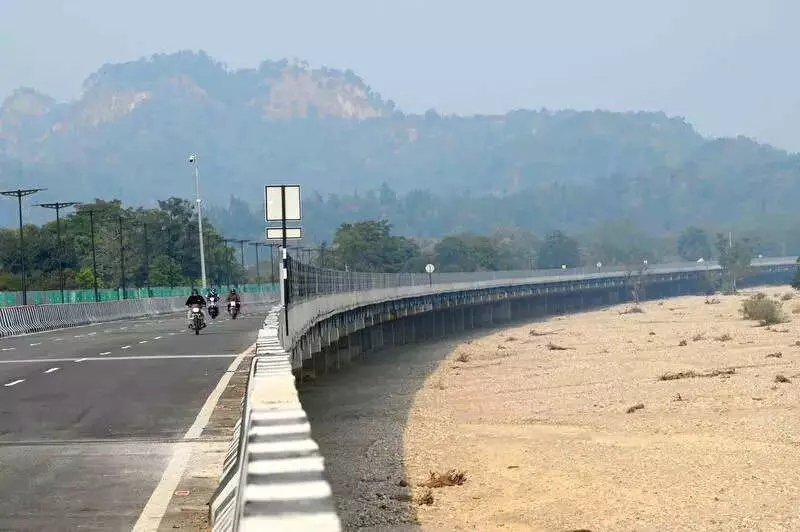
The much-anticipated Delhi-Dehradun Economic Corridor is in its final stages of completion and is poised to open for traffic shortly after the first week of February. This ambitious Rs 11,000-crore project promises to drastically reduce the travel time between the national capital and the Uttarakhand capital to less than three hours by car.
Final Touches and Local Adjustments
As workers race against time to complete the last stretches, the highway's opening is imminent. The National Highways Authority of India (NHAI) has made significant design tweaks in the second phase to accommodate local demands. A prominent example is in Karaunda Mahajan, Muzaffarnagar, where the road's elevation was raised by one metre to 5.5 metres to allow overloaded sugarcane tractors to pass through underpasses.
Similarly, public protests in Badgaon, Saharanpur, led to the addition of an extra interchange. The construction also faced delays due to additional land acquisition and specific hurdles like an irrigation project in Biral, Muzaffarnagar, which held up a bridge. Shifting high-tension power lines was another task recently completed.

Journey Experience and Cost Benefits
Once operational, the 213-km access-controlled corridor will offer a superior ride quality compared to other expressways like the Delhi-Jaipur or Eastern Peripheral Expressway. Officials attribute this to the strategic decision to lay the road before the last monsoon, allowing it to settle properly.
Commuters will benefit from a streamlined toll system. With a FASTag annual pass, the one-way cost for crossing four toll plazas will be a mere Rs 60. For those without the pass, the toll will be approximately Rs 500. The speed limit is set at 100 kmph for cars and 80 kmph for trucks.
Phases and Environmental Considerations
The project is divided into four distinct phases. The first phase is a 31.6-km brownfield stretch from Akshardham to the Eastern Peripheral Expressway (EPE). The second, a 120-km section from EPE to Saharanpur Bypass, is completely greenfield. Phase three to Ganeshpur is ready, while the final 20-km phase into Dehradun presented environmental challenges.
This last stretch passes through the sensitive Rajaji National Park and an elephant corridor. Construction faced restrictions from the National Board for Wildlife, prohibiting work from sunset to sunrise. NHAI officials state that special measures, including animal-friendly lighting, have been implemented to minimize wildlife disturbance.
With over 99% physical progress completed, all remaining work is scheduled to be wrapped up within the next ten days. The NHAI is already planning two more corridors to improve connectivity to Mussoorie and Paonta Sahib, signaling a new era of travel in the region.