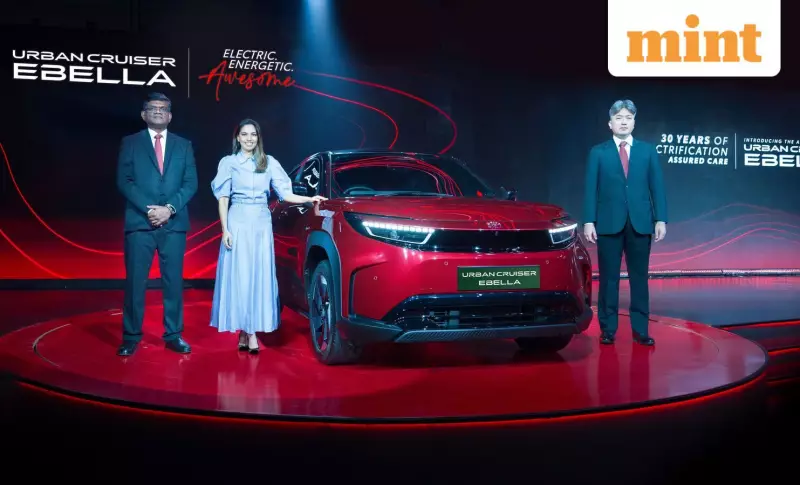
Toyota Kirloskar Motor has finally entered India's electric vehicle market. The company launched its first electric car in the country on Tuesday. This move makes Toyota the last major automaker to join the battery-powered mobility race in the world's third-largest car market.
Partnership with Maruti Suzuki Drives Entry
The Japanese automaker is leveraging its model-sharing partnership with Maruti Suzuki India Ltd to bring electric vehicles to Indian consumers. Toyota started bookings for the Urban Cruiser Ebella on Tuesday. This vehicle represents a cross-badged version of Maruti Suzuki's eVitara.
However, Toyota has not disclosed the prices for its new electric offering. The company also remains silent about when it will actually begin delivering the car to buyers. This lack of clarity extends to their partner as well.

Maruti's eVitara Yet to Reach Indian Roads
Maruti Suzuki, the Indian unit of Japan's Suzuki Corp., has not delivered a single eVitara in India yet. The company has also kept prices under wraps. This situation persists a full year after Maruti unveiled the car at the Bharat Mobility Global Expo in New Delhi last January.
Instead of focusing on the domestic market, Maruti has prioritized deliveries to the more lucrative European market. In Europe, the eVitara starts at approximately €35,000, which translates to over ₹37 lakh. Since beginning exports from Maruti's Hansalpur plant in Gujarat, the company has shipped more than 13,000 units overseas.
Strategic Partnership Benefits Both Companies
The 2019 partnership between Toyota and Suzuki creates significant advantages for both automakers. Toyota gains the ability to rebadge Suzuki's cars as its own models. In return, Maruti Suzuki accesses Toyota's extensive export network.
During the current financial year, Maruti Suzuki has guided to produce 70,000 electric cars. A portion of this production will be supplied to Toyota. The exact number of rebadged units remains unclear at this stage.
Toyota's Position in the Indian Market
Toyota enters the electric vehicle segment as one of the last major automakers to do so in India. Between April and December 2025, Toyota ranked as the fifth-largest car seller in the country. The company sold just over 270,000 vehicles during this period, capturing a market share of 8.1% according to data from the Society of Indian Automotive Manufacturers.
Toyota trailed behind its product-sharing partner Maruti Suzuki, which leads the market. Other competitors outselling Toyota included Mahindra and Mahindra Ltd, Tata Motors Ltd, and Hyundai Motor India Ltd.
Competitive Landscape and Challenges
While other automakers like the Renault-Nissan alliance and German brands Skoda and Volkswagen also don't sell EVs in India yet, they command much smaller market shares. Skoda holds less than 2% of the passenger vehicle market, while others maintain sub-1% shares. Notably, Volkswagen Group's luxury brand Audi has been selling electric cars in India for some time.
Toyota faces significant challenges in the electric car market. Domestic manufacturers Tata Motors and Mahindra and Mahindra present stiff competition with their established EV offerings.
Hybrid Advocacy and Market Strategy
Toyota's entry into India's EV market comes with an interesting backdrop. The company has been one of the most vocal critics of government policies that limit subsidies exclusively to electric vehicles. As a global leader in hybrid vehicle technology, Toyota argues that policy support should extend to hybrids. The company believes hybrids offer a more practical alternative to conventional internal combustion engine cars.
Vikram Gulati, country head and executive vice president at Toyota Kirloskar Motor, explained the company's perspective. "In India, it's been 10-12 years since we have been selling strong hybrid vehicles," Gulati said during the launch event. "This enabled the ecosystem for electric vehicle parts to develop because when you sell a hybrid vehicle, you're also selling an electric powertrain."
Gulati emphasized that hybrid vehicle sales in India helped develop the EV parts ecosystem and brought down costs. "Otherwise, we would have still been struggling with a chicken and egg situation," he added.

Analyst Perspectives on Toyota's EV Prospects
Industry analysts have mixed views about Toyota's electric vehicle prospects in India. While Toyota leads the hybrid car market with its Innova Hycross, the electric vehicle segment presents different challenges.
Gaurav Vangaal, associate director at S&P Global Mobility, offered his assessment. "Toyota is late in the EV market because Maruti Suzuki itself is late to launch an EV in India," Vangaal noted. "As per our understanding, there is little excitement in the market for the Urban Cruiser Ebella as rivals have more flashy cars on offer."
However, Vangaal also highlighted potential advantages. "That said, Maruti has a history of recreating a market segment even when they enter late by selling solid products at competitive prices," he explained. "By extension, this advantage will go to Toyota as well. So we need to wait for the prices and launch before coming to a conclusion."
The Indian electric vehicle market continues to evolve rapidly. Toyota's entry, though delayed, adds another significant player to the competition. Consumers now await crucial details about pricing and availability that will determine the Urban Cruiser Ebella's success in this competitive landscape.