Plywood and Laminate Shortage Grips Madhya Pradesh Amid Supply Chain Crisis
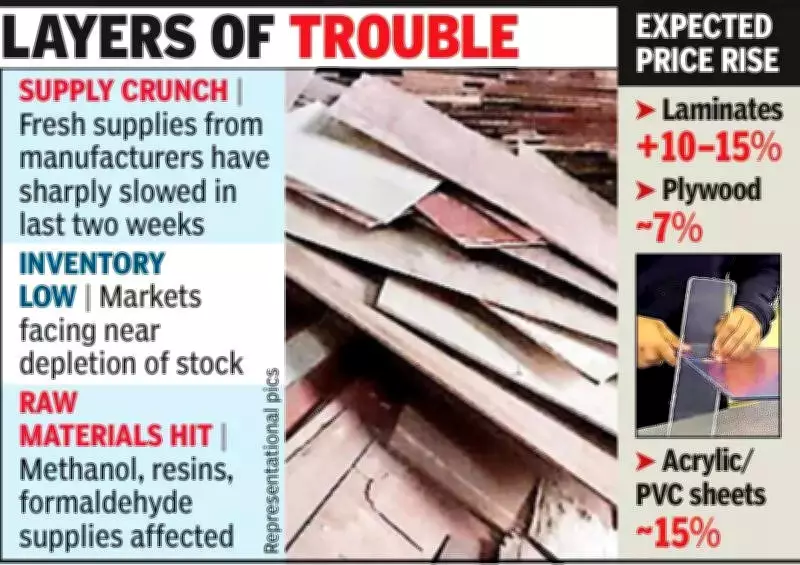
Indore: A critical shortage of plywood and laminates has emerged across Madhya Pradesh, driven by rapidly depleting inventories and severely restricted fresh supplies from manufacturing units. Industry traders report that sales have plummeted by more than 20 percent as the ongoing conflict in West Asia continues to disrupt essential raw material supply chains, simultaneously triggering significant price increases.
Manufacturing Slowdown and Inventory Depletion
Plywood dealers throughout the state have observed a sharp decline in fresh supplies from manufacturers over the past two weeks. Factories are exhibiting extreme hesitation in booking new orders due to volatile raw material prices and profound uncertainty within global supply networks. This cautious approach has created a bottleneck in the distribution pipeline, exacerbating the shortage.
Narendra Bafna, a representative from the All Bharat Plywood and Laminate Trade Vyapari Association, highlighted the alarming state of market inventories. "Stocks in the market are rapidly thinning to critical levels," Bafna stated. "There is almost no inventory left in the market because supplies from manufacturers and suppliers have completely dried up. The situation is compounded by prices changing on a daily basis, which has made conducting business extremely difficult and unpredictable for all stakeholders."

Root Causes: Petrochemical Dependence and Geopolitical Tensions
Industry experts explain that the plywood manufacturing sector is heavily reliant on petrochemical-derived inputs. Key materials such as methanol, resins, and formaldehyde—which are crucial for adhesive chemistry in plywood production—are intrinsically linked to supply chains originating in the Middle East. The regional conflict has led to rising crude oil prices and created severe uncertainty in the chemical supply sector, directly pushing production costs higher and destabilizing the entire industry.
Arvind Jain, a plywood trader based in Gwalior, provided a ground-level perspective on the crisis. "Supplies from factories have noticeably reduced over the past two weeks, and we are witnessing frequent, unpredictable price changes," Jain reported. "This volatility has made dealers extremely cautious about placing new orders, as the financial risk associated with fluctuating rates has become too high to manage effectively."
Broader Implications and Market Response
The supply chain disruption extends beyond immediate shortages, affecting construction, furniture manufacturing, and retail sectors dependent on these materials. The conflict in West Asia, involving nations like Israel, Iran, and their allies, has introduced a layer of geopolitical risk that the industry is struggling to navigate. Reports indicate that events such as drone attacks impacting logistics hubs and nations considering involvement in the conflict are further straining international trade routes.
As raw material costs soar and supply lines remain inconsistent, the plywood market in Madhya Pradesh faces a prolonged period of instability. Traders and manufacturers are now compelled to adapt to a new reality where daily price revisions and supply uncertainties become the norm, potentially leading to broader economic repercussions within the state's industrial and construction ecosystems.