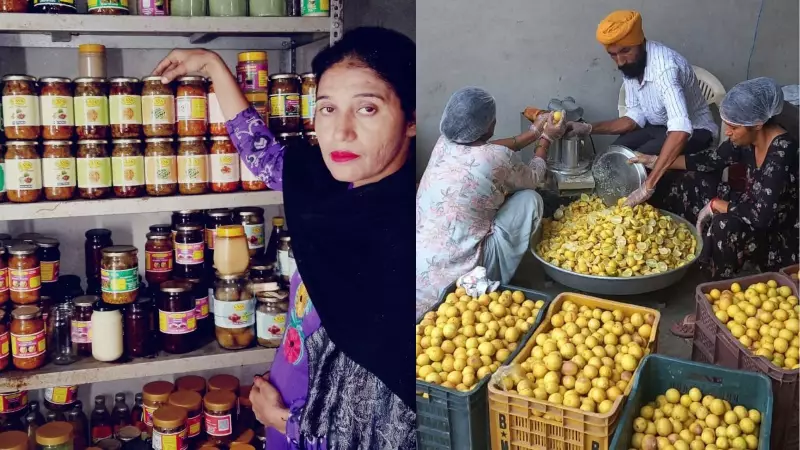
From Struggle to Success: A Patiala Couple's Remarkable Transformation
Gurpreet Kaur, a 36-year-old marginal farmer from Kalyan village in Patiala district, and her husband Lakhwinder Singh, 42, have completely rewritten their family's destiny in just six years. Their journey began with immense hardship on a small 2.5-acre plot of land, where they relied entirely on seasonal vegetable farming for survival.
The Turning Point During Crisis
Life was extremely difficult for the couple. Gurpreet recalls the days when they took vegetables to local markets and survived solely on whatever they earned that same day. "Going to Patiala city without an urgent reason felt impossible because we simply lacked the money," she says. The situation reached its lowest point during the Covid-19 lockdown when markets closed and their vegetables couldn't be sold, resulting in devastating losses.
This adversity, however, sparked a crucial realization. Gurpreet understood that processing their vegetables could have prevented these losses. With a natural passion for making traditional pickles and preserves, she decided to explore food processing as a way to add value to their farm produce.

Training and Humble Beginnings
After lockdown restrictions eased, Gurpreet enrolled in training programs at Krishi Vigyan Kendra in Patiala. She credits KVK officials, particularly Rachna Singla, for motivating her to turn passion into profession. "She inspired me to take training seriously," Gurpreet acknowledges.
Armed with new knowledge and determination, the couple started small. They began processing just 10-15 kilograms of produce at home, using vegetables from their own fields. Their first product was a simple mixed pickle made from gobhi, gajar, and shalgam available in their farm.
Overcoming Initial Challenges
The beginning was not easy. When they first took their homemade pickles and murabbas to the market alongside vegetables, nobody showed interest for four to five days. "No one was ready to even taste our products," Gurpreet remembers.
Refusing to give up, they changed their strategy. They started offering small sample packs of 25-30 grams to potential customers. This simple move changed everything. People tasted their products and began demanding more. "On the first day we sold pickles worth just Rs 150, but we were overjoyed," she says with a smile.
Rapid Growth and Expansion
Word spread quickly through the local markets. What began as kilogram-level processing soon grew to quintals, and eventually reached tonne-level operations. Today, their enterprise KS Agro processes nearly 200 tonnes of produce annually.
The couple's product range has expanded dramatically to around 100 different items, including:
- 35-40 varieties of pickles (mango, mixed, amla, turmeric, chilli, and more)
- 6-7 types of chutneys
- Multiple murabbas, juices, jams, and vinegars
- Traditional sweets like pinni and burfi made from milk of their Sahiwal cows
A Self-Sustaining Model
What makes KS Agro unique is its self-sufficient approach. Most raw materials come directly from their own fields. They grow carrots, chillies, turmeric, gobhi, shalgam, mustard for oil, and several other ingredients themselves. "The oil, turmeric and chillies used in our pickles are grown on our own land," Gurpreet states proudly.
This model has completely transformed their farming approach. They no longer take vegetables to traditional markets, instead focusing exclusively on crops needed for their processing unit.
Impressive Scale and Reach
On a large scale, the couple now processes:
- 25-30 tonnes of mangoes annually
- Around 50 tonnes of amla (Indian gooseberry)
- Over 100 tonnes of other vegetables and fruits
Their products reach customers across multiple states. They recently fulfilled a bulk order of 20 quintals of pickles and murabba during an exhibition in Kolkata. Regular supplies go to stores in Chandigarh, Sangrur, and Patiala, plus numerous dhabas and restaurants.

Financial Success and Social Impact
From pricing pickles at Rs 150-400 per kg, murabba at Rs 200-300 per kg, and chutney around Rs 400 per kg, KS Agro now achieves an annual turnover exceeding a couple of crores. They maintain a healthy profit margin of 15-20% after covering all input costs.
The enterprise employs 10 permanent workers, including nine women, significantly contributing to rural livelihoods and women's empowerment in their community.
Recognition and Future Plans
Despite having studied only up to Class 10, both Gurpreet and Lakhwinder have emerged as successful entrepreneurs. Gurpreet has become a master trainer herself, sharing her knowledge with others while continuing to learn new techniques.
Her efforts earned recognition with a state-level food processing award from Punjab Agricultural University in 2025. "We never thought we would reach here," she says emotionally. "Six years ago, life was about losses and survival. Today, orders are waiting, we have no storage space left, and we travel across India for business."
The couple now searches for land to establish a proper factory and plans to open their own retail stores. Gurpreet emphasizes that none of this would have been possible without her husband's unconditional support. "He worked hard in the fields, marketed our products initially, and cared for our children when I attended trainings," she acknowledges gratefully.
The Greatest Achievement
For Gurpreet, the biggest success extends beyond financial stability. It's about securing the future of their children—a daughter in Class 9 and a son in Class 2. "Earlier, even education was a constant worry. Today, we can actually dream about their futures," she concludes with visible pride and satisfaction.
Their story stands as a powerful testament to what determination, training, and innovation can achieve, even starting from the most challenging circumstances.